
The Space Race
Puzzle 59 · Apollo 11 · Page 85 in print
Eagle's Descent
Armstrong steered Eagle by hand past West Crater and its boulder field.
Jump to a word
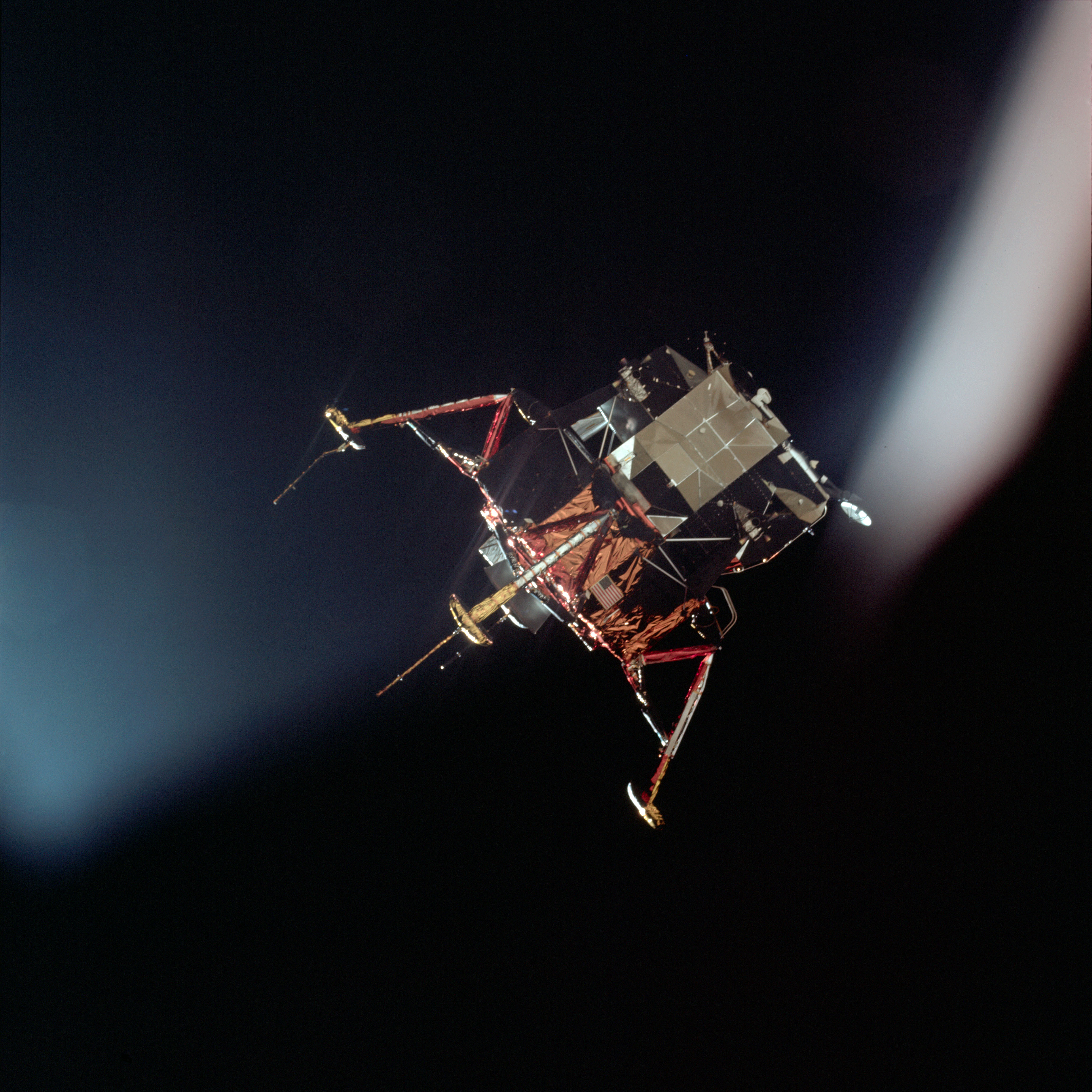
Eagle after separation from Columbia, with its landing gear extended.
NASA / Johnson Space Center (as11-44-6584) · NASA media-use guidelines · Original recordThe words
Bingo
A fuel-reserve threshold used in landing-or-abort decisions.
Houston sent fuel countdowns as Armstrong brought Eagle down. They warned of an approaching decision about landing or aborting, while propellant remained for the final descent.
Boulder Field
Eagle approached an area strewn with rocks near West Crater. Armstrong took control and flew beyond the rough ground to find a clearer place for the landing.
Charlie Duke
Astronaut Charlie Duke was the capsule communicator in Houston during the landing. He relayed Mission Control’s assessments to Armstrong and Aldrin, including permission to continue after the computer alarms.
Contact Light
Aldrin called out when a probe beneath one of Eagle’s landing pads touched the Moon. The light signaled probe contact while the spacecraft was still settling onto the surface.
Did you know?
Eagle had surface probes beneath three landing pads. The leg with the ladder had none; Aldrin said the crew had asked for that probe to be removed.
Data Dropout
Eagle’s radio link to Earth was interrupted during early powered descent. Controllers temporarily lost spacecraft data, making it harder to follow the landing from Houston.
NASA mission report, pp. 114–115, 189 · NASA report: Eagle’s descent systems (opens a new tab)
Descent Engine
Eagle’s lower stage carried an engine whose thrust could be varied during landing. It slowed the spacecraft toward the surface; a separate engine later lifted the astronauts back into orbit.
Fuel Gauge
Eagle’s instruments showed the propellant remaining, and a separate low-level light warned as the supply fell. These indications helped the crew and Houston judge the landing margin.
NASA mission report, p. 118 · NASA report: Eagle’s descent systems (opens a new tab)
Landing Radar
Eagle’s landing radar measured its height and motion relative to the Moon. It supplied altitude and velocity information to the guidance computer as the spacecraft approached the surface.
Apollo 11 press kit, p. 105 · NASA press kit: Eagle’s guidance (opens a new tab)
Low Gate
An aviation term marking the start of the final landing phase.
Eagle’s descent was planned in braking, approach and landing phases. Near low gate, the design allowed continued inspection of the terrain and pilot takeover for the final touchdown.
Bennett, lunar trajectories, pp. 3, 10 · Bennett: the descent’s three phases (opens a new tab)
Luminary
Luminary IA was the guidance software carried by Eagle. It processed landing radar information for the descent; Apollo 10’s earlier software had not included the final landing phase.
Apollo 11 press kit, p. 105 · NASA press kit: Eagle’s guidance (opens a new tab)
Pitchover
Eagle tilted toward an upright attitude as it approached the landing area. The maneuver brought the ground ahead into Armstrong’s view through the forward window.
Program Alarm
The 1201 and 1202 alarms warned that Eagle’s computer could not finish all the requested work. Its guidance functions continued while the crew and Houston assessed the warnings.
NASA mission report, pp. 33, 190–191 · NASA report: Eagle’s descent systems (opens a new tab)
Steve Bales
Steve Bales was the guidance officer in Mission Control. With support from computer specialist Jack Garman in the back room, he assessed the alarms and recommended continuing Eagle’s descent.
Did you know?
After the mission, Bales accepted a NASA Group Achievement Award for the flight operations team. The astronauts received Presidential Medals of Freedom at the same dinner.
NASA history: Bales and Garman (opens a new tab) · NASA: the flight team’s award (opens a new tab)
West Crater
West Crater and its surrounding rocks lay near Eagle’s initial landing path. Armstrong flew beyond them; this was a different crater from Little West, near the final landing spot.
White Team
Flight director Gene Kranz led the White Team in Houston for Eagle’s landing. The controllers monitored spacecraft systems and supported decisions while Duke handled radio exchanges with the crew.
Did you know?
People on Earth followed the landing by radio, without live pictures from Eagle. The onboard film became available only after the astronauts returned it to Earth.
Sources
- 50 Years Ago: One Small Step, One Giant LeapJohn Uri; NASA Johnson Space Center; July 19, 2019; landing-day control team, pitch-over, boulders and absence of live landing television
- Apollo 11 Lunar Module / EASEPNASA Space Science Data Coordinated Archive, spacecraft 1969-059C; Lunar Module Spacecraft and Subsystems, throttleable descent engine and separate ascent stage
- The First Lunar LandingEric M. Jones and contributors; NASA Apollo Lunar Surface Journal; 102:42:32–102:45:44 and surrounding commentary, West and Little West craters, fuel countdown, contact light and landing probes
- Apollo 11 Mission ReportNASA Mission Evaluation Team; NASA SP-238 edition, title page dated 1971; pp. 33, 114–118 and 189–191 (PDF pp. 45, 126–130 and 201–203), data interruptions, propellant gaging and computer alarms
- Apollo Lunar Descent and Ascent TrajectoriesFloyd V. Bennett; NASA TM X-58040; March 1970; pp. 3 and 10 (PDF pp. 6 and 13), operational phases and low-gate landing phase
- Apollo 11 Lunar Landing Mission: Press KitNASA; Release 69-83K, July 6, 1969; p. 105 (PDF p. 109), guidance and navigation, Luminary IA and landing radar; preflight document
- Apollo-Era Hero John “Jack” Garman DiesNicholas Russo; NASA History Division, News & Notes, Volume 33, Number 4, Fourth Quarter 2016; p. 34 (PDF p. 34), guidance officer Bales and back-room support from Garman
- 50 Years Ago: Apollo 11 Astronauts Leave Quarantine…John Uri; NASA Johnson Space Center; August 12, 2019; Los Angeles state-dinner paragraphs, Bales’s NASA Group Achievement Award and astronauts’ Presidential Medals of Freedom