
The Space Race
Puzzle 58 · Apollo 11 · Page 84 in print
The Journey Out
A Soviet probe, Luna 15, was already circling the Moon when Apollo 11 arrived.
Jump to a word
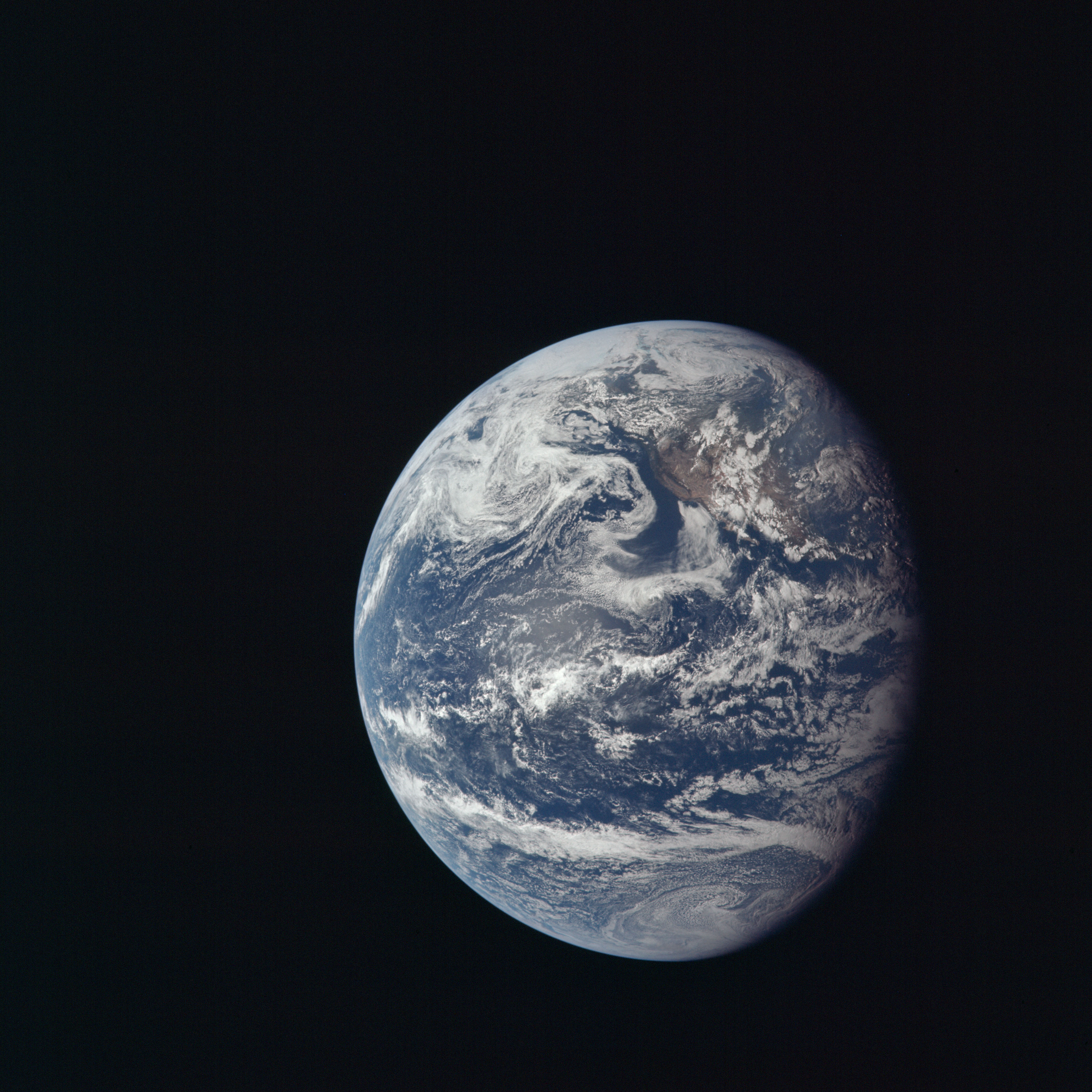
Earth photographed from Apollo 11 during the journey to the Moon.
NASA / Johnson Space Center (as11-36-5337) · NASA media-use guidelines · Original recordThe words
Bacon Squares
Bacon squares were among Apollo 11’s packaged foods. Some dishes came as compressed cubes ready to eat, while others were dehydrated and mixed with water.
Did you know?
Apollo 11’s astronauts were allowed a stainless steel spoon for eating. Their menu also included brownies and butterscotch pudding alongside packaged savory foods.
Barbecue Roll
The spacecraft slowly rotated so solar heating was shared around its exterior. This passive thermal control, nicknamed the barbecue roll, helped manage temperature extremes during the coast.
Cue Cards
During a television broadcast, Charlie Duke in Mission Control jokingly asked whether Aldrin was holding cue cards for Collins. Collins replied that they were not competing with professionals.
NASA commentary, PDF pp. 122, 131 · NASA: Apollo 11’s radio commentary (opens a new tab)
Czar
During the outward coast, Houston relayed a news report that Pravda called Armstrong the “Czar of the Ship.” The crew adopted the nickname in later radio banter.
Did you know?
A later radio message explained that the “Czar” was brushing his teeth. Houston played along with the nickname before returning to spacecraft business.
NASA commentary, PDF pp. 227, 232 · NASA: Apollo 11’s radio commentary (opens a new tab)
Earthshine
Sunlight reflected from Earth onto the Moon.
Approaching lunar orbit, the crew watched Earthshine illuminate parts of the Moon that lay in darkness. Reflected light revealed the surface beyond the directly sunlit areas.
NASA: Apollo 11’s outward coast (opens a new tab) · NASA: Earth’s reflected light (opens a new tab)
Extraction
After docking, Columbia drew Eagle out of the adapter that held it on the third stage. The two spacecraft could then travel together toward the Moon.
NASA: Apollo 11’s mission overview (opens a new tab) · NASA report: navigation on the way out (opens a new tab)
Free Return
A free-return trajectory was designed to swing around the Moon and back toward Earth without entering lunar orbit. Apollo 11 still used navigation checks and small course maneuvers.
NASA: Apollo 11’s mission overview (opens a new tab) · NASA report: navigation on the way out (opens a new tab)
Halfway
About midway in distance between Earth and Moon, Apollo 11 was still coasting outward. This milestone came well before the crew entered lunar orbit or prepared to land.
Did you know?
Backup commander Jim Lovell radioed a playful check on Armstrong. Armstrong told him he had lost his chance to take the flight, and Lovell conceded.
Light Flashes
On Apollo 11’s return coast, Aldrin and Armstrong reported faint flashes in a dark cabin. NASA later studied whether cosmic rays interacting with the visual system caused them.
Biomedical Results of Apollo, pp. 355, 365 · NASA: studying the astronauts’ flashes (opens a new tab)
Luna Fifteen
Luna 15 entered lunar orbit on July 17, 1969, before Apollo 11 arrived. The Soviet probe aimed to return samples, but crashed during its landing attempt on July 21.
Siddiqi, Beyond Earth, pp. 90–91 · Siddiqi, Beyond Earth: Luna 15 (opens a new tab)
Midcourse
Only one of Apollo 11’s planned midcourse corrections was needed on the outward coast. A small engine maneuver refined the path before the spacecraft entered lunar orbit.
Solar Orbit
After releasing Columbia and Eagle, Apollo 11’s spent S-IVB stage was sent onto a path that led to solar orbit. It no longer traveled with the crew.
Star Sighting
The crew used a sextant to measure angles between stars and Earth’s horizon. These observations checked navigation during the coast; a smaller Earth later made the work easier.
NASA mission report, p. 16 · NASA report: navigation on the way out (opens a new tab)
Translunar
Traveling from Earth toward the Moon.
The S-IVB third stage restarted while Apollo 11 was in Earth orbit. Its translunar injection burn sent the crew onto a path toward the Moon.
Transposition
Columbia turned around after separating from the third stage. That maneuver lined up its docking equipment with Eagle, ready to join the spacecraft and free the lander.
Sources
- Apollo 11 Mission OverviewNASA; Mission Objective and Mission Highlights, free-return trajectory, translunar injection, docking and third-stage separation
- Apollo 11 Command and Service Module (CSM)NASA Space Science Data Coordinated Archive, spacecraft 1969-059A; Mission Profile, third-stage disposal and outward midcourse correction; launch-vehicle serial typo is not adopted
- 50 Years Ago: The Journey to the Moon BeginsJohn Uri; NASA Johnson Space Center; July 16, 2019; passive thermal control, halfway exchange, course correction and Moon lit by Earthshine
- Apollo 11 Mission CommentaryNASA Manned Spacecraft Center; July 1969; PDF p. 122 identifies Charlie Duke, p. 131 contains the cue-card joke; pp. 227 and 232 contain the Pravda news item and later Czar banter
- Apollo 11 Mission ReportNASA Mission Evaluation Team; NASA SP-238 edition, title page dated 1971; pp. 16 and 72 (PDF pp. 28 and 84), extraction, cislunar optical navigation and free-return analysis
- Beyond Astronaut Ice Cream: How Consumer America Engineered Food for Space ExplorationU.S. National Archives, The Unwritten Record; June 18, 2019; food formats, Apollo 11 menu and stainless steel spoon; article text, not an audiovisual viewing claim
- Apollo Light Flash InvestigationsW. Zachary Osborne, Lawrence S. Pinsky and J. Vernon Bailey; Biomedical Results of Apollo, NASA SP-368; 1975; pp. 355–365 (PDF pp. 1–11), introduction and conclusions
- Beyond Earth: A Chronicle of Deep Space Exploration, 1958–2016Asif A. Siddiqi; NASA SP-2018-4041; 2018; Luna 15 entry, pp. 90–91 (PDF pp. 110–111), sample-return objective, lunar orbit and failed landing
- EarthshineHolli Riebeek; NASA Earth Observatory; May 29, 2014; reflected sunlight from Earth illuminating the Moon; seasonal claims and lyrics are not adopted