
The Space Race
Puzzle 54 · The Road to the Moon · Page 78 in print
Moon Geology Training
Blasts at Cinder Lake made a full-size copy of a proposed Moon landing site.
Jump to a word
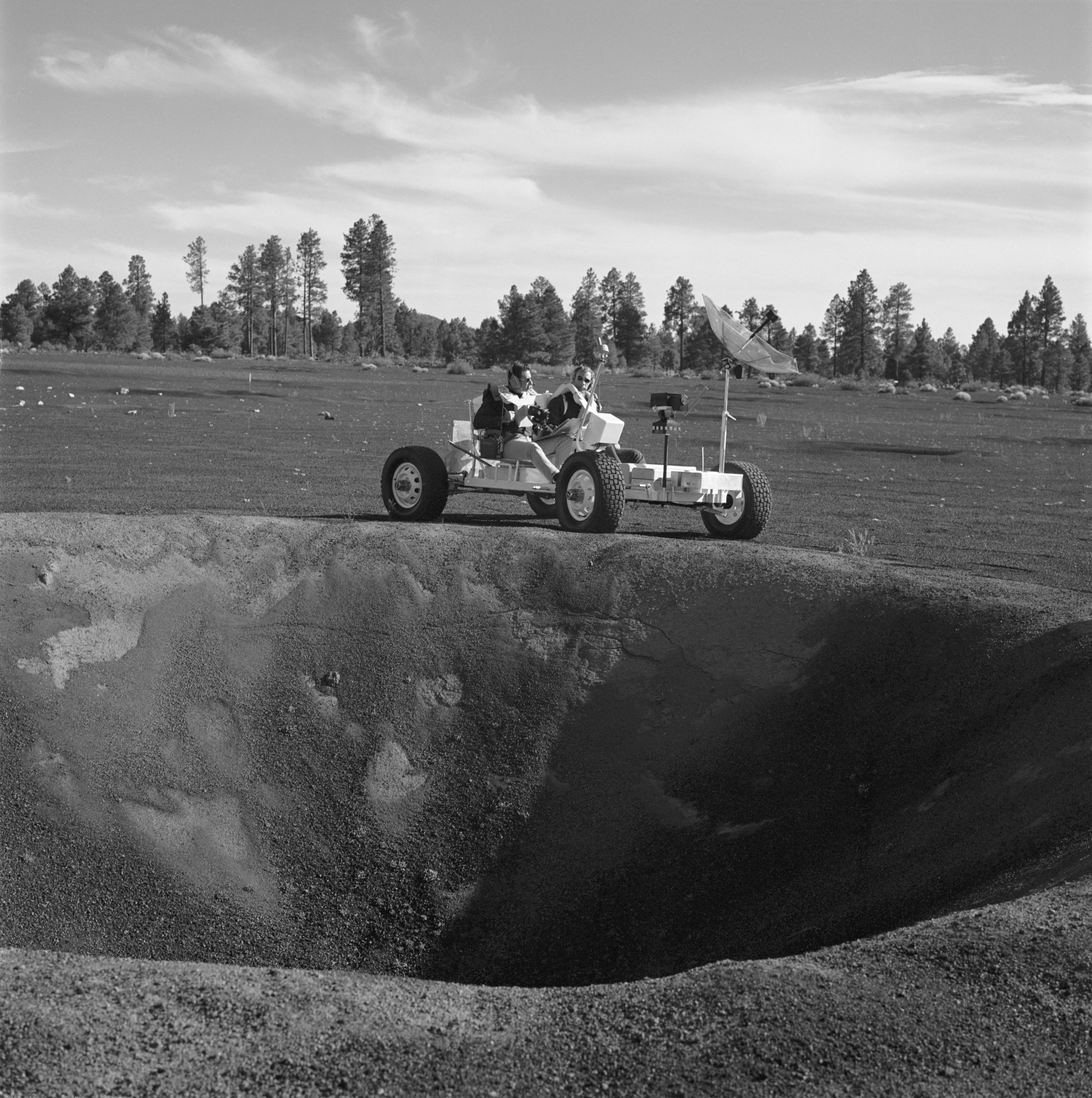
Apollo 15 astronauts train with a rover simulator at Arizona’s Cinder Lake crater field.
NASA / Johnson Space Center (S70-53300) · NASA media-use guidelines · Original recordThe words
Askja
Astronauts trained near Askja in Iceland, where sparse vegetation left volcanic features exposed. They studied lava flows, ash cones and other landforms, practicing observations for lunar exploration.
Phinney, p. 63 · NASA: Phinney’s science training history (opens a new tab)
Cinder Lake
At Cinder Lake near Flagstaff, the USGS blasted craters into volcanic cinders to copy a lunar site at full size. Astronauts used the artificial landscape for field rehearsals.
NASA: Arizona’s lunar crater fields (opens a new tab) · USGS: Apollo geology training history (opens a new tab)
Dale Jackson
Dale Jackson headed the USGS astronaut training group in Houston. He helped organize the geological instruction that prepared astronauts for observing and collecting rocks on the Moon.
Schaber, p. 62 · USGS: Apollo geology training history (opens a new tab)
Field Geology
Studying rocks and landforms in their natural setting.
For Apollo 11, field practice meant choosing samples that represented the different rocks at a site. Astronauts needed that judgment when time on the Moon was limited.
Flagstaff
Flagstaff, Arizona, offered training grounds near volcanic terrain. The nearby Cinder Lake crater fields let Apollo astronauts rehearse exploration in a landscape modeled on the Moon.
Gene Shoemaker
Gene Shoemaker helped establish geological training for astronauts. In January 1963, he led a group near Flagstaff to compare impact and volcanic features before studying the Moon.
Phinney, p. 29 · NASA: Phinney’s science training history (opens a new tab)
Grand Canyon
In March 1964, astronauts walked through the Grand Canyon with geologists. Along the trails, they studied rock layers, faults and the boundaries between formations to interpret geological history.
Schaber, p. 78 · USGS: Apollo geology training history (opens a new tab)
Hand Lens
A hand lens was a small magnifier for examining rocks. During Apollo planning, geologists considered how its view would work through a spacesuit helmet, with the lens held outside.
Schaber, pp. 140–141 · USGS: Apollo geology training history (opens a new tab)
Katmai
Astronauts visited Alaska’s Katmai region in 1965 and 1966. Its Valley of Ten Thousand Smokes offered volcanic deposits where they could practice observing landforms and collecting geological samples.
Did you know?
The valley took its name from the many vents that released steam and gas after the 1912 eruption. Some vents lasted until the 1990s.
Kilauea
In January 1965, astronauts examined volcanic features at Kilauea in Hawaii. They crossed the cooling Kilauea Iki lava lake and studied evidence left by recent eruptions.
Schaber, p. 112 · USGS: Apollo geology training history (opens a new tab)
Meteor Crater
Meteor Crater was a stop on Shoemaker’s January 1963 geology trip. Comparing this impact crater with nearby volcanic features helped astronauts distinguish different origins for circular landforms.
Phinney, p. 29 · NASA: Phinney’s science training history (opens a new tab)
Moon Game
The Moon game placed pairs of astronauts at unfamiliar field sites as if they were on the Moon. They practiced selecting representative samples and describing observations to scientists.
Phantom Ranch
During Grand Canyon training in March 1964, astronauts stayed overnight in Phantom Ranch’s cabins. Their descent and return climb gave them different views of the canyon’s geology.
Did you know?
On the climb back, mules were available for astronauts who wanted a ride. Some rode, while others chose to walk the rest of the way.
Phinney, p. 55 · NASA: Phinney’s science training history (opens a new tab)
Rock Hammer
During field rehearsals, astronauts carried a lunar rock hammer with sample bags and other collecting tools. These exercises helped them practice working as lunar explorers.
Did you know?
The training camera was attached to the astronaut’s chest. Aiming it meant turning the body, and crews studied their practice pictures to improve the results.
Sierra Blanca
Armstrong and Aldrin practiced geology near Sierra Blanca, Texas, on February 24, 1969. Their backups, Lovell and Haise, joined them in learning to select a representative rock collection.
Sources
- 50 Years Ago: Apollo 11 Preparations February 1969John Uri; NASA Johnson Space Center; February 20, 2019; geology field exercise near Sierra Blanca
- Playing the Moon GameLindsey Doermann; NASA Earth Observatory; June 24, 2026; Apollo training in Katmai and the Valley of Ten Thousand Smokes
- Arizona’s “Lunar” CratersNASA Earth Observatory; September 4, 2019; Cinder Lake crater fields near Flagstaff
- The U.S. Geological Survey, Branch of Astrogeology—A Chronology of Activities from Conception through the End of Project Apollo (1960–1973)Gerald G. Schaber; U.S. Geological Survey, Open-File Report 2005-1190; 2005; pp. 62, 78, 112, 140–141 and 182 (PDF pp. 68, 84, 118, 146–147 and 188)
- Science Training History of the Apollo AstronautsWilliam C. Phinney; NASA/SP-2015-626; November 2015; pp. 29, 55 and 63 (PDF pp. 37, 63 and 71)
- Astronaut Still Photography During ApolloGary H. Kitmacher; NASA; October 9, 2006; Astronaut Training for Lunar Photography