
The Space Race
Puzzle 53 · The Road to the Moon · Page 77 in print
Snoopy and Charlie Brown
Stafford and Cernan flew Snoopy within nine miles of the Moon to “snoop around.”
Jump to a word
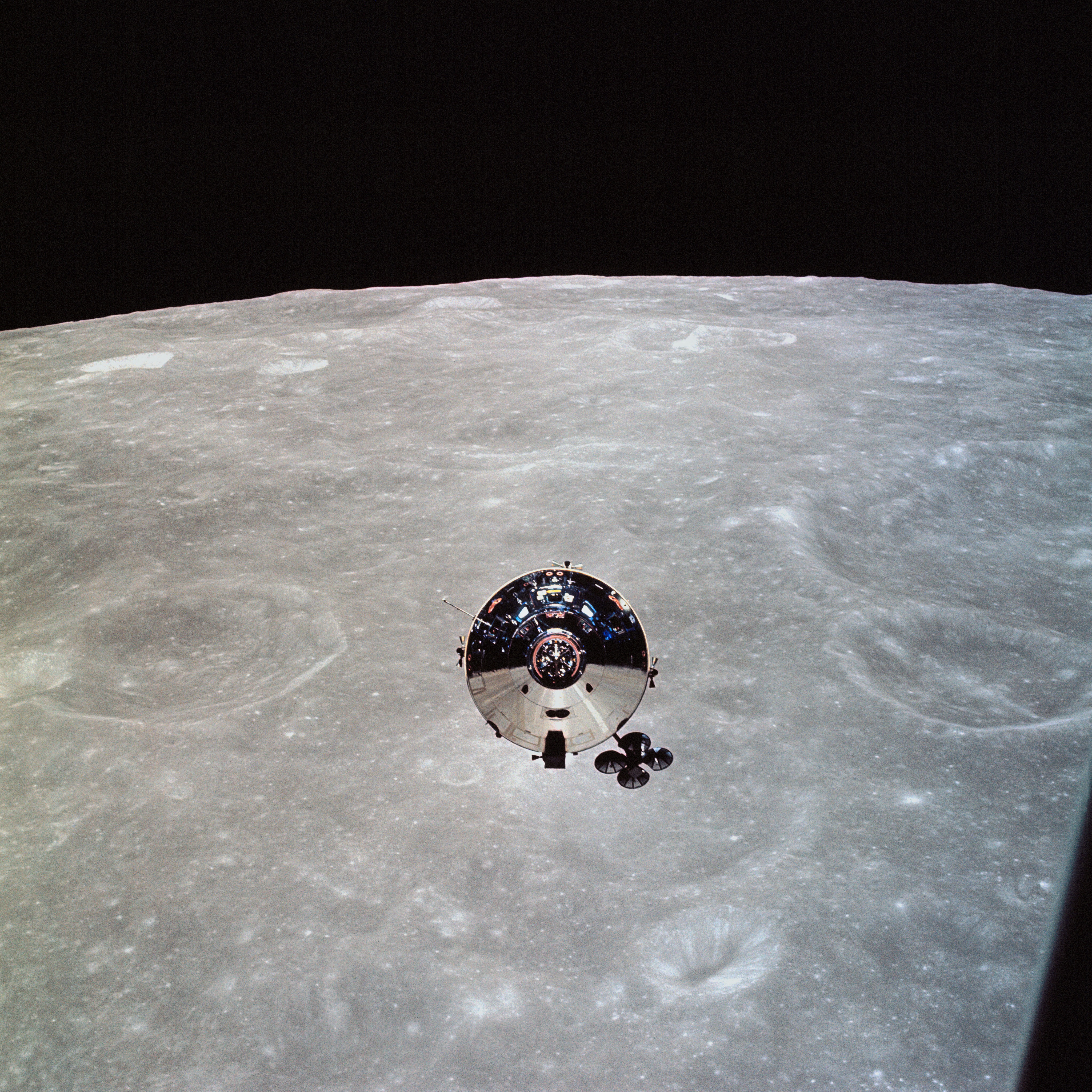
Apollo 10’s command and service modules above the Moon, photographed from its lunar module.
NASA / Johnson Space Center (as10-27-3873) · NASA media-use guidelines · Original recordThe words
Apollo Ten
Apollo 10 launched on May 18, 1969, carrying Stafford, Cernan and Young toward the Moon. It was NASA’s second crewed lunar orbit mission and the final rehearsal before Apollo 11.
NASA: Apollo 10 launches (opens a new tab) · NASA: Apollo 10’s lunar rehearsal (opens a new tab)
Cernan
Eugene Cernan flew as lunar module pilot while Stafford commanded Apollo 10. He accompanied Stafford in Snoopy’s low pass before they rejoined Young in Charlie Brown.
NASA: Apollo 10 returns to Earth (opens a new tab) · NASA: Apollo 10’s lunar flight tests (opens a new tab)
Charlie Brown
The command module was named after Snoopy’s owner, Charlie Brown. The two character names gave Apollo 10’s separately flying spacecraft a recognizable pair of radio call signs.
NASA: Peanuts and Apollo 10 (opens a new tab) · NASA: Apollo 10 launches (opens a new tab)
Color Camera
Apollo 10 sent the first live color television from a crewed spacecraft. Viewers watched Young guide Charlie Brown toward Snoopy during docking early in the journey.
Did you know?
A small monitor showed the crew a picture in black and white to help them aim the color camera. Viewers on Earth received color images.
NASA: Apollo 10 launches (opens a new tab) · NASA report: color camera and monitor (opens a new tab)
Low Pass
Stafford and Cernan took Snoopy to about nine miles (14 km) above the Moon. They surveyed the intended Apollo 11 landing area and tested the approach before returning.
Pago Pago
After recovery, the astronauts flew by helicopter to Pago Pago in American Samoa. A welcome ceremony at Tafuna International Airport came before their flight back to Houston.
Peanuts
Charles M. Schulz’s Peanuts provided both spacecraft names. NASA’s partnership with the cartoonist began during the Apollo era, and Snoopy also appeared in strips set on the Moon.
Did you know?
NASA’s Silver Snoopy award honored employees and contractors whose work improved human flight safety or mission success. Astronauts presented the award.
Perilune
The point in a lunar orbit closest to the Moon.
Lowering Snoopy’s perilune brought the lander close enough to test its landing radar. The readings helped NASA compare the actual lunar approach with predictions made on Earth.
Rehearsal
Apollo 10 tested navigation, landing radar, rendezvous and docking around the Moon. The final descent and touchdown were left for the next mission, Apollo 11.
NASA: Apollo 10’s lunar flight tests (opens a new tab) · NASA: Apollo 10’s lunar rehearsal (opens a new tab)
Snoopy
The lunar module was named after Snoopy, the Peanuts dog. NASA linked the name to its scouting role: looking over the site intended for Apollo 11.
Speed Record
Apollo 10 reached a record speed on its return toward Earth in May 1969. NASA’s history gives its atmospheric entry speed as 24,791 mph (about 39,900 km/h).
Stafford
Thomas Stafford commanded Apollo 10 and flew Snoopy with Cernan. They surveyed and photographed the intended Apollo 11 landing area before returning to Young’s orbiting command module.
Staging
Staging detached Snoopy’s descent stage so the ascent stage could return to Charlie Brown. An unexpected spin followed separation, but the crew regained control and completed the rendezvous.
NASA: Apollo 10’s lunar flight tests (opens a new tab) · NASA: Apollo 10’s lunar rehearsal (opens a new tab)
USS Princeton
USS Princeton was Apollo 10’s Pacific recovery ship. After splashdown on May 26, 1969, recovery forces brought Stafford, Cernan and Young aboard, where the captain and sailors greeted them.
Young
John Young stayed in Charlie Brown while Stafford and Cernan flew Snoopy separately. He took an active role in the rendezvous that brought the two spacecraft together again.
NASA: Apollo 10 returns to Earth (opens a new tab) · NASA: Apollo 10’s lunar flight tests (opens a new tab)
Sources
- 50 Years Ago: Apollo 10 to Sort Out the UnknownsJohn Uri; NASA Johnson Space Center; May 16, 2019; launch, independent spacecraft call signs and first color broadcasts
- NASA and Peanuts Celebrate Apollo 10’s 50th AnniversaryMark A. Garcia; NASA; May 18, 2019; Schulz partnership, spacecraft names and Silver Snoopy awards
- Apollo 10 Clears the Way for the First Moon LandingJohn Uri; NASA Johnson Space Center; May 24, 2019; return from lunar orbit, atmospheric entry and Pacific recovery
- Apollo 10: Mission DetailsNASA; July 8, 2009; Mission Objective and Mission Highlights, landing radar, low orbit, staging and rendezvous
- Apollo 10 Mission ReportNASA Manned Spacecraft Center, MSC-00126; August 1969; appendix A, section A.1.9, p. A-4 (PDF p. 300), television equipment
- Apollo 10 was Moon Landing Rehearsal, EFT-1 Preps for Trips BeyondBob Granath; NASA Kennedy Space Center; June 3, 2014; Apollo 10 retrospective, near-surface pass, photography and staging