
The Space Race
Puzzle 52 · The Road to the Moon · Page 76 in print
Spider and Gumdrop
Spider could not return to Earth, so McDivitt and Schweickart had to get back to Gumdrop.
Jump to a word
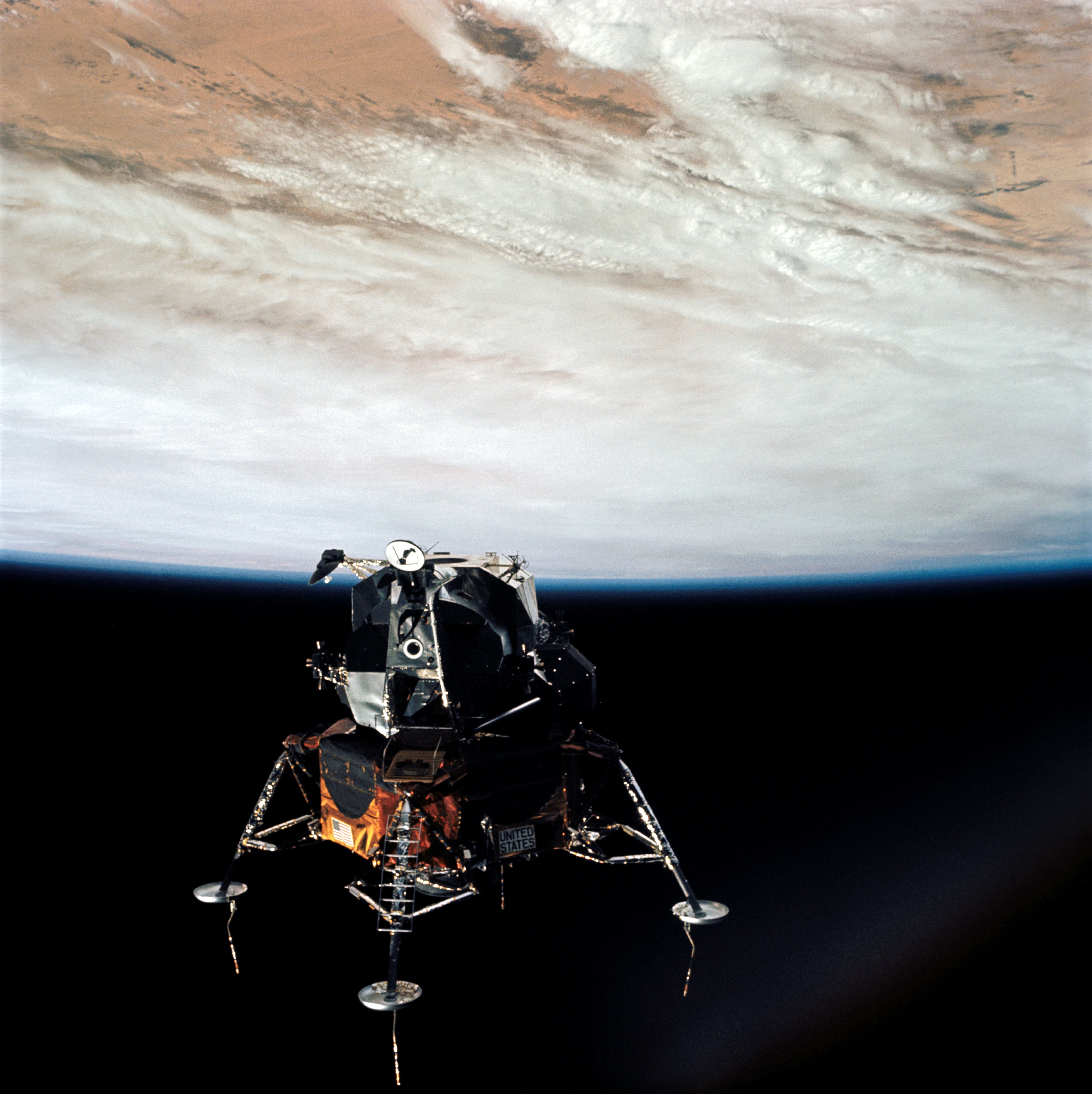
Apollo 9’s lunar module, Spider, with its landing gear deployed in Earth orbit.
NASA / Johnson Space Center (as09-21-3212) · NASA media-use guidelines · Original recordThe words
Apollo Nine
Apollo 9 tested the first crewed lunar module in Earth orbit in March 1969. The flight brought the command module, service module and lunar lander together for a rehearsal of a Moon mission.
Crew Transfer
McDivitt and Schweickart moved through a connecting tunnel between Gumdrop and Spider. This internal passage let them activate and test the lunar module, then rejoin Scott in the command module.
Dave Scott
Dave Scott served as command module pilot, keeping Gumdrop flying while the lunar module operated separately. He had previously flown on Gemini 8 and later commanded Apollo 15.
Docked Burn
Gumdrop’s service module engine was fired with Spider still attached. This test checked how the joined spacecraft responded to forces like those expected on a lunar mission.
Front Porch
The front porch was Spider’s platform outside its side hatch. Schweickart stood there to test the spacesuit and backpack that would support astronauts working on the Moon.
Did you know?
Schweickart put his feet into restraints painted gold nicknamed golden slippers. They kept him in place while he evaluated equipment outside the hatch.
Gumdrop
Gumdrop’s name came from its appearance during shipment on Earth. Blue wrappings made the command and service modules resemble a wrapped candy, inspiring the crew’s radio call sign.
pp. 10–11 (PDF pp. 20–21) · NASA: Apollo 9’s spacecraft names (opens a new tab)
Hundred Miles
Spider traveled more than 100 miles (160 km) from Gumdrop during the independent flight test. Its crew then had to return and dock with Scott’s spacecraft.
McDivitt
James McDivitt commanded Apollo 9 after leading Gemini 4. With Schweickart aboard Spider, he tested the lunar module’s independent flight and returned it to dock with Scott’s spacecraft.
Nausea
Schweickart developed space motion sickness during Apollo 9. The illness prompted NASA to shorten the planned spacewalk and drop the exterior crossing between Spider and Gumdrop.
Red Rover
Schweickart used Red Rover as his radio call sign outside Spider. The name referred to his red hair and distinguished his transmissions from the two spacecraft.
Schweickart
Lunar module pilot Russell Schweickart tested the spacesuit outside Spider. His portable backpack supplied oxygen, demonstrating equipment that later astronauts would need while working on the lunar surface.
Separation
Spider left Gumdrop on the fifth day and later shed its descent stage. The ascent stage then returned for docking, rehearsing the reunion needed after a lunar landing.
Spider
The name Spider reflected the lunar module’s buglike shape. Its crew had to dock with Gumdrop again because Spider could not carry them through Earth’s atmosphere.
NASA: Apollo 9’s spacecraft names (opens a new tab) · NASA: Spider, Gumdrop and Red Rover (opens a new tab)
Ten Days
The mission lasted about ten days, ending with an Atlantic splashdown on March 13, 1969. Once the lunar module tests were finished, the crew continued Earth observations in Gumdrop.
Did you know?
Four cameras photographed Earth through different filters at the same time. The experiment helped prepare for Landsat’s later studies of our planet.
NASA: Apollo 9 completes its mission (opens a new tab) · NASA: Apollo 9’s splashdown (opens a new tab)
Throttle
A control that changes the pushing force of an engine.
Apollo 9 tested manual control of the lunar module’s descent engine while docked to Gumdrop. McDivitt varied its output, a capability needed for the later Moon landings.
Sources
- 50 Years Ago: Apollo 9 Completes its MissionJohn Uri; NASA Johnson Space Center; March 13, 2019; final mission days, Earth photography and recovery
- Apollo 9Smithsonian National Air and Space Museum; mission overview, crew biographies and spacecraft names
- Apollo 9 SplashdownNASA image article; March 13, 2014; caption identifying the crew, ten-day mission and March 13, 1969 splashdown
- 50 Years Ago: Spider, Gumdrop, and Red Rover in SpaceJohn Uri; NASA Johnson Space Center; March 6, 2019; crew transfers, curtailed spacewalk, call signs and independent lunar-module flight
- Apollo 9: Mission DetailsNASA; July 8, 2009; Mission Objective and Mission Highlights, docked engine tests, tunnel transfer and separation
- Apollo 9 Press KitNASA Release 69-29, February 23, 1969; pp. 10–11 (PDF pp. 20–21), spacecraft call signs and name origins; NASA Technical Reports Server copy