
The Space Race
Puzzle 51 · The Road to the Moon · Page 75 in print
Apollo 8 and Earthrise
Earthrise had occurred on three earlier orbits; the crew first saw it on the fourth.
Jump to a word
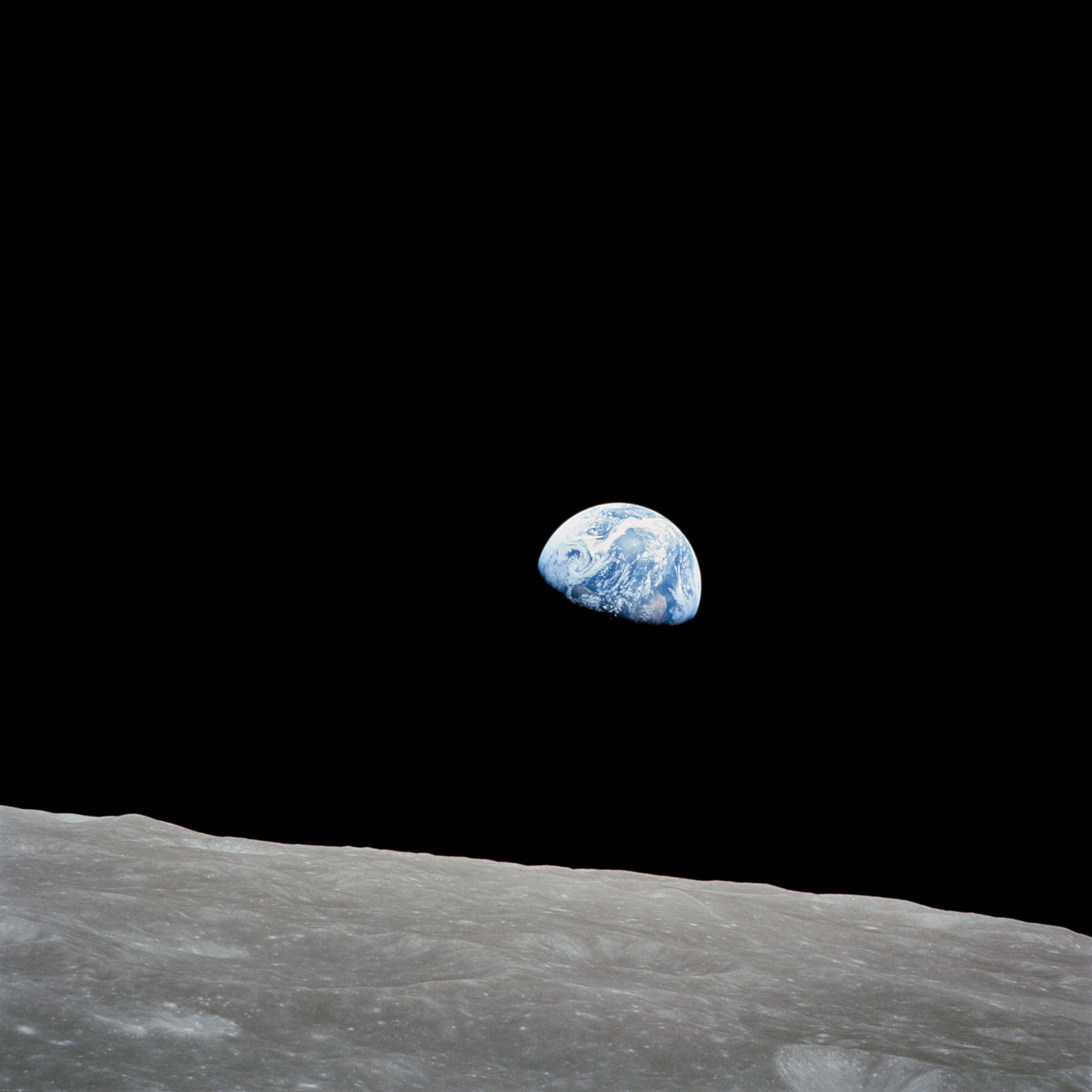
Earth above the lunar horizon, photographed from Apollo 8 on December 24, 1968.
NASA / Johnson Space Center (as08-14-2383) · NASA media-use guidelines · Original recordThe words
Apollo Eight
Frank Borman, Jim Lovell and Bill Anders entered lunar orbit on December 24, 1968. They became the first people to circle the Moon and examined possible sites for later Apollo landings.
Bill Anders
Anders photographed Earthrise in black and white, then asked Lovell for color film. His color photographs captured Earth above the gray lunar horizon.
NASA: reconstructing Earthrise (opens a new tab) · NASA: Apollo 8 in lunar orbit (opens a new tab)
Book of Genesis
Each Apollo 8 astronaut read part of the first ten verses of Genesis during the Christmas Eve broadcast. The Bible’s opening creation account closed a program showing Earth and the Moon.
Genesis 1:1–10 · NASA: Apollo 8 in lunar orbit (opens a new tab) · NASA: Apollo 8’s crew and mission (opens a new tab)
Borman
Commander Frank Borman occupied Apollo 8’s left-hand seat. His planned spacecraft turn brought Earth into Anders’ side window during the fourth lunar orbit.
Christmas Eve
Apollo 8 began its ninth lunar orbit with a television broadcast on December 24, 1968. The crew showed Earth and the Moon, described the terrain and closed with Christmas greetings.
Earthrise
Earth appeared to rise because Apollo 8 was moving around the Moon. The color photograph set our blue-and-white planet against a gray lunar horizon.
Eight Homeward
The crater officially named 8 Homeward appears in the Earthrise photograph. Its name, adopted in 2018, commemorated Apollo 8’s safe return to Earth.
George Low
Delays to the lunar module threatened Apollo’s schedule. In August 1968, George Low proposed sending Apollo 8 to lunar orbit without the lander, replacing the planned Earth-orbit test.
Lovell
Jim Lovell, Apollo 8’s command module pilot, prepared to sight lunar landmarks with a sextant. He was working in the lower equipment bay when Earthrise appeared.
NASA: Apollo 8’s crew and mission (opens a new tab) · NASA: reconstructing Earthrise (opens a new tab)
Men of the Year
Time magazine chose Anders, Borman and Lovell as its Men of the Year for 1968. The honor marked their journey around the Moon and return to Earth.
Mount Marilyn
Jim Lovell named Mount Marilyn after his wife. The triangular mountain became a navigation landmark for Apollo 11’s approach to the first crewed lunar landing.
Did you know?
The International Astronomical Union formally adopted Mount Marilyn on July 26, 2017, nearly half a century after Lovell’s Apollo 8 flight.
LROC: Lovell’s Mount Marilyn (opens a new tab) · USGS/IAU: Mount Marilyn’s name (opens a new tab)
Telephoto Lens
A camera lens that makes distant subjects appear larger.
Anders used a telephoto lens on his handheld Hasselblad for Earthrise. Another Hasselblad, mounted at Borman’s window, photographed the Moon automatically at regular intervals.
Did you know?
NASA later matched the automatic camera’s timed photographs with Lunar Reconnaissance Orbiter maps to reconstruct Apollo 8’s position and orientation during Earthrise.
Ten Orbits
The crew circled the Moon ten times over about twenty hours. Their work included photography, tracking landmarks and examining possible landing sites before the engine firing that sent them home.
USS Yorktown
USS Yorktown was Apollo 8’s recovery carrier in the Pacific. After the December 27, 1968 splashdown, rescuers waited for local sunrise before bringing the astronauts aboard.
Zond
During 1968, Soviet Zond probes tested flights around the Moon without people. Zond 5 returned to Earth; Zond 6 lost cabin pressure, killing its animal passengers, and crashed.
Sources
- 50 Years Ago: Apollo 8 in Lunar OrbitJohn Uri; NASA Johnson Space Center; December 24, 2018; lunar orbit, television broadcast and Genesis reading
- The Story Behind Apollo 8’s Famous Earthrise PhotoNASA Science / Scientific Visualization Studio; December 21, 2018; Andrew Chaikin’s narrated reconstruction and onboard recording transcript
- Apollo 8 Mission DetailsNASA; Mission Objectives, Mission Highlights, crew roles and splashdown/recovery
- 50 Years Ago: Considered Changes to Apollo 8John Uri; NASA Johnson Space Center; August 8, 2018; George Low’s August 1968 proposal and lunar-module delays
- First to the Moon: Apollo 8 and the Soviet UnionMichael J. Neufeld; Smithsonian National Air and Space Museum; December 21, 2018; Zond 5/6 and the limits of evidence for Soviet influence on Apollo 8
- Astronauts Anders, Borman and Lovell: 1968TIME, Person of the Year: A Photo History; researched by Joan Levinstein, Time Inc. Research Center; 1968 selection
- Gazetteer of Planetary Nomenclature: 8 HomewardUSGS Astrogeology / International Astronomical Union; feature 9340, Status and Origin; approved October 5, 2018
- Mount MarilynLunar Reconnaissance Orbiter Camera team, A New Moon Rises exhibit; NASA/GSFC/Arizona State University; image M1142226401LR and exhibit caption
- Gazetteer of Planetary Nomenclature: Mount MarilynUSGS Astrogeology / International Astronomical Union; feature 15617, Status and Origin; approved July 26, 2017