
The Space Race
Puzzle 48 · Building Apollo · Page 70 in print
The Apollo 1 Fire
Grissom complained, “How are we gonna get to the Moon if we can’t talk between three buildings?”
Jump to a word
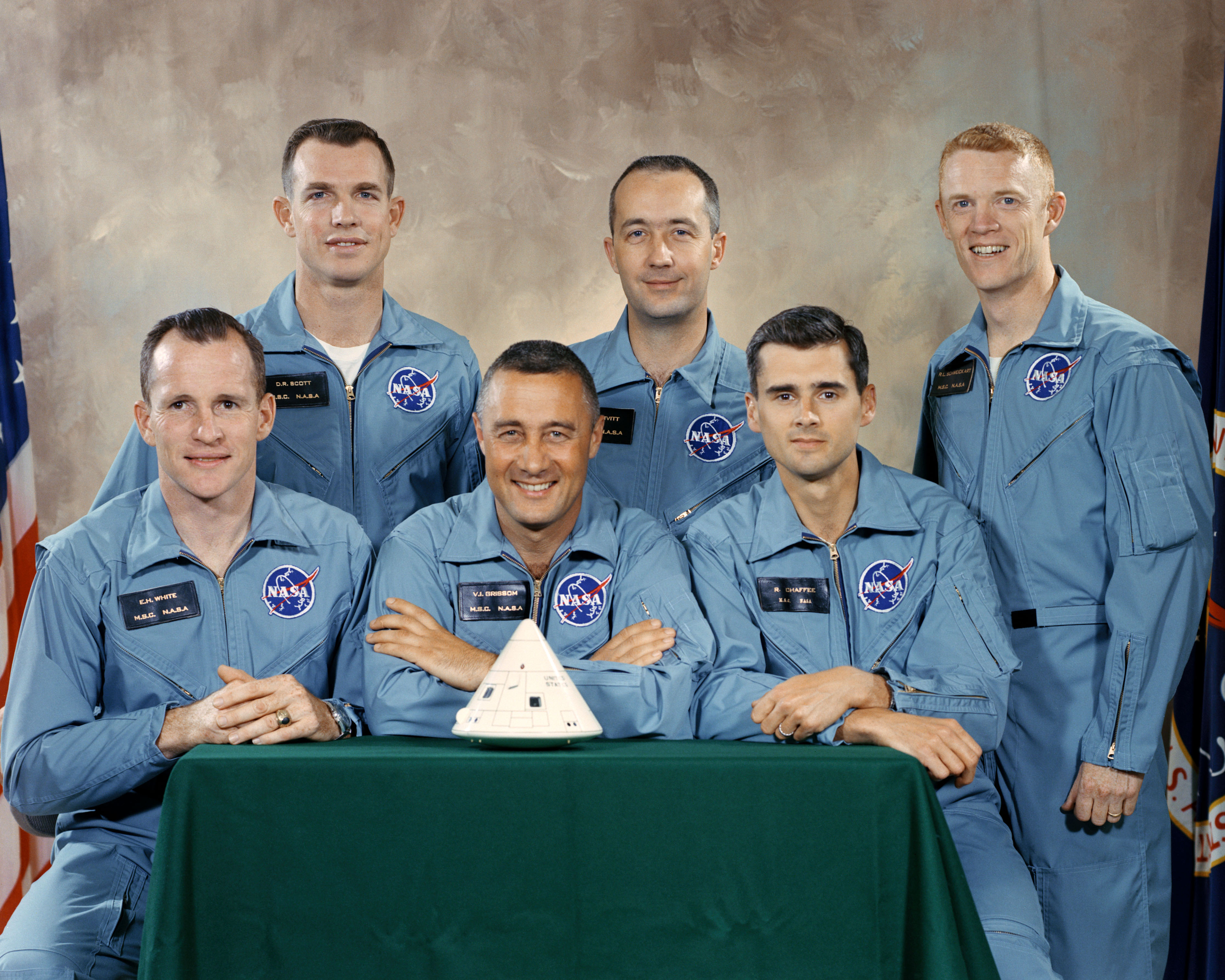
Apollo 1’s prime and backup crews before the mission.
NASA / Johnson Space Center (S66-30238) · NASA media-use guidelines · Original recordThe words
Apollo One
Apollo 1, then officially AS-204, was to be the first crewed Apollo flight, scheduled for February 21, 1967. Its crew, Grissom, White and Chaffee, died in a fire during a launch-pad test on January 27, 1967.
Did you know?
In spring 1967, NASA named the crew’s mission Apollo 1; two earlier uncrewed flights had carried the names Apollo 1 and 2 only unofficially. No flight was ever designated Apollo 2 or 3, and the AS-204 rocket later flew as Apollo 5, carrying a lunar module.
NASA: Apollo 1 mission page (opens a new tab) · NASA: The Apollo 1 fire and its aftermath (opens a new tab)
Arlington
On January 31, 1967, Grissom and Chaffee were buried with full military honors at Arlington National Cemetery, with President Lyndon B. Johnson attending. The third crewman, Ed White, was buried at West Point.
Did you know?
Arlington’s Apollo 1 Monument was dedicated on June 2, 2022, in Section 3, where Grissom and Chaffee lie. At the families’ request, the granite stone bears the Latin “Ad Astra per Aspera”: “A rough road leads to the stars.”
NASA: The Apollo 1 fire and its aftermath (opens a new tab) · Arlington National Cemetery: Apollo 1 (opens a new tab)
Edward White
Air Force Lieutenant Colonel Edward H. White II made the first American spacewalk, on Gemini 4 in June 1965. Apollo 1’s senior pilot, he died in the fire on January 27, 1967, at 36.
Did you know?
On his spacewalk, White steered with a small handheld thruster he called the “zip gun.” In 2017, Kennedy Space Center put it on display beside an electric drill, a tool he loved using to make things for his family.
NASA biography: Edward H. White II (opens a new tab) · Arlington National Cemetery: Apollo 1 (opens a new tab) · NASA: Apollo 1 tribute opens, 2017 (opens a new tab)
Flash Fire
At 6:31 p.m. on January 27, 1967, a flash fire swept through the sealed Apollo 1 cabin during a launch-pad test. Grissom, White and Chaffee died from the fire’s toxic gases, the review board found.
Did you know?
Investigators later re-created the fire in a full-scale mock-up of the cabin, lighting it with a hot wire where the real fire most likely began. The test fire closely matched the real one, and the board recommended such full-scale tests to judge fire risk.
NASA: Tragedy on the launch pad (opens a new tab) · NASA: The Apollo 1 fire and its aftermath (opens a new tab) · Apollo 204 Review Board report (opens a new tab)
Inner Hatch
Of the three hatches, the innermost opened inward and took 90 seconds to open in ideal conditions. Once the fire raised the cabin pressure, it could not be opened, and the crew could not escape.
Did you know?
For the 50th anniversary in January 2017, NASA put the three-piece hatch on display at Kennedy Space Center, the first time any part of the Apollo 1 spacecraft had been shown publicly. As of 2022, the capsule itself remained in storage at NASA’s Langley Research Center.
Apollo 204 Review Board report (opens a new tab) · NASA: The Apollo 1 fire and its aftermath (opens a new tab) · NASA: Apollo 1 tribute opens, 2017 (opens a new tab)
Mixed Gas
A cabin atmosphere of oxygen diluted with another gas, such as nitrogen or helium, to reduce the risk of fire.
On March 14, 1968, NASA announced that on the launch pad, the cabin of Apollo 7, the first crewed Apollo mission, would hold 60 percent oxygen and 40 percent nitrogen rather than pure oxygen.
Did you know?
Crews still breathed pure oxygen in their suits at launch, to lower the risk of the bends. Once in orbit, the spacecraft gradually replaced the mixture with pure oxygen at 5 pounds per square inch (34 kPa), standard for American spacecraft at the time.
NASA: The 1968 mixed-gas decision (opens a new tab) · Apollo 204 Review Board report (opens a new tab)
Pad Thirty Four
Launch Complex 34 at Cape Kennedy held the Apollo 1 spacecraft atop its unfueled Saturn IB rocket on January 27, 1967, when Grissom, White and Chaffee died there in the fire.
Did you know?
The pad was dismantled in 1968, after the launch of Apollo 7. In 2018, NASA noted that only the launch platform still stood, with a plaque at its base: “Remember them not for how they died but for those ideals for which they lived.”
NASA Science: Launch Complex 34 (opens a new tab) · NASA: Tragedy on the launch pad (opens a new tab) · NASA: The Apollo 1 fire and its aftermath (opens a new tab) · NASA: Apollo 1 tribute opens, 2017 (opens a new tab)
Plugs-Out Test
A mock countdown with the ground cables disconnected at simulated liftoff, to show that the spacecraft and rocket can run on internal power alone.
Grissom, White and Chaffee were running the formal “Space Vehicle Plugs-Out Integrated Test” on January 27, 1967. Two days earlier, the backup crew had run a “plugs-in” version, with the spacecraft still on ground power.
Did you know?
The test was not classed as hazardous, because the rocket held no fuel; only tests involving fueled vehicles, live pyrotechnics and the like were. Afterward, NASA defined every test in a pure-oxygen atmosphere as hazardous.
NASA: Tragedy on the launch pad (opens a new tab) · NASA SP-4205, Chariots for Apollo, ch. 9 (opens a new tab) · Apollo 204 Review Board report (opens a new tab) · NASA’s response to the review board (opens a new tab) · NASA: The Apollo 1 fire and its aftermath (opens a new tab)
Pure Oxygen
For the test, the cabin held pure oxygen at 16.7 pounds per square inch (115 kPa), slightly above outside air pressure, which helped the fire spread very rapidly. The review board called the test conditions “extremely hazardous.”
Did you know?
In March 1965, Apollo spacecraft manager Joseph Shea and Houston’s crew-systems engineers weighed one gas against two and concluded that pure oxygen was safer, simpler and lighter, though most of their studies considered fire in space, not on the ground.
Apollo 204 Review Board report (opens a new tab) · NASA SP-4205, Chariots for Apollo, ch. 9 (opens a new tab) · NASA: The Apollo 1 fire and its aftermath (opens a new tab)
Review Board
The day after the fire, NASA Deputy Administrator Robert Seamans set up the Apollo 204 Review Board, chaired by Floyd L. Thompson, director of Langley Research Center. Astronaut Frank Borman was among its members.
Did you know?
By late February 1967, 1,500 people, 600 from government and 900 from industry and universities, were supporting the investigation. The board’s final report, released on April 9, ran to almost 3,000 pages in 14 booklets, a stack about 8 inches (20 cm) high.
NASA: The Apollo 1 fire and its aftermath (opens a new tab) · NASA SP-4205, Chariots for Apollo, ch. 9 (opens a new tab)
Roger Chaffee
Navy Lieutenant Commander Roger B. Chaffee, chosen as an astronaut in 1963, was to make his first spaceflight as Apollo 1’s pilot. He died with Grissom and White in the fire on January 27, 1967, at 31.
Did you know?
Before Apollo 1, Chaffee served as capsule communicator, relaying information to and from the crew, on Gemini 3 and Gemini 4. On Gemini 4, the mission of White’s spacewalk, he and Grissom both held the job, talking to White and commander James McDivitt.
NASA biography: Roger B. Chaffee (opens a new tab) · Purdue University: Roger Chaffee (opens a new tab) · Arlington National Cemetery: Apollo 1 (opens a new tab) · NASA: Apollo 1 tribute opens, 2017 (opens a new tab) · NASA: Former astronaut Roger B. Chaffee (opens a new tab)
Unified Hatch
“Unified” because a single hatch replaced the separate inner and outer crew hatches.
A 2022 NASA history calls it the most significant hardware change after the fire. The new hatch opened outward within seconds, from inside or outside, pushing the outer boost cover out of the way.
Did you know?
At a news conference on May 10, 1967, Apollo 1’s backup crew, Walter Schirra, Donn Eisele and Walter Cunningham, and their own backups cited the new hatch among changes making their spacecraft safe to fly. Schirra’s crew flew it on Apollo 7.
NASA SP-4205, Chariots for Apollo, ch. 9 (opens a new tab) · NASA: The Apollo 1 fire and its aftermath (opens a new tab) · NASA: Apollo 1 tribute opens, 2017 (opens a new tab) · NASA: The 1968 mixed-gas decision (opens a new tab)
Velcro
Velcro strips near the fire’s likely starting point burned in its first stage, the review board found. A month after the fire, NASA’s George Mueller told Congress the “four Fs” needed further study: fabrics, fasteners, film and foams.
Did you know?
NASA did not invent Velcro, its Spinoff office says. A Swiss engineer invented it in the 1940s, and its extensive use on Apollo missions to anchor equipment is what led to its association with NASA.
Apollo 204 Review Board report (opens a new tab) · NASA SP-4205, Chariots for Apollo, ch. 9 (opens a new tab) · NASA Spinoff: Frequently asked questions (opens a new tab)
Virgil Grissom
Air Force Lieutenant Colonel Virgil “Gus” Grissom, a Mercury astronaut, flew Liberty Bell 7 in 1961 and commanded Gemini’s first crewed flight in 1965. Apollo 1’s command pilot, he died in the fire on January 27, 1967, at 40.
Did you know?
When Kennedy Space Center opened its Apollo 1 tribute in 2017, Grissom’s displays included a hunting jacket and ski boots, a slide rule, and a model of the kind of F-86 Sabre jet he flew on 100 combat missions in Korea.
NASA biography: Virgil I. Grissom (opens a new tab) · NASA: Apollo 1 tribute opens, 2017 (opens a new tab)
Wiring
The review board judged that the “most probable initiator was an electrical arc” in wiring near the floor on Grissom’s side of the cabin, and it faulted the wiring’s design, installation and quality control.
Did you know?
Investigators studied parts “inch by inch with magnifying glasses.” Among examples of poor workmanship, they reported a wrench socket found in the spacecraft. In later Apollo cabins, wire bundles that had been exposed were covered by metal shields.
Apollo 204 Review Board report (opens a new tab) · NASA: The Apollo 1 fire and its aftermath (opens a new tab) · NASA: The 1968 mixed-gas decision (opens a new tab)
Sources
- 55 Years Ago: The Apollo 1 Fire and its AftermathNASA, Johnson Space Center
- Apollo 1NASA
- 55 Years Ago: Tragedy on the Launch PadNASA, Johnson Space Center
- 50th anniversary of NASA deciding on a mixed-gas atmosphere for Apollo, a direct result of the Apollo fire.NASA, Johnson Space Center
- Report of the Apollo 204 Review BoardNASA History Office
- Chariots for Apollo (NASA SP-4205), ch. 9: Tragedy and RecoveryNASA History Office
- NASA Response to Findings, Determinations, and Recommendations of Apollo 204 Review BoardNASA History Office
- Virgil I. Grissom (Lieutenant Colonel, USAF), NASA Astronaut (Deceased)NASA, Johnson Space Center
- Edward H. White, II (Lieutenant Colonel), NASA Astronaut (Deceased)NASA, Johnson Space Center
- Roger B. Chaffee (Lieutenant Commander, USN), NASA Astronaut (Deceased)NASA, Johnson Space Center
- NASA Unveils Tribute to Crew of Apollo 1NASA, Kennedy Space Center
- Apollo 1 MonumentArlington National Cemetery
- Launch Complex 34NASA Science
- Frequently Asked QuestionsNASA Spinoff
- Roger ChaffeePurdue University, Purdue in Space
- Roger B. ChaffeeNASA