
The Space Race
Puzzle 47 · Building Apollo · Page 69 in print
Mission Control Houston
Projectors hidden in the Bat Cave threw maps onto Mission Control’s big screens.
Jump to a word
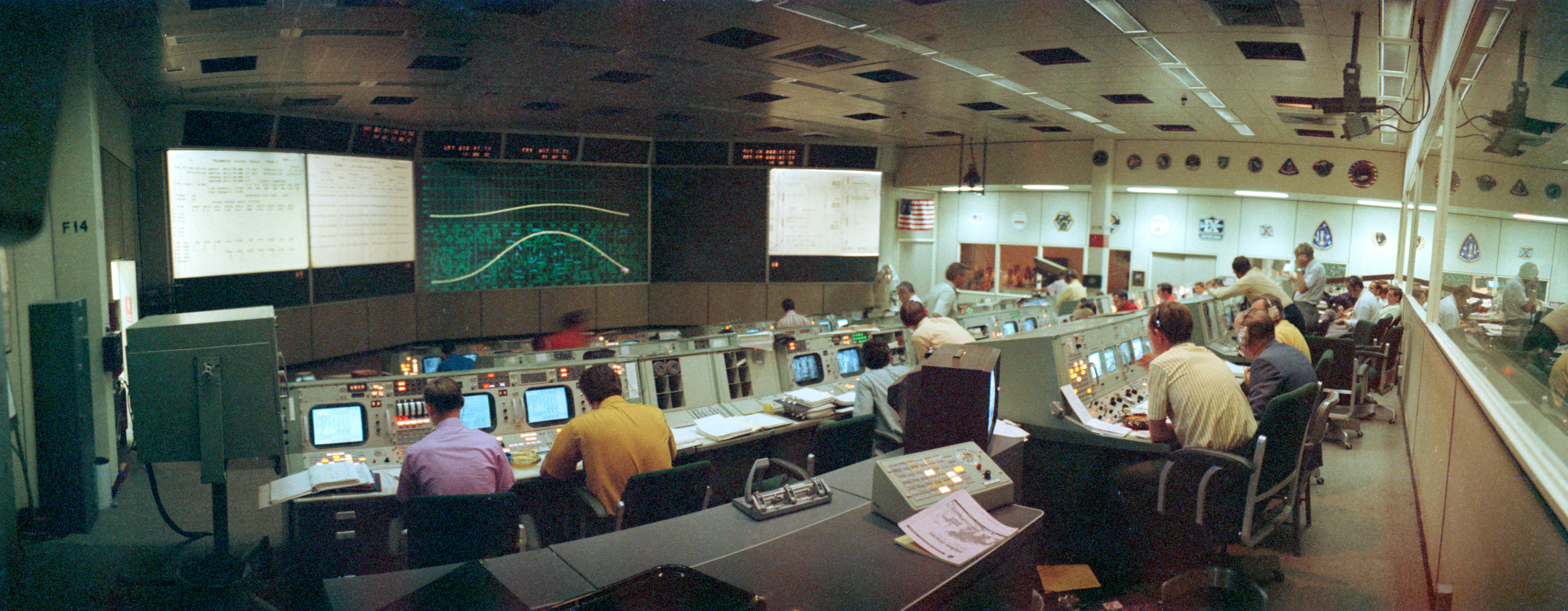
Mission Control in Houston during Apollo 15’s lunar landing.
NASA / Johnson Space Center (S71-41424) · NASA media-use guidelines · Original recordThe words
Back Room
Spacecraft specialists worked in support rooms beside the main control room. They helped the controllers at the consoles, extending Mission Control’s expertise beyond the people visible on television.
Bat Cave
The Bat Cave was the projection room behind Mission Control’s large front screens. Its equipment projected maps, images and changing mission information onto the screens from the rear.
Did you know?
The room’s video projectors, called Eidophors, grew from efforts in the late 1940s to develop video projection for movie theaters.
Capcom
An astronaut serving as CAPCOM was the crew’s voice contact in Houston. This station relayed information between the spacecraft and ground team while other controllers listened.
NASA: Apollo’s voice recordings (opens a new tab) · Park Service: Apollo control-room record (opens a new tab)
Cigars
Apollo 7’s return brought a cigar celebration in Mission Control. An October 1968 NASA photograph showed flight directors Glynn Lunney, Gene Kranz and Gerry Griffin smoking together.
Consoles
The consoles combined controls with television-style displays for monitoring spacecraft systems. Their cathode-ray tubes showed mission information, giving each controller a view of a particular part of the flight.
Controllers
Flight controllers in Houston followed the spacecraft throughout its mission. Information appeared on their consoles, while the large wall displays showed its position on a world map.
Flight Surgeon
The flight surgeon watched the crew’s heart and breathing rates on console displays. A medical support team helped compare those readings with conditions inside the spacecraft and spacesuits.
p. 135 (PDF p. 139) · NASA: Apollo 11 biomedical monitoring (opens a new tab)
Glynn Lunney
Glynn Lunney directed later Gemini flights and became one of Apollo’s flight directors. He was Apollo 7’s lead flight director when its crew returned in October 1968.
NASA: control transfers to Houston (opens a new tab) · UHCL archives: Apollo 7’s return (opens a new tab)
Houston
Houston became the primary control center for American crewed space missions with Gemini 4 in June 1965. Its larger facilities supported the longer, more complex flights leading to Apollo.
Did you know?
During Gemini 3 in March 1965, the Houston center served as backup. The Florida control center still held primary responsibility for that flight.
Pneumatic Tube
Its air-driven carriers brought paper messages, charts and graphs directly to controllers’ consoles. The tubes linked the main room with computers and the specialists in support rooms.
p. 20 (PDF p. 21) · Park Service: Apollo control-room record (opens a new tab)
SimSup
The simulation supervisor’s team prepared practice failures for astronauts and controllers to solve together. Fred Haise recalled training in simulators at Kennedy while connected to Mission Control in Houston.
Telemetry
Measurements transmitted from a distant vehicle to a receiving station.
Apollo 11’s crew health measurements traveled through the tracking network to Mission Control. Heart and breathing data appeared on displays so ground specialists could follow the astronauts’ condition.
p. 135 (PDF p. 139) · NASA: Apollo 11 biomedical monitoring (opens a new tab)
Trench
The Trench was the controllers’ nickname for the front row of consoles. Its stations covered the booster, retrofire, flight dynamics and guidance, placing flight-path specialists together near the screens.
Viewing Room
A glass wall separated the visitors’ viewing room from Mission Control. Dignitaries, guests and reporters watched from behind the controllers, observing a mission without interrupting their work.
Voice Loops
Separate voice channels linked controllers with the flight director and support teams. They let specialists coordinate their work and listen to crew communications without shouting across the control room.
Sources
- Building on a Mission: The Houston Mission Control CenterJohn Uri; NASA Johnson Space Center; September 29, 2021; opening description of controllers and displays
- Apollo Mission Control Center RestorationNASA Johnson Space Center; Consoles, Visitors Viewing Area and Summary Display Projection Room sections
- 1965: Mission Control Transfers to HoustonJohn Uri; NASA Johnson Space Center; April 9, 2018; Gemini control transfer, support rooms and flight directors
- Apollo 11 Lunar Landing Mission: Press KitNASA Release 69-83K, July 6, 1969; p. 135 (PDF p. 139), Biomedical Inflight Monitoring
- NASA MSC Mission Control Flight Directors Celebrate Apollo 7 Mission Photo, October 1968NASA Manned Spacecraft Center photograph; October 1968; Glynn S. Lunney Papers, HSF-90, Box 12, Folder 21; University of Houston-Clear Lake Archives and Special Collections
- Apollo Mission Control PhotosSpace Center Houston; July 2017 photograph captions, front-row controller stations
- Apollo 13NASA Johnson Space Center, Houston We Have a Podcast, episode 139; interview with Fred Haise and Jim Lovell recorded January 13, 2020; Fred Haise on simulation training
- The Heroes Behind the HeroesNASA Johnson Space Center, Houston We Have a Podcast, episode 88; April 19, 2019; Pat Ryan’s explanation of voice loops and Apollo 11 recordings
- Johnson Space Center, Apollo Mission Control (Building No. 30, Apollo Mission Control Center)Douglas Jerolimov; National Park Service, Historic American Engineering Record TX-109-C; December 2011; pp. 20 and 29 (PDF pp. 21 and 30); Library of Congress copy