
The Space Race
Puzzle 46 · Building Apollo · Page 68 in print
The Moon Suit
Armstrong wrote that his moon suit’s true beauty “was that it worked.”
Jump to a word
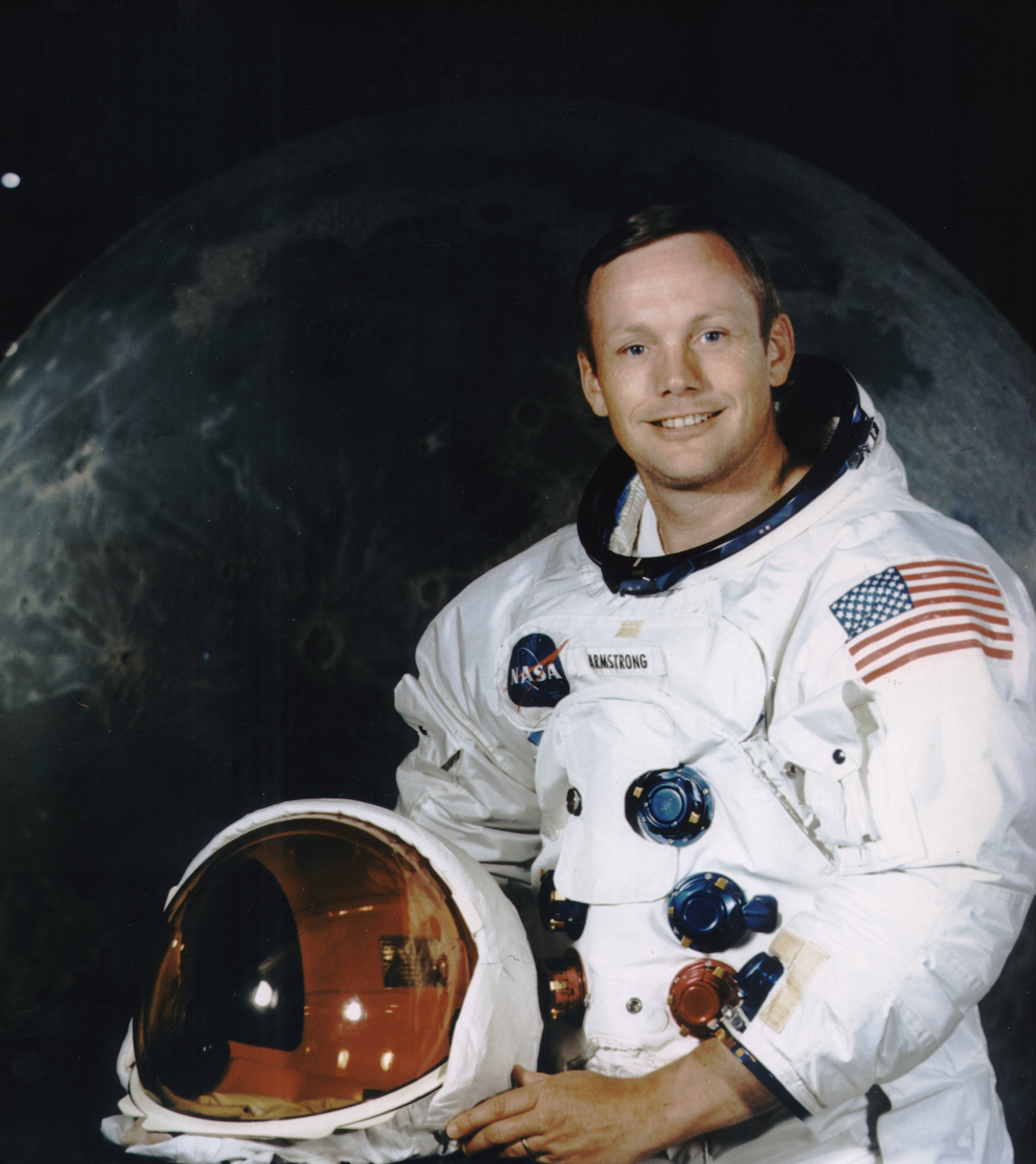
Neil Armstrong in his Apollo spacesuit, with his helmet beside him.
NASA / Marshall Space Flight Center (9018112) · NASA media-use guidelines · Original recordThe words
Beta Cloth
After the Apollo 1 fire killed three astronauts, NASA sought more fire-resistant suit materials. Beta cloth, made from Teflon-coated silica fibers, became part of the outer covering.
NASA: certifying Apollo’s spacesuits (opens a new tab) · Smithsonian: Armstrong’s spacesuit (opens a new tab) · ASME: Apollo suit design and manufacture (opens a new tab)
Bubble Helmet
The clear pressure helmet enclosed the astronaut’s head and fastened at the suit’s neck ring. A separate outer visor assembly provided additional protection during moonwalks.
ASME: Apollo suit design and manufacture (opens a new tab) · Lunar journal: Aldrin’s flown suit (opens a new tab)
Convolute
A bellows-shaped flexible joint in a pressure suit.
Apollo’s pressurized garment resisted movement. Convolutes at the elbows, knees and other joints let astronauts bend their limbs while restraint cords controlled the joint’s shape.
Did you know?
Later A7LB suits added a waist joint so the crews of Apollo 15–17 could sit on the lunar rover.
Dover
Dover, Delaware, was one of ILC’s Apollo spacesuit manufacturing locations. The company also made suits at its Frederica facility, bringing both towns into the lunar program.
p. 1 (PDF p. 3) · ASME: Apollo suit design and manufacture (opens a new tab)
Gauntlets
The gauntlet was the glove’s extended cuff over the wrist. On Aldrin’s left Apollo 11 glove, a checklist was sewn onto its upper surface.
Life Support
The backpack supplied oxygen, removed exhaled carbon dioxide and circulated cooling water. It let Apollo’s moonwalkers carry their own life-support system away from the lunar module.
NASA: Apollo 11 suit and life support (opens a new tab) · Apollo news reference: backpack cooling (opens a new tab)
Long Underwear
For moonwalks, astronauts wore a close-fitting liquid-cooling garment beneath the pressure suit. Water circulating through its network of plastic tubes carried away body heat.
NASA: Apollo 11 suit and life support (opens a new tab) · Apollo news reference: backpack cooling (opens a new tab)
Lunar Boots
Lunar boots were protective overshoes worn over the pressure suit’s fitted boots. They combined insulation, molded silicone soles and a cut-resistant metal-fiber cover.
Did you know?
Apollo 11’s moonwalkers left their overshoes and life-support backpacks on the lunar surface to reduce launch weight.
ASME: Apollo suit design and manufacture (opens a new tab) · Smithsonian: Armstrong’s spacesuit (opens a new tab)
Neck Ring
The helmet fitted into a metal ring at the suit’s neck. Locking pins engaged a channel around the helmet’s base to hold the connection together.
Neoprene
Neoprene, a synthetic rubber, coated the nylon bladder that held gas inside the suit. A separate restraint layer kept the pressure garment from swelling out of shape.
Smithsonian: Armstrong’s spacesuit (opens a new tab) · NASA: Apollo 11 suit and life support (opens a new tab)
Playtex
Playtex was the familiar underwear brand in the suit maker’s corporate family. ILC’s Apollo work drew on a business already experienced in flexible garments and rubber products.
Seamstresses
Seamstresses such as Jean Wilson stitched Apollo’s protective suit layers using specialized sewing machines. Their skilled handwork turned engineering designs into garments astronauts could wear.
Sublimator
A cooler that removes heat by turning ice directly into vapor.
The backpack’s sublimator rejected heat from the astronaut’s cooling water. It used the vacuum of space to carry heat away while the astronaut worked.
pp. P-2–P-3 (PDF pp. 2–3) · Apollo news reference: backpack cooling (opens a new tab)
Teflon
The suit’s Beta-cloth glass fibers were coated with Teflon. This coating helped keep the fibers from abrading one another as the astronaut moved.
Smithsonian: Armstrong’s spacesuit (opens a new tab) · ASME: Apollo suit design and manufacture (opens a new tab)
Zipper
A long pressure-sealing zipper ran down the back of the A7L suit. It let the astronaut enter the garment and then close its gas-retaining layer.
Sources
- 50 Years Ago: Certifying Apollo SpacesuitsJohn Uri; NASA Johnson Space Center; January 10, 2018; post-fire materials and suit certification
- Armstrong SpacesuitSmithsonian National Air and Space Museum; suit materials, closure and returned Apollo 11 garments
- Apollo Space Suit, 1962–1974ASME Historic Mechanical Engineering Landmark brochure; September 20, 2013; pp. 1, 5–7 (PDF pp. 3, 7–9)
- Apollo 11 Lunar Landing Mission: Press KitNASA Release 69-83K, July 6, 1969; p. 117 (PDF p. 121), pressure garment, cooling garment and backpack
- Portable Life Support SystemHamilton Standard, Apollo News Reference, pp. P-1–P-3; Apollo Lunar Surface Journal document archive
- Apollo Suit ConvolutesApollo Lunar Surface Journal; adapted from NASA SP-368, Biomedical Results of Apollo, section VI.6; revised May 8, 2025
- Buzz Aldrin’s Apollo 11 SuitApollo Lunar Surface Journal; museum photographs and captions by Ken Glover, Amanda Young, Ulli Lotzmann and Bill Ayrey; revised January 29, 2018
- Apollo Seamstress Jean Wilson’s Identity RecoveredCathleen Lewis; Smithsonian National Air and Space Museum; March 29, 2026; industrial sewing and corporate background