
The Space Race
Puzzle 45 · Building Apollo · Page 67 in print
The Guidance Computer
Apollo’s programs were woven into core rope; Margaret Hamilton was their “Rope Mother.”
Jump to a word
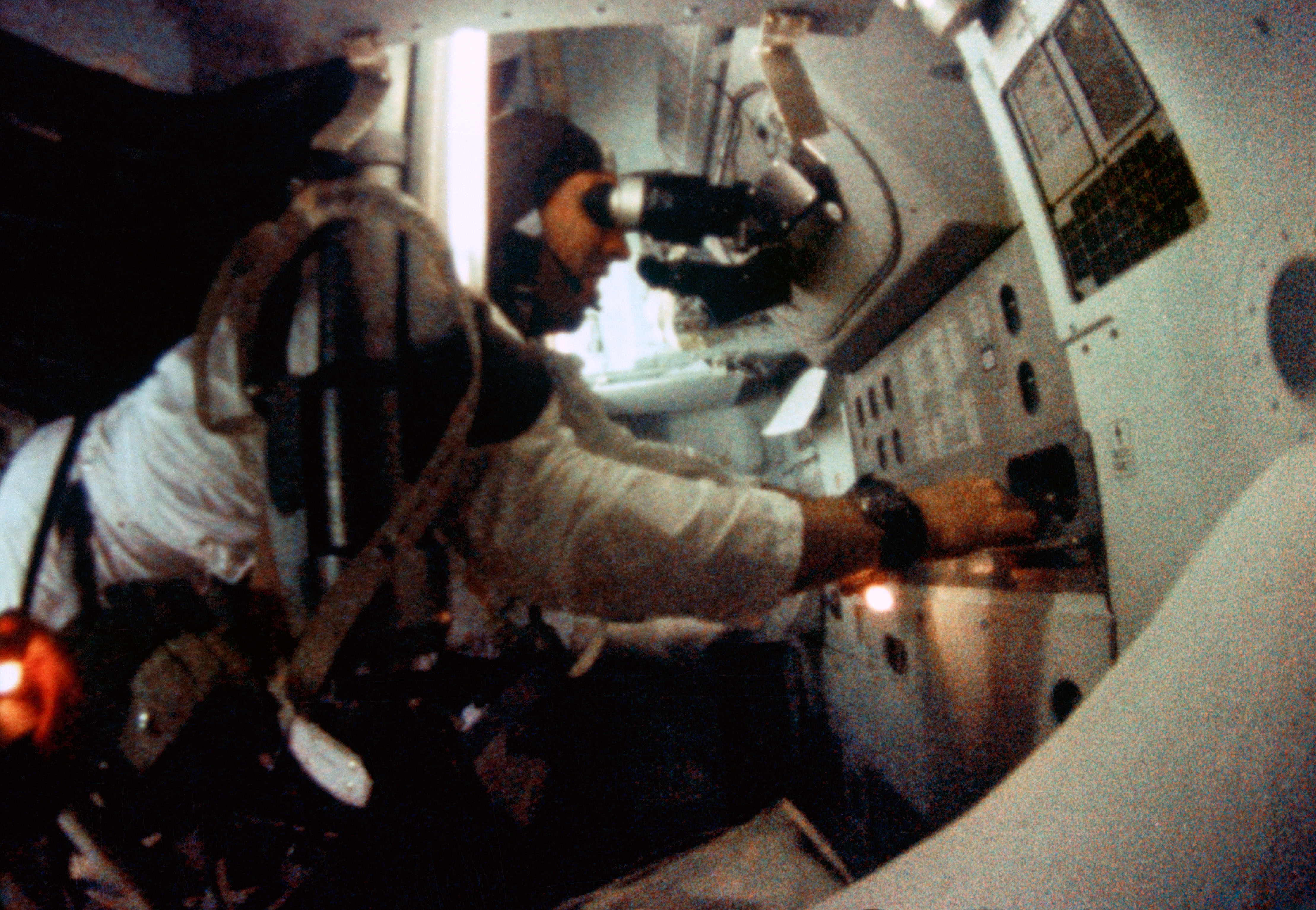
Jim Lovell at Apollo 8’s guidance and navigation station, in a frame from onboard film.
NASA / Johnson Space Center (S69-35099) · NASA media-use guidelines · Original recordThe words
Charles Draper
Charles Stark Draper directed MIT’s Instrumentation Laboratory. Its guidance expertise helped persuade NASA that an onboard computer could support a mission from Earth to the Moon.
p. 28 (PDF p. 37) · NASA: Apollo computing and its keyboard (opens a new tab)
Core Rope
A wire passing through a magnetic core represented one; a wire bypassing it represented zero. These woven patterns held the computer’s read-only programs.
Don Eyles
Don Eyles helped program the lunar module’s computer at MIT. His work included software for powered descent, as the lander slowed toward the Moon’s surface.
Don Eyles: programming the lunar module (opens a new tab) · NASA archive: Apollo computer designers (opens a new tab)
Eldon Hall
Eldon C. Hall led the Apollo Guidance Computer’s hardware design at MIT. His team developed the physical electronics used to carry out the spacecraft’s flight programs.
Slide 31 · NASA archive: Apollo computer designers (opens a new tab)
Fairchild
Fairchild Semiconductor designed the integrated circuits chosen for Apollo’s computer. MIT worked closely with the company to test their reliability before trusting the new technology in space.
Did you know?
Fairchild’s design was licensed to Philco in Pennsylvania, which supplied thousands of chips used in Apollo’s guidance computers.
Gimbal Lock
Loss of one independent direction of rotation when two axes line up.
Apollo measured its orientation using a platform held in rotating rings called gimbals. Crews avoided alignments that could prevent the platform from keeping a steady reference.
105:00:30 commentary · NASA lunar journal: gimbal lock (opens a new tab)
Hamilton
Margaret Hamilton led Apollo flight-software development and production at MIT. The work included testing and reviewing programs whose behavior had to be dependable throughout the mission.
Keyboard
Astronauts communicated with the computer through the display and keyboard, or DSKY. Number keys, readouts and warning lights made a compact interface for operating the spacecraft.
p. 53 (PDF p. 62) · NASA: Apollo computing and its keyboard (opens a new tab)
Noun
A noun identified the information involved in a command, such as velocity. Paired with a verb, it told Apollo’s computer which data the astronaut wanted to use.
p. 58 (PDF p. 67) · NASA: Apollo computing and its keyboard (opens a new tab)
Raytheon
Raytheon manufactured the Apollo Guidance Computers designed at MIT. Building the machines for flight meant turning a laboratory design into equipment for spacecraft guidance and navigation.
Rope Mother
Hamilton’s nickname connected her work with the woven program memory. Her responsibility included checking and documenting the software before its instructions were embodied in core ropes.
Silicon Chip
An integrated circuit placed several electronic components on a small piece of silicon. These chips helped make Apollo’s onboard computer compact enough to fit within tight spacecraft limits.
Software
Apollo’s software calculated navigation and flight-control tasks while managing the computer’s limited resources. A priority system kept important work ahead of less urgent jobs.
p. 44 (PDF p. 53) · NASA: Apollo computing and its keyboard (opens a new tab)
Verb
A verb selected an action, such as displaying data. Apollo paired it with a noun, letting astronauts request useful operations through a small set of numbered keys.
p. 58 (PDF p. 67) · NASA: Apollo computing and its keyboard (opens a new tab)
Weavers
Skilled technicians at Raytheon threaded wires to make Apollo’s fixed memory. Most were women, turning the software prepared at MIT into physical patterns inside the computer.
Did you know?
Programs were first punched onto paper tape. A machine read the tape to position the cores before technicians threaded the wires.
Sources
- Computer, Apollo Guidance, Block ISmithsonian National Air and Space Museum; object A19720340000; MIT design and Raytheon manufacture
- Apollo Guidance Computer and the First Silicon ChipsPaul Ceruzzi; Smithsonian National Air and Space Museum; October 14, 2015; Fairchild, Philco and integrated circuits
- The “Rope Mother” Margaret HamiltonPaul Ceruzzi; Smithsonian National Air and Space Museum; March 11, 2016; software leadership and rope-memory manufacture
- Computers in Spaceflight: The NASA ExperienceJames E. Tomayko; NASA CR-182505, March 1988; pp. 28, 44, 53 and 58 (PDF pp. 37, 53, 62 and 67)
- Tales from the Lunar Module Guidance ComputerDon Eyles; AAS paper 04-064, February 6, 2004; illustrated copy in the klabs.org archive
- Human Lunar Landing Experience on Project Apollo: How We Did It, Why We Did It That WayDean Eppler, The Aerospace Corporation; December 31, 2019; NASA-hosted presentation, slide 31
- Post-landing ActivitiesEric M. Jones; NASA Apollo 11 Lunar Surface Journal; gimbal explanation near 105:00:30, with commentary by David Woods