
The Space Race
Puzzle 44 · Building Apollo · Page 66 in print
The Lunar Module
Tom Kelly said the six descent stages on the Moon bear a ‘Made in Bethpage’ nameplate.
Jump to a word
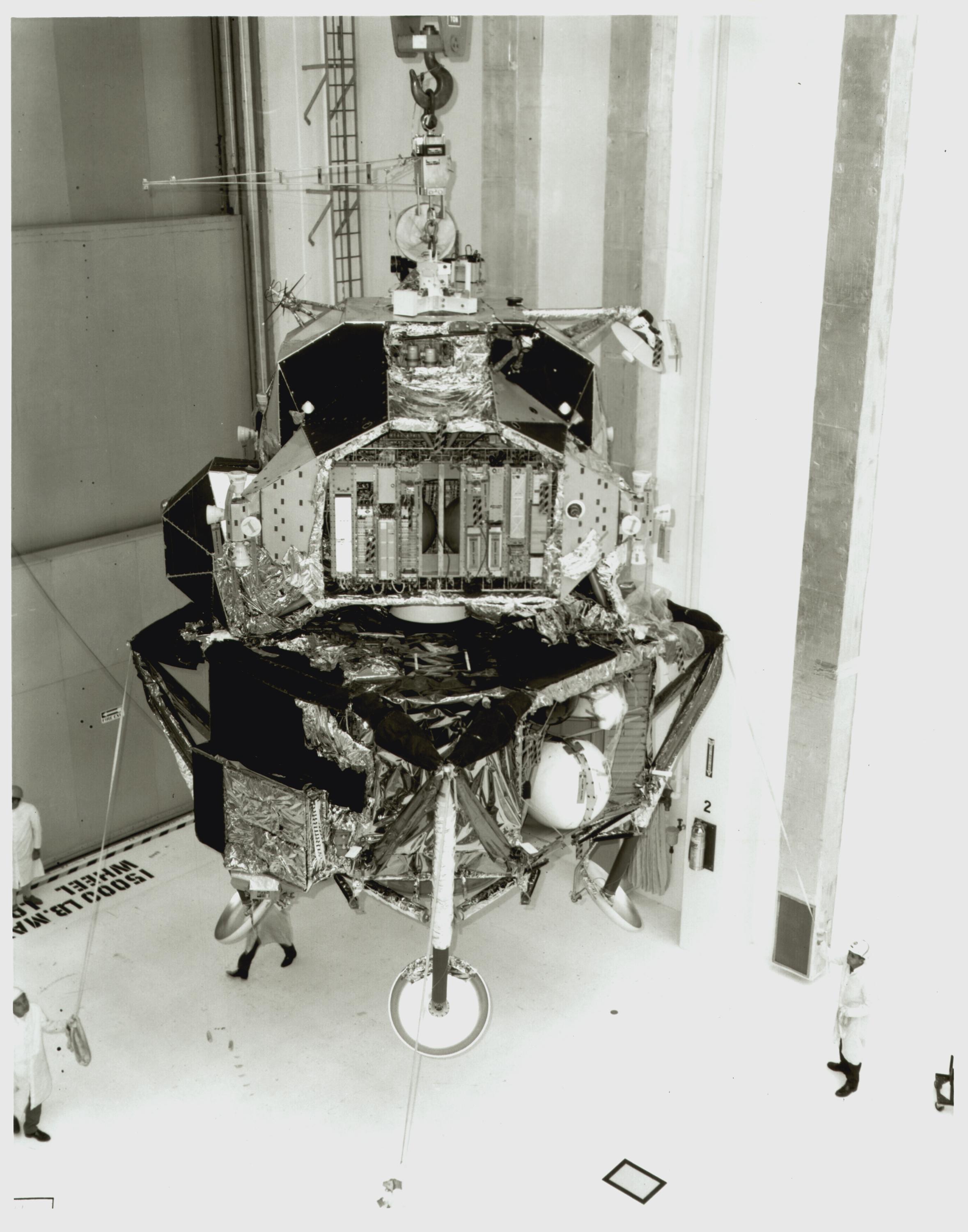
Apollo 11’s lunar module during assembly before flight.
NASA / Kennedy Space Center (624073main_1969-04-04_full) · NASA media-use guidelines · Original recordThe words
Apollo Five
Apollo 5 tested the lunar module without astronauts in Earth orbit on January 22, 1968. The flight exercised both engines before crews were allowed aboard.
Did you know?
LM-1 carried no landing legs. Since the test craft would stay in space and never land, leaving them off saved weight.
Ascent Engine
The ascent engine lifted the crew cabin from the Moon. It returned the astronauts to lunar orbit, where they would meet the waiting command module.
Bethpage
Bethpage, New York, was home to Grumman’s lunar-module team. Kelly’s nameplate recollection, quoted in print, linked the descent stages left on the Moon to the people who built them.
Descent Stage
The descent stage carried the landing engine, legs and surface experiments beneath the crew cabin. It stayed on the Moon when the ascent stage lifted off.
Smithsonian: lunar-module structure (opens a new tab) · Cradle of Aviation: Kelly’s recollection (opens a new tab)
Drop Test
Engineers dropped models to study whether the lunar module would remain stable at touchdown. These tests helped them design legs for uneven ground and uncertain lunar soil.
p. 152 (PDF p. 170) · NASA: designing the lunar module (opens a new tab)
Eight Ball
The eight ball showed the lander’s orientation, giving the pilots an attitude reference. Astronauts pressed to keep the instrument in the cockpit during the design debate.
pp. 148–149 (PDF pp. 166–167) · NASA: designing the lunar module (opens a new tab)
Fire in the Hole
Apollo 5 tested starting the ascent engine while the two stages were still together. This checked a way to separate the crew cabin during an aborted landing.
Footpads
Broad pads at the ends of the lunar module’s legs supported it on the surface. Their width helped spread the lander’s weight across the soil.
p. 103 (PDF p. 107) · NASA: Apollo 11 lander and landing gear (opens a new tab)
Forward Hatch
The forward hatch opened onto a small porch and a ladder down a landing leg. It was the astronauts’ doorway between the cabin and the lunar surface.
Did you know?
Early designs used a round hatch. Tests with astronauts in pressurized suits and backpacks led engineers to make the opening rectangular.
p. 151 (PDF p. 169) · NASA: designing the lunar module (opens a new tab)
Gold Foil
Gold-colored blankets helped insulate the lunar module’s equipment. They included metallized plastic films such as Mylar and Kapton, part of the lander’s thermal protection.
Smithsonian: lunar-module structure (opens a new tab) · NASA: Apollo 11 lander and landing gear (opens a new tab)
Grumman
Grumman designed and built the lunar module. Its two-stage lander carried two astronauts between lunar orbit and the surface, while the command module remained above the Moon.
Smithsonian: lunar-module structure (opens a new tab) · NASA: Apollo 5’s uncrewed test (opens a new tab)
Joe Gavin
Joseph G. Gavin Jr. directed Grumman’s lunar-module program. He later recalled working closely with engine suppliers and electronics contractors while keeping the whole project moving.
Landing Gear
Four folding legs supported the lunar module at touchdown. Crushable aluminum honeycomb inside the main struts absorbed compression loads, helping soften the impact of landing.
NASA: designing the lunar module (opens a new tab) · NASA: Apollo 11 lander and landing gear (opens a new tab)
Peter Pan Rig
Cables in the Peter Pan rig supported much of an astronaut’s weight. Grumman used it to test ways of climbing out of the lander in simulated lunar gravity.
p. 151 (PDF p. 169) · NASA: designing the lunar module (opens a new tab)
Tom Kelly
Thomas J. Kelly led Grumman’s lunar-module engineering. In 1967, he moved into manufacturing, assembly and testing, taking responsibility for building the spacecraft he had helped design.
PDF pp. 45–46 · NASA oral history: Tom Kelly (opens a new tab)
Sources
- Lunar Module LM-2Smithsonian National Air and Space Museum; object A19711598000; two-stage layout and blanket materials
- 55 Years Ago: The First Test Flight of the Apollo Lunar ModuleJohn Uri; NASA Johnson Space Center; January 23, 2023; Apollo 5 and abort-staging test
- Chariots for Apollo: A History of Manned Lunar SpacecraftCourtney G. Brooks, James M. Grimwood and Loyd S. Swenson Jr.; NASA SP-4205, 1979; pp. 148–152 (PDF pp. 166–170)
- Apollo 11 Lunar Landing Mission: Press KitNASA Release 69-83K, July 6, 1969; pp. 101 and 103 (PDF pp. 105 and 107), thermal protection and landing gear
- Thomas J. Kelly Oral History Transcript, September 19, 2000NASA Johnson Space Center Oral History Project; Kevin M. Rusnak interview; pp. 12-45–12-46 (PDF pp. 45–46)
- Joseph G. Gavin Jr. Oral History Transcript, January 10, 2003NASA Johnson Space Center Oral History Project; Rebecca Wright interview; pp. 8–9
- Lunar ModuleCradle of Aviation Museum; Kelly’s nameplate recollection and Grumman team history