
The Space Race
Puzzle 43 · Building Apollo · Page 65 in print
The Command Module
Apollo’s 1963 command and service module contract was the largest U.S. research deal yet.
Jump to a word
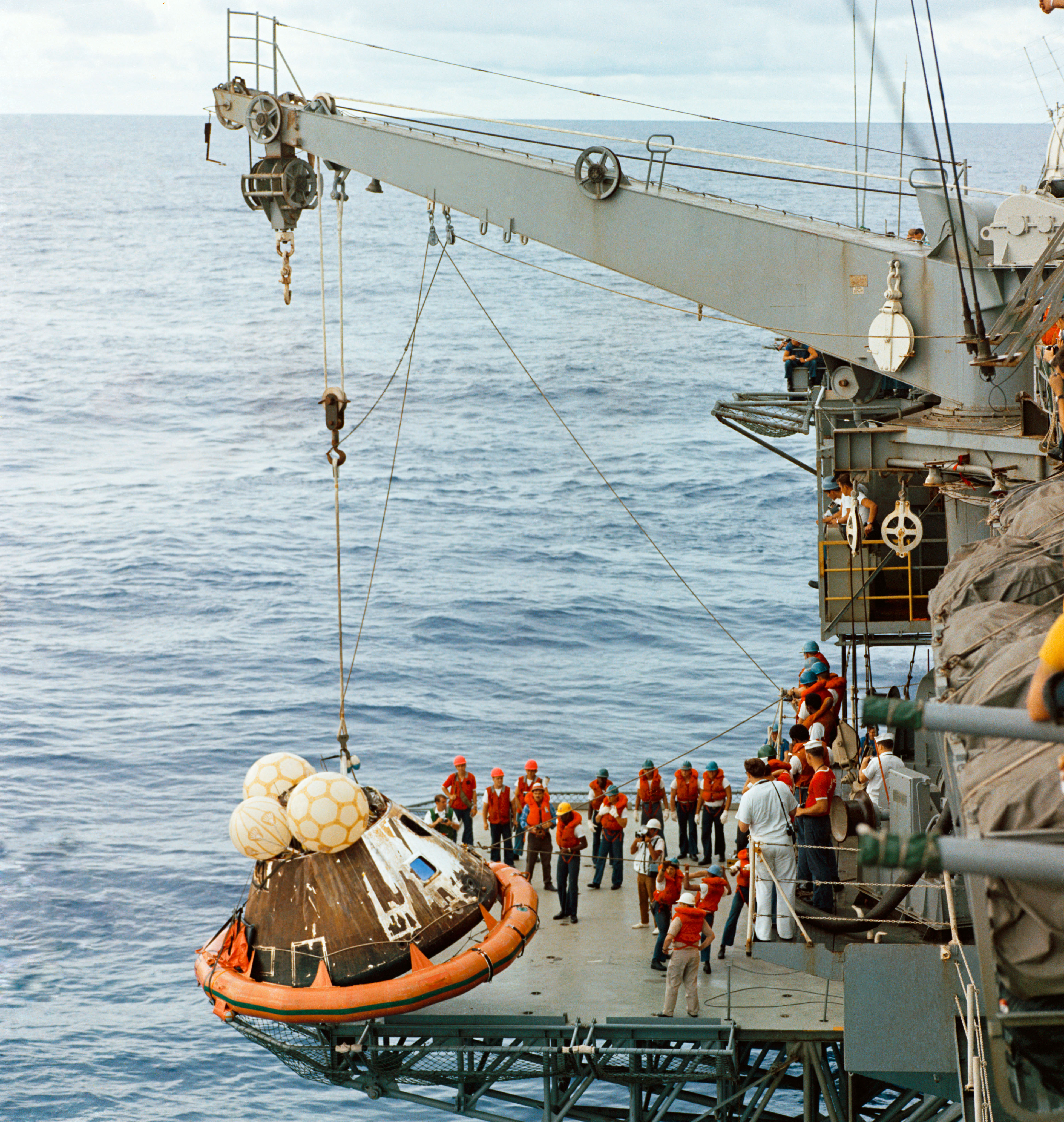
Apollo 13’s command module is lifted aboard USS Iwo Jima after recovery.
NASA / Johnson Space Center (S70-15530) · NASA media-use guidelines · Original recordThe words
Apex Cover
The apex cover was the forward heat shield over the command module’s parachute compartment. It was discarded during descent so the landing parachutes could deploy.
NASA news reference: the command module (opens a new tab) · NASA: Apollo’s apex cover and landing (opens a new tab)
Avcoat
Avcoat was the material packed into Apollo’s heat-shield cells. It absorbed reentry heat while being consumed, helping protect the crew compartment inside the command module.
NASA: Apollo heat-shield construction (opens a new tab) · Smithsonian: Apollo heat-shield fragment (opens a new tab)
Block II
Block II included equipment for docking with the lunar module. After the Apollo 1 ground-test fire killed three astronauts, NASA made further changes before crews flew this version.
Blunt Body
Apollo entered the atmosphere broad end first. Its blunt shape pushed the shock wave away from the capsule, keeping much of the heated air from reaching its surface.
Boilerplate
Boilerplate command modules were engineering test capsules. Dropping them from aircraft let engineers examine the parachute landing system before astronauts relied on it during a return from space.
Did you know?
The first parachute drop of an Apollo boilerplate from a modified Air Force C-133 took place on May 3, 1963.
Caulking Gun
Workers used a tool like a caulking gun to put heat-protective material into Apollo’s honeycomb cells. Each cell was filled by hand, making construction laborious.
p. 72 (PDF p. 85) · NASA: Apollo heat-shield construction (opens a new tab)
Docking Tunnel
A short passage led from the command module’s cabin to the docking hatch in its nose. After docking, astronauts could move through it to the lunar module.
Downey
Downey, California, was home to North American Aviation’s Apollo spacecraft plant. The company built the command and service modules there for NASA’s lunar program.
NASA: building Apollo’s command module (opens a new tab) · NASA: qualifying Apollo’s parachutes (opens a new tab)
El Centro
Northrop Ventura dropped test capsules at El Centro, California, to qualify Apollo’s landing system. The trials included conditions in which only some parachutes opened.
Equipment Bay
Equipment bays lined the command module’s cabin walls. The lower bay served as the navigation station, while other bays held life-support equipment, clothing, food and medical supplies.
p. 48 (PDF p. 10) · NASA news reference: the command module (opens a new tab)
Faget
Maxime Faget helped shape the Apollo command module after his work on Mercury’s capsule. From 1962, he led engineering and development at NASA’s Manned Spacecraft Center in Houston.
Fiberglass
Fiberglass formed the honeycomb that held resin in Apollo’s outer heat shield. This layer was designed to wear away during reentry, protecting the crew compartment from heat.
Did you know?
The Smithsonian’s fragment came from command module 011, flown on the uncrewed AS-202 test in 1966. The shield was cut into smaller museum pieces in 1972.
Honeycomb
Apollo’s inner shell sandwiched aluminum honeycomb between metal sheets. Fiberglass honeycomb served a different purpose outside, holding the material that protected the capsule during reentry.
NASA news reference: the command module (opens a new tab) · Smithsonian: Apollo heat-shield fragment (opens a new tab)
Main Parachute
Three main parachutes were stored near the command module’s nose. They opened during the final descent to slow the capsule for its landing in the ocean.
NASA: Apollo 11 command module (opens a new tab) · NASA: Apollo’s apex cover and landing (opens a new tab)
Storms
Harrison A. Storms led North American Aviation’s Space and Information Systems Division. The division in Downey was responsible for building Apollo’s command and service modules.
Sources
- Apollo 11 Command and Service Module (CSM)NASA Space Science Data Coordinated Archive; Command Module section
- Heat Shield, Fragment, Ablated, ApolloSmithsonian National Air and Space Museum; object A19731423008
- 60 Years Ago: NASA Signs Contract for Apollo Command and Service ModulesJohn Uri; NASA Johnson Space Center; August 14, 2023; contractor, Downey plant and Harrison Storms
- Maxime A. FagetNASA Langley Research Center; August 10, 2015; command-module design and engineering leadership
- Coming Home: Reentry and Recovery from SpaceRoger D. Launius and Dennis R. Jenkins; NASA SP-2011-593, 2012; p. 72 (PDF p. 85)
- Command Module OverviewNASA Apollo Command Module News Reference, pp. 39–52; Apollo Lunar Surface Journal archive; structure p. 41 and equipment bays p. 48
- Final Parachute Test Qualifies Apollo Landing SystemJohn Uri; NASA Johnson Space Center; July 2, 2018; El Centro drop tests and boilerplate capsules
- 55 Years Ago: The Apollo 1 Fire and its AftermathJohn Uri; NASA Johnson Space Center; February 3, 2022; Block I, Block II and post-fire changes
- Ames Contributions to ApolloNASA Ames Research Center; blunt-body reentry research and capsule shape
- Apollo 16 Splashes DownJohn Uri; NASA Johnson Space Center; April 29, 2022; apex cover and parachute deployment