
The Space Race
Puzzle 42 · Building Apollo · Page 64 in print
Lunar Orbit Rendezvous
Garrick, Houbolt’s boss, said Houbolt “single-handedly saved the government $20 billion.”
Jump to a word
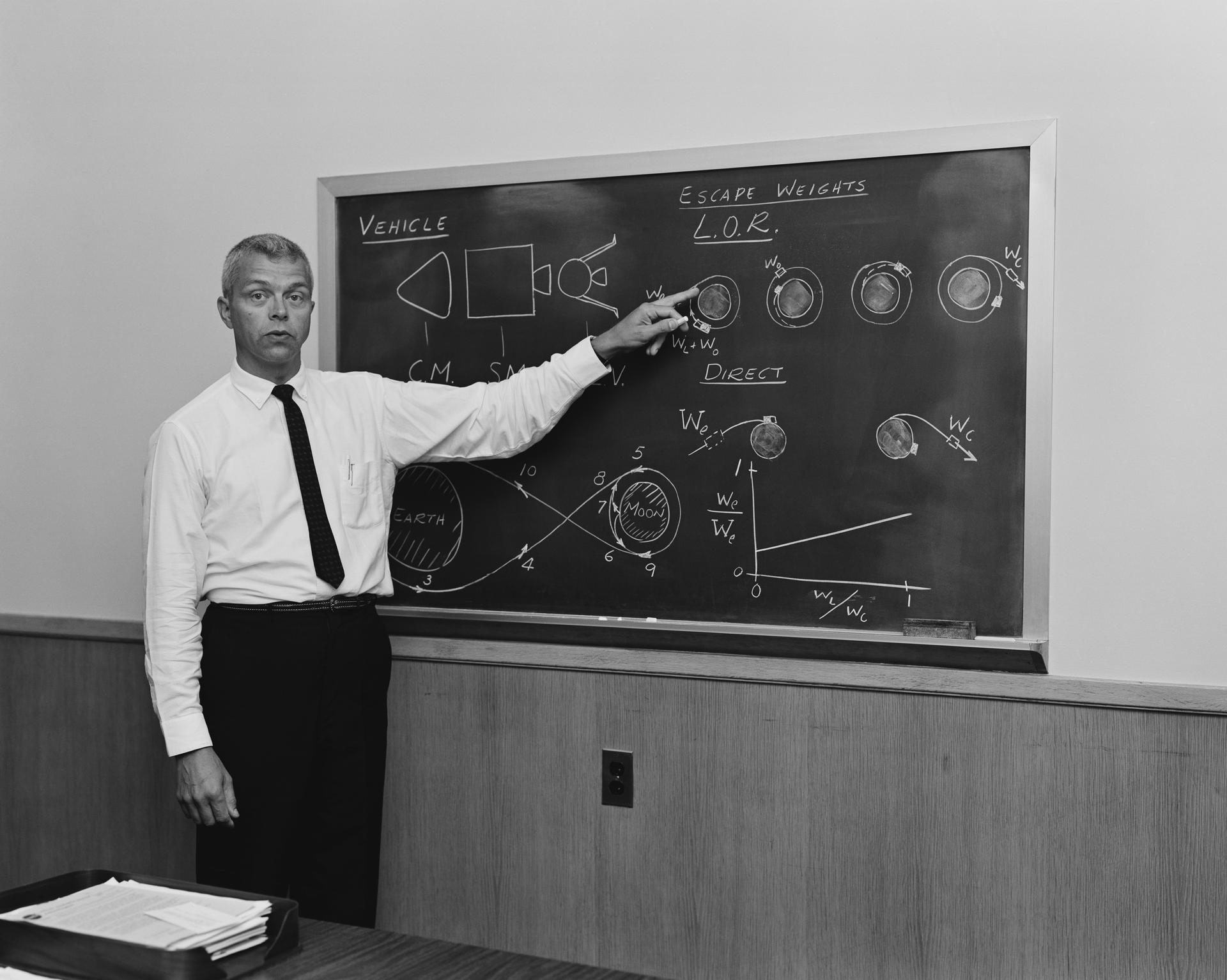
John Houbolt explains lunar-orbit rendezvous at a blackboard.
NASA / Langley Research Center (LRC-1962-B701_P-05849) · NASA media-use guidelines · Original recordThe words
Bill Michael
William H. “Bill” Michael Jr. studied parking-orbit ideas at Langley. He shared them with Clint Brown’s group as it considered how to send people to the Moon.
NASA Langley: Houbolt, Michael and Garrick (opens a new tab)
Dark Horse
Lunar-orbit rendezvous began as an outsider in the mission debate. It gained support because of the smaller landing craft, and NASA announced its selection on July 11, 1962.
Direct Ascent
Direct ascent would land the Earth-return spacecraft itself on the Moon. Its greater landing mass called for a giant launcher, with Nova studied for that role.
Garrick
Houbolt’s supervisor Ed Garrick congratulated him when NASA selected lunar-orbit rendezvous. The printed $20 billion savings figure records Garrick’s assessment of Houbolt’s contribution.
NASA Langley: Houbolt, Michael and Garrick (opens a new tab)
Hampton
NASA’s Langley Research Center in Hampton, Virginia, was a base for lunar-orbit rendezvous studies. Its researchers examined the weight savings and practical problems of a lunar rendezvous.
Holmes
D. Brainerd Holmes led NASA’s Office of Manned Space Flight. After receiving Houbolt’s arguments from Seamans, he involved Joe Shea in evaluating how Apollo should reach the Moon.
PDF p. 35 · NASA LOR history: origins and managers (opens a new tab)
Houbolt
John Houbolt persistently argued for lunar-orbit rendezvous within NASA. Several researchers had developed related ideas; his distinctive role was pushing the agency to examine this approach.
Did you know?
In 1963, NASA honored Houbolt with its Exceptional Scientific Achievement Medal for his analysis and advocacy of lunar-orbit rendezvous.
NASA Langley: Houbolt, Michael and Garrick (opens a new tab)
Jerome Wiesner
Jerome Wiesner was Kennedy’s science adviser. He remained opposed to lunar-orbit rendezvous when NASA announced its selection in July 1962, despite growing agreement within the agency.
PDF p. 40 · NASA LOR history: origins and managers (opens a new tab)
Joe Shea
Joseph F. “Joe” Shea became Holmes’s deputy for spaceflight systems in January 1962. He helped compare the proposed routes to the Moon and build support for a decision.
PDF p. 35 · NASA LOR history: origins and managers (opens a new tab)
Kondratyuk
Yuri Kondratyuk had expressed early ideas about lunar-orbit rendezvous before Apollo. Langley researchers later said they had not known his work when forming their own proposals.
PDF pp. 10–11 · NASA LOR history: origins and managers (opens a new tab)
Lunar Lander
Lunar-orbit rendezvous used a small, separate craft to descend to the Moon and return to orbit. It left the heavier Earth-return vehicle above the surface.
Mother Ship
The Command and Service Modules remained above the Moon while the smaller lander went down. They carried the equipment needed for the astronauts’ journey back to Earth.
Did you know?
Choosing lunar-orbit rendezvous required a docking system and an internal crew-transfer tunnel in the Command Module. NASA also needed a separate landing vehicle.
Parking Orbit
An orbit used as a temporary holding path.
Michael’s calculations explored leaving Earth-return equipment circling the Moon. Keeping that mass above the surface reduced what the landing portion would need to carry.
PDF p. 10 · NASA LOR history: origins and managers (opens a new tab)
Seamans
Robert C. Seamans Jr., NASA’s Associate Administrator, received Houbolt’s 1961 appeal. He helped get the competing mission plans reviewed before the 1962 decision.
NASA: choosing the lunar mission plan (opens a new tab) · NASA: Dryden and Seamans’s leadership roles (opens a new tab)
Tanker
A spacecraft sent up to supply propellant to another vehicle.
A competing Earth-orbit rendezvous plan would launch a tanker separately from the crewed Moon vehicle. The vehicles would meet near Earth before the lunar journey.
June 7 briefing, p. 5 (PDF p. 82) · NASA: von Braun’s tanker alternative (opens a new tab)
Sources
- John C. HouboltNASA Langley Research Center; August 10, 2015; Michael’s studies, Houbolt’s advocacy, Garrick’s statement and 1963 medal
- 60 years ago: NASA Decides on Lunar Orbit Rendezvous for Moon LandingJohn Uri; NASA Johnson Space Center; July 11, 2022; comparison of mission modes, Langley location, selection and management review
- 60 Years Ago: NASA Signs Contract for Apollo Command and Service ModulesJohn Uri; NASA Johnson Space Center; August 14, 2023; LOR-related redesign, orbital CSM and separate lunar module
- Enchanted Rendezvous: John C. Houbolt and the Genesis of the Lunar-Orbit Rendezvous ConceptJames R. Hansen; NASA Monographs in Aerospace History No. 4; version revised January 25, 1999; PDF pp. 10–11, 35 and 40
- Project Apollo: Administrative Personnel BiographiesNASA History Office, Apollo 11 historical archive; Hugh Dryden and Robert C. Seamans biographies
- Apollo: A Retrospective AnalysisRoger D. Launius; NASA Monographs in Aerospace History No. 3, SP-2004-4503, reprinted July 2004; reproduced June 7, 1962 von Braun mode-selection briefing, p. 5 of 11, PDF p. 82