
The Space Race
Puzzle 41 · Building Apollo · Page 63 in print
Kennedy's Moon Challenge
Cheers for Kennedy’s penciled-in “Why does Rice play Texas?” nearly drowned his next line.
Jump to a word
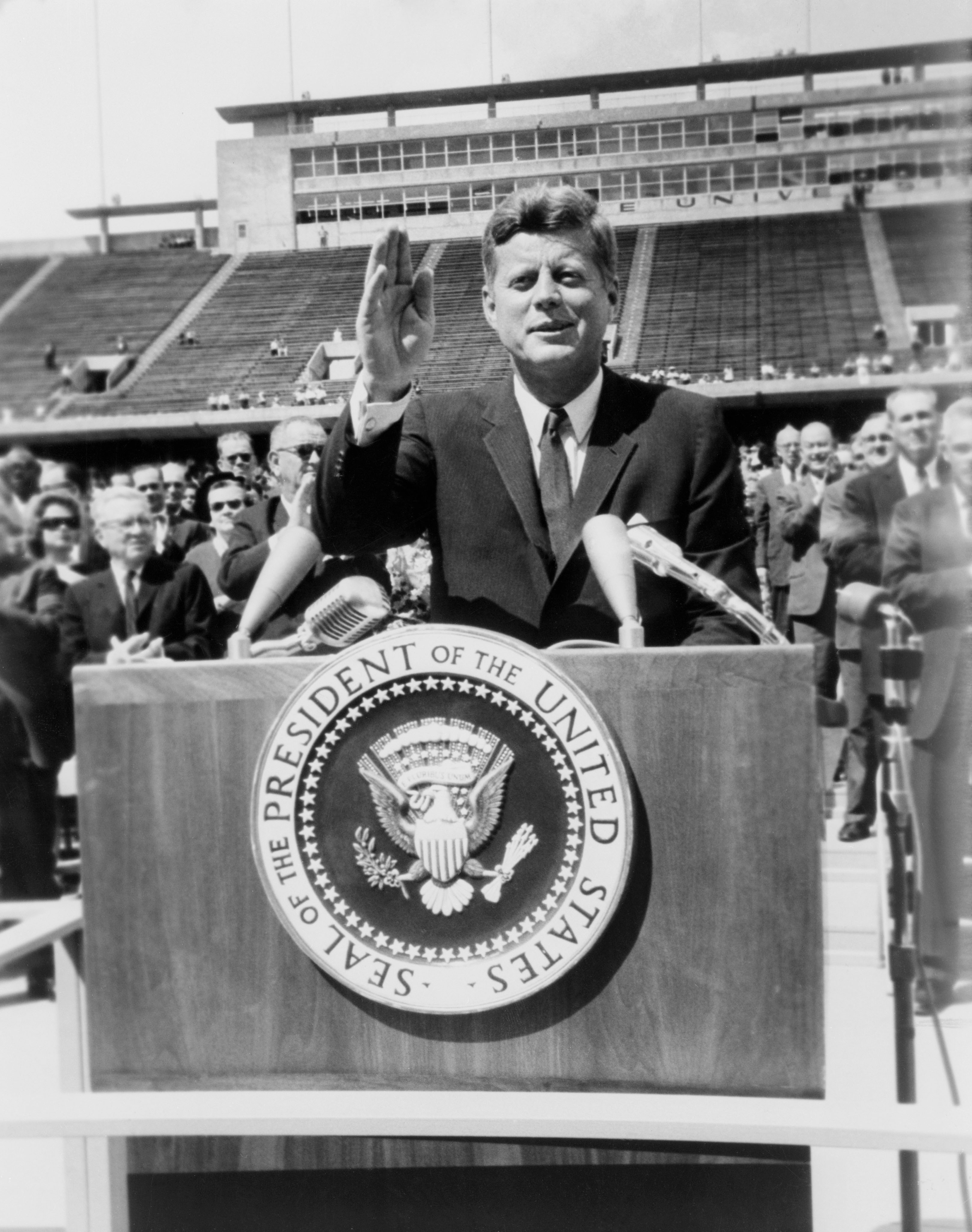
President John F. Kennedy speaks at Rice Stadium about the Moon program.
NASA / Johnson Space Center (s67-19620) · NASA media-use guidelines · Original recordThe words
Bay of Pigs
In April 1961, U.S.-backed Cuban exiles failed to overthrow Fidel Castro. Attackers were killed or imprisoned; the invasion became part of the political backdrop to Kennedy’s space decision.
Kennedy Library: Bay of Pigs, p. 8 (opens a new tab) · NASA: Moon decision and Johnson memorandum (opens a new tab)
Congress
On May 25, 1961, Kennedy asked a joint session of Congress to support a lunar landing before the decade ended. He also requested the funding needed to pursue it.
James Webb
NASA Administrator James Webb helped shape the lunar commitment. He urged an end-of-decade deadline, giving NASA more time than an earlier 1967 target.
Did you know?
The broader plan included robotic probes and communications and weather satellites. Webb wanted scientific results alongside the Moon program’s political prestige.
p. 5 · NASA: Moon decision and Johnson memorandum (opens a new tab)
Kennedy
President John F. Kennedy made a lunar landing a national goal in May 1961. His speech asked for sustained funding and a major scientific and technical effort.
Mallory
At Rice, Kennedy invoked mountaineer George Mallory’s reported reason for climbing Everest: “Because it is there.” He used the story to introduce space as a further challenge.
Man on the Moon
The goal Kennedy presented in May 1961 included both a lunar landing and a safe return to Earth before the end of the decade.
McNamara
Robert McNamara was Kennedy’s secretary of defense. In April 1961, Kennedy directed him to help Johnson assess possible space achievements before the public Moon landing commitment.
NASA: McNamara at a space briefing (opens a new tab) · NASA: Moon decision and Johnson memorandum (opens a new tab)
Memorandum
Kennedy’s April 20, 1961, memo asked Johnson which space project might give the United States a lead. Its questions covered possible Moon missions, costs and accelerating existing work.
April 20 memorandum, PDF p. 36 · NASA: Moon decision and Johnson memorandum (opens a new tab)
Moonshot
Kennedy’s lunar goal required a national effort in science, engineering, industry and government. His May 1961 speech stressed the resources and sustained commitment it would demand.
Mount Everest
Mount Everest supplied a comparison for Kennedy’s Moon challenge. At Rice, he linked climbing a mountain with choosing difficult work that could extend human knowledge.
New Frontier
In his July 15, 1960, nomination acceptance speech, Kennedy used New Frontier to describe national challenges. He included science and space, peace, poverty and prejudice.
Project Apollo
Apollo was the program used to carry out Kennedy’s lunar goal. Its first crewed Moon landing, Apollo 11, took place on July 20, 1969.
Rice Stadium
Kennedy spoke at Rice Stadium in Houston on September 12, 1962. The address publicly renewed the Moon commitment he had announced to Congress the previous year.
Did you know?
Rice’s fall classes had not yet begun. First-year students who had arrived for orientation joined the audience, along with school children bused in from around Houston.
Sorensen
Ted Sorensen, a White House aide, prepared the typed draft of the Rice address. Kennedy added his football question about Rice and Texas by hand.
Space Council
Vice President Lyndon Johnson chaired the National Aeronautics and Space Council. Kennedy asked him to review possible space goals in April 1961, before announcing the lunar commitment.
NASA: Moon decision and Johnson memorandum (opens a new tab)
Sources
- The Decision to Go to the Moon: President John F. Kennedy’s May 25, 1961 Speech before a Joint Session of CongressNASA History Office; September 22, 1998; decision history and Section IX: Space of the May 25, 1961 address
- 60 Years Ago: President Kennedy Reaffirms Moon Landing Goal in Rice University SpeechJohn Uri; NASA Johnson Space Center; September 7, 2022; stadium setting, speech comparisons and audience
- Apollo: A Retrospective AnalysisRoger D. Launius; NASA Monographs in Aerospace History No. 3, SP-2004-4503, reprinted July 2004; printed pp. 3–5 and original April 20 memorandum on PDF p. 36
- JFK’s 1962 moon speech still appeals 50 years laterRice University, News and Media Relations; August 30, 2012; Sorensen’s typed draft and Kennedy’s handwritten insertion
- The Bay of Pigs: Lessons LearnedJohn F. Kennedy Presidential Library and Museum; New Frontiers, Issue 23, Fall 2017; printed p. 8, background paragraph
- Address Accepting the Democratic Nomination for President at the Memorial Coliseum in Los Angeles, CaliforniaJohn F. Kennedy, July 15, 1960; The American Presidency Project, University of California, Santa Barbara; speech transcript
- John F. Kennedy and the Race to the MoonNASA; May 24, 2019; 1962 Blockhouse 34 briefing photograph caption identifying Defense Secretary Robert McNamara