
The Space Race
Puzzle 40 · Project Gemini · Page 60 in print
Gemini 12
Yellow foot restraints nicknamed “golden slippers” held Aldrin steady as he worked.
Jump to a word
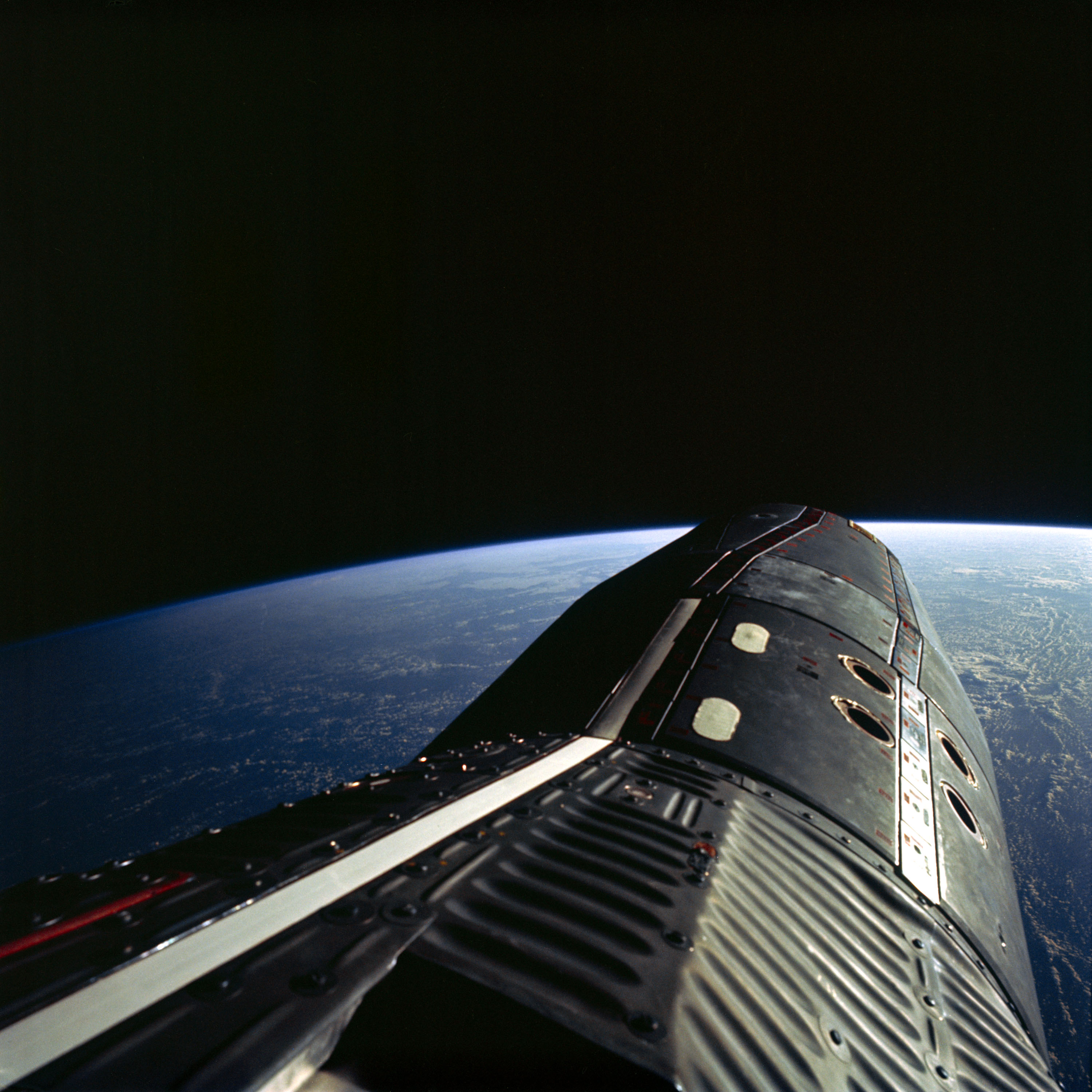
A view along Gemini 12, photographed by Edwin Aldrin during a stand-up spacewalk.
NASA / Johnson Space Center (S66-63011) · NASA media-use guidelines · Original recordThe words
Aldrin
Buzz Aldrin was Gemini 12’s pilot. His three excursions included two standup sessions and a full spacewalk to evaluate working methods and body restraints.
Backup Charts
After the radar readings became unreliable, Aldrin checked his sextant observations against backup rendezvous charts. These paper aids helped him calculate corrections for the spacecraft’s computer.
NASA Gemini history: charts and restraints (opens a new tab)
Busy Box
An astronaut’s work station for testing manual tasks.
At the busy box, Aldrin tightened bolts and cut metal while his restraints held him steady. These tasks tested practical work outside a spacecraft.
Did you know?
When a bolt and washer floated free, Aldrin caught them in a corner, one in each hand. He compared the little chase to a rendezvous.
NASA Gemini history: charts and restraints (opens a new tab)
Gemini Twelve
Lovell and Aldrin flew the final crewed Gemini mission from November 11 to 15, 1966. It brought together docking, spacewalking and an automatically controlled reentry.
Golden Slipper
Overshoe-style foot restraints held Aldrin steady at Gemini 12’s rear work station. He could relax his body while using his hands for the assigned tasks.
NASA Gemini history: charts and restraints (opens a new tab)
Handholds
Additional external grips gave Aldrin places to steady himself while moving around the spacecraft. They were part of the equipment changes made after earlier spacewalkers struggled.
Handrails
During his first standup spacewalk, Aldrin installed a handrail leading from the Gemini hatch toward the Agena. It provided a route for the following day’s work.
Jim Lovell
Jim Lovell commanded Gemini 12 after his long-duration flight aboard Gemini 7. He worked inside the capsule while Aldrin tested equipment and working methods outside.
Did you know?
Lovell later flew on Apollo 8, the first crewed mission to orbit the Moon, in 1968. He commanded Apollo 13 in 1970.
Radar Failure
When Gemini 12’s radar readings became unreliable, the crew changed to backup navigation methods. Visual sightings and calculations helped them reach the Agena; the computer remained in use.
NASA Gemini history: charts and restraints (opens a new tab)
Rest Periods
Gemini 12’s spacewalk plan included two-minute rest periods for Aldrin. These planned pauses helped keep his workload manageable while he performed tasks outside the spacecraft.
Slide Rule
A mechanical calculating tool with sliding numbered scales.
Aldrin’s slide rule was one of the calculation aids used after the radar problem. Sextant observations, charts and the spacecraft computer also supported the rendezvous.
NASA: Gemini 12 crew and work methods (opens a new tab) · NASA mathematics: how a slide rule works (opens a new tab)
Solar Eclipse
Gemini 12’s crew photographed the total solar eclipse of November 12, 1966, through the spacecraft windows. Their orbit was adjusted to bring them into the eclipse’s path.
Swimming Pool
Before Gemini 12, Aldrin practiced spacewalk tasks with a spacecraft mockup in a Maryland swimming pool. Underwater sessions gave him time to rehearse movements and the use of restraints.
Torque Wrench
At an Agena work station, Aldrin tested an Apollo-designed torque wrench. He tried it with and without waist tethers to compare working conditions.
NASA EVA chronology: tethers and tool test (opens a new tab)
Waist Tether
Aldrin used waist tethers to hold his body beside the Agena work station. They freed both hands for testing tools and connections instead of maintaining position.
NASA EVA chronology: tethers and tool test (opens a new tab)
Sources
- Gemini XIINASA; mission summary, dates and Mission Overview, EVA schedule and eclipse photography
- On the Shoulders of Titans: A History of Project GeminiBarton C. Hacker and James M. Grimwood; NASA SP-4203, 1977; printed pp. 375–378
- Gemini XII Crew Masters the Challenges of SpacewalksBob Granath; NASA Kennedy Space Center; November 14, 2016; Lovell, navigation aids, handholds, handrail and pool training
- Walking to Olympus: An EVA ChronologyDavid S. F. Portree and Robert C. Treviño; NASA Monographs in Aerospace History No. 7, October 1997; printed p. 9, Gemini 12 November 13 EVA
- Deriving Approximate LogarithmsNASA Goddard Space Flight Center; From Stargazers to Starships mathematics page M-16, archived reference edited October 29, 2016; slide-rule section