
The Space Race
Puzzle 39 · Project Gemini · Page 59 in print
Gemini 10 and 11
From a record 850 miles up, Gemini 11’s Pete Conrad said, “the world is round.”
Jump to a word
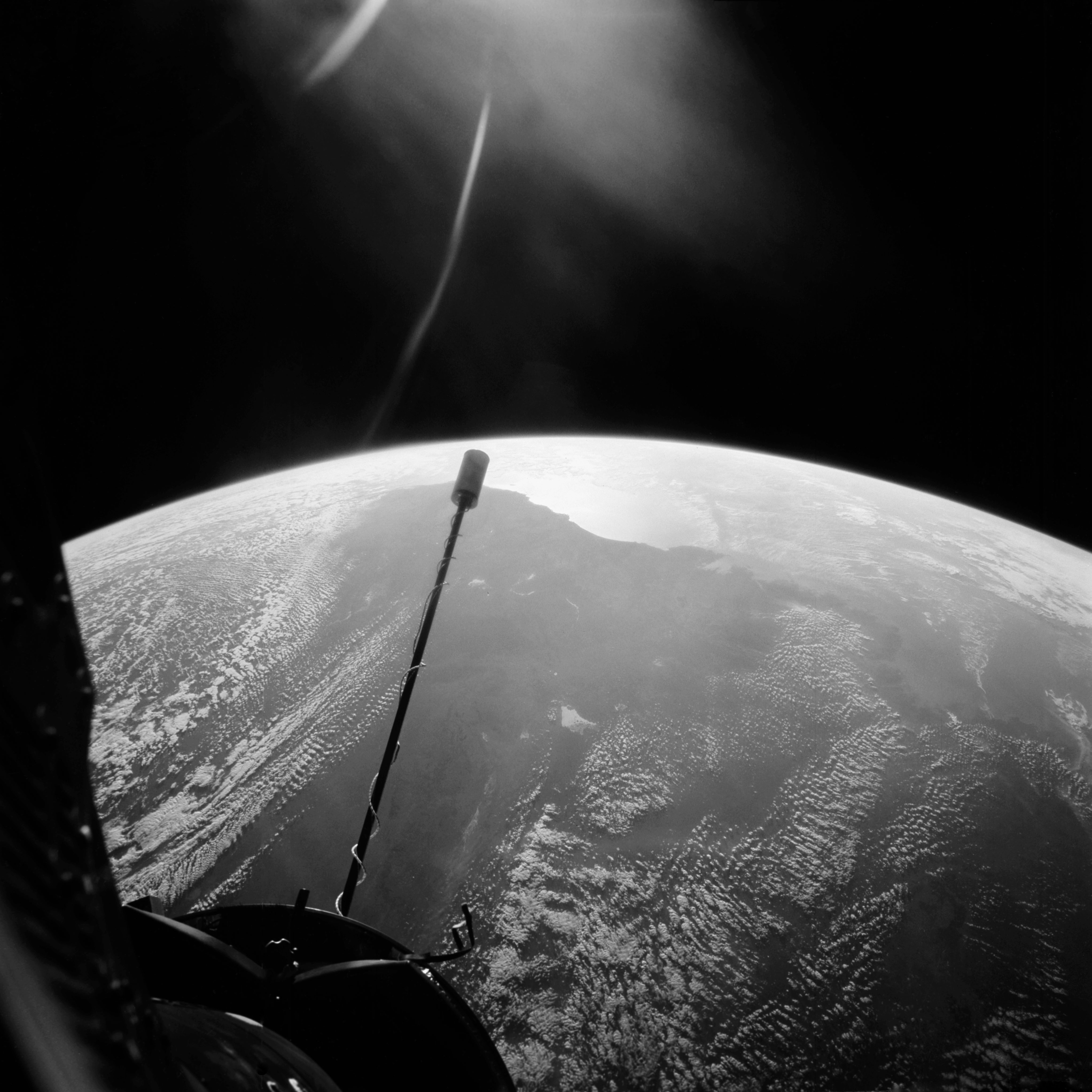
Earth viewed from Gemini 11 on September 14, 1966.
NASA / Johnson Space Center (s66-54643) · NASA media-use guidelines · Original recordThe words
Agena
For Gemini 10 and 11, an Agena provided both a docking target and an engine. Once joined, the spacecraft used Agena propulsion to change their orbits.
NASA: Gemini 11’s Agena and high orbit (opens a new tab) · NASA: Gemini 10’s targets and photography (opens a new tab)
Collector
Collins retrieved a micrometeorite collector from Gemini 8’s old Agena during Gemini 10. Its surfaces recorded impacts from tiny space particles and collected debris for study.
NASA: Gemini 10’s targets and photography (opens a new tab) · NASA experiment S010: particle impacts (opens a new tab)
Dick Gordon
Richard Gordon was Gemini 11’s pilot. He worked outside the spacecraft on one excursion and took photographs from the open hatch on another.
Did you know?
Conrad and Gordon flew together again on Apollo 12. Conrad commanded the mission, while Gordon served as its command module pilot.
Eye Irritation
During Collins’s standup spacewalk on Gemini 10, both he and Young developed eye irritation. Young called for an early end to the photography session.
First Orbit
Gemini 11 reached its Agena 85 minutes after launch and docked nine minutes later. The first-orbit meeting tested an approach planned for Apollo’s lunar missions.
Gemini Eleven
Pete Conrad and Richard Gordon flew Gemini 11 in September 1966. They practiced docking and undocking and completed a computer-guided reentry at the end of the mission.
Did you know?
With Gemini 11 and the Agena tethered together, slow rotation produced a tiny artificial-gravity effect. It was too weak for the crew to feel, but a camera drifted toward the cabin’s rear.
Gemini Ten
John Young and Michael Collins flew Gemini 10 from July 18 to 21, 1966. The mission combined docking, a second rendezvous and two different kinds of spacewalk.
Guadalcanal
USS Guadalcanal recovered Young and Collins after Gemini 10’s Atlantic splashdown on July 21, 1966. A helicopter carried them from the ocean to the ship’s deck.
High Altitude
Gemini 11 used the Agena’s engine to raise its orbital high point to about 850 miles. After two orbits, the crew used the Agena again to return to a lower orbit.
Launch Window
The interval when a launch can meet its intended flight plan.
To reach its Agena during the first orbit, Gemini 11 had to launch within a two-second window. The launch team met that demanding timing requirement.
Mike Collins
Michael Collins’s two Gemini 10 spacewalks involved different work: photography from the open hatch, followed by an excursion to Gemini 8’s old Agena.
Milky Way
Collins stood in Gemini 10’s open hatch to photograph the southern Milky Way in ultraviolet light. He took 22 images as part of the mission’s astronomy work.
Passive Target
A target approached without active help from its own systems.
Gemini 8’s old Agena became Gemini 10’s second rendezvous target. The dormant vehicle remained in orbit while Young maneuvered the Gemini nearby and Collins worked outside.
Ride 'em Cowboy
Conrad used this remark while Gordon sat astride the docking area to attach a tether between Gemini 11 and the Agena during his spacewalk.
USS Guam
A helicopter from USS Guam collected Conrad and Gordon after Gemini 11’s Atlantic splashdown on September 15, 1966. It then carried them to the recovery ship.
Sources
- Demanding Gemini XI Mission Flies on Top of the WorldBob Granath; NASA Kennedy Space Center; September 1, 2016; Agena propulsion, high orbit, tether attachment and USS Guam
- Gemini X Set Records for Rendezvous, Altitude Above EarthBob Granath; NASA Kennedy Space Center; July 6, 2016; two target vehicles, collector, ultraviolet photography and Guadalcanal
- 55 Years Ago: Gemini XI Achieves One-Orbit Rendezvous, Record AltitudeJohn Uri; NASA Johnson Space Center; September 15, 2021; first-orbit rendezvous, launch timing, tether experiment and automatic reentry
- Gemini XNASA; mission dates, Collins biography and Mission Overview, both EVA sessions
- Gemini XINASA; crew biographies and Mission Overview, Gordon’s two excursions and Apollo 12
- Experiment S010: Agena micrometeorite collectionC. L. Hemenway; NASA, September 1, 1971; NTRS 19720003227, catalog abstract and metadata only