
The Space Race
Puzzle 49 · The Road to the Moon · Page 73 in print
Robot Scouts
Ranger 7’s crash area was renamed Mare Cognitum, Latin for “The Known Sea.”
Jump to a word
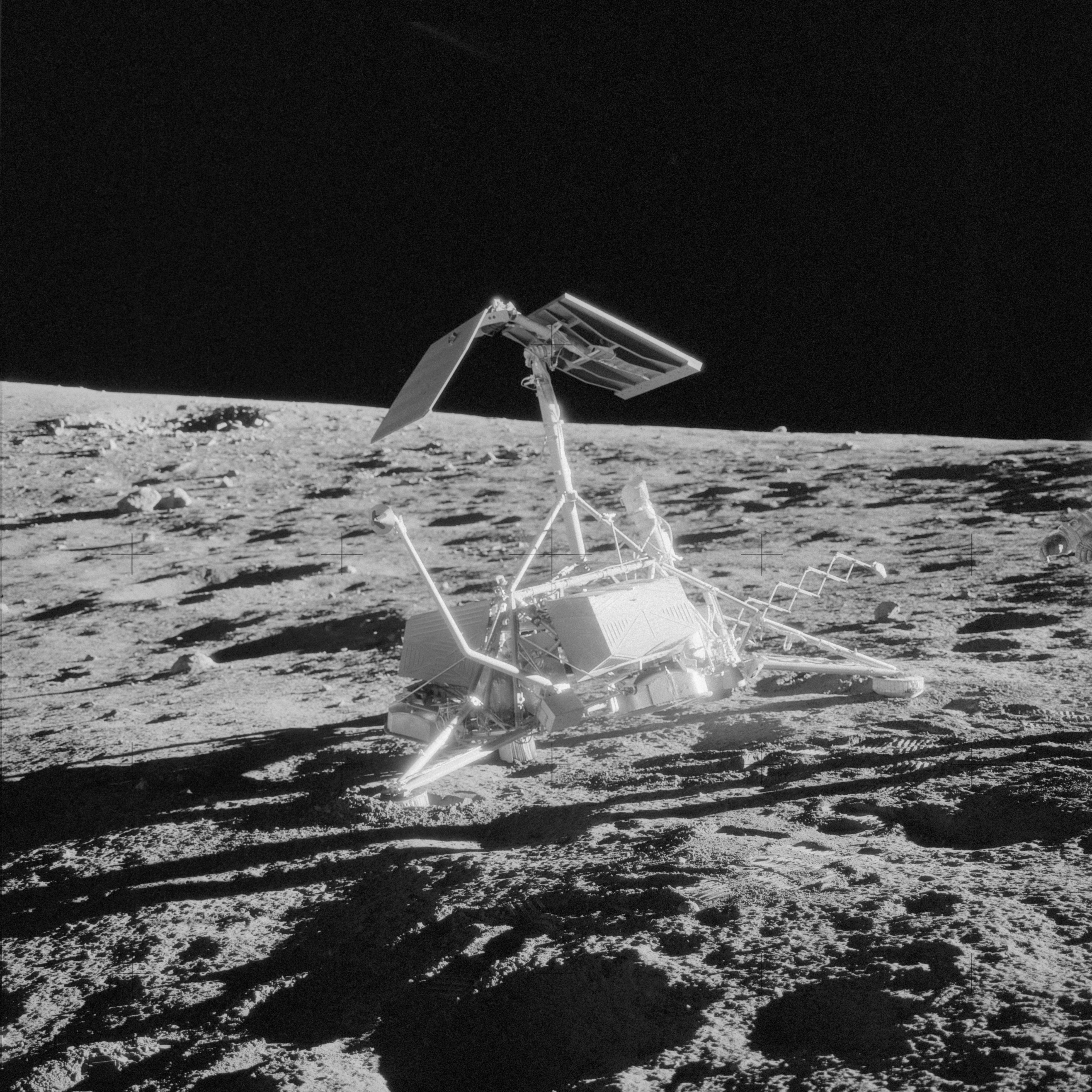
Surveyor 3 photographed on the Moon during Apollo 12.
NASA / Johnson Space Center (as12-48-7121) · NASA media-use guidelines · Original recordThe words
Alphonsus
Ranger 9 ended its flight inside Alphonsus, a lunar crater. Its approaching views were broadcast to television audiences on Earth, showing the surface in increasing detail before impact.
Copernicus
Lunar Orbiter 2’s 1966 view of Copernicus looked across the crater rather than straight down. This slanting perspective revealed the shape of the Moon’s rugged terrain.
Flamsteed
Surveyor 1 touched down inside Flamsteed P in the Ocean of Storms on June 2, 1966. Photographs of its footpad showed how the surface supported the landed spacecraft.
Gerard Kuiper
Gerard Kuiper, an astronomer at the University of Arizona, was Ranger’s principal investigator. He also worked on Surveyor and helped identify Apollo landing sites, linking lunar photography with landing preparation.
Kodak
Eastman Kodak supplied Lunar Orbiter’s photographic system. Film was exposed and developed aboard the spacecraft, then scanned so its images could be transmitted to Earth as radio signals.
Did you know?
Two lenses exposed the same roll of film at once, recording a detailed narrow view and a wider view of the surrounding terrain.
Landing Sites
The first three Lunar Orbiters examined possible Apollo landing areas from above. Surveyor’s close-up observations added ground-level evidence, helping planners judge places before sending astronauts.
NASA: the Lunar Orbiter program (opens a new tab) · NASA: Surveyor 1 lands on the Moon (opens a new tab)
Lunar Orbiter
Five Lunar Orbiters photographed the Moon during 1966 and 1967. The early missions surveyed possible Apollo landing sites; later spacecraft extended the mapping to much of the far side.
Mare Cognitum
After Ranger 7 returned its close-up pictures in July 1964, the impact region was named Mare Cognitum. The name commemorated a lunar landscape newly seen in detail.
Mascons
Lunar Orbiter tracking helped reveal irregularities in the Moon’s gravity. These concentrations of mass disturbed spacecraft paths and mattered when planning Apollo’s precise rendezvous and docking maneuvers.
Ranger
Ranger 7, 8 and 9 sent close-up television pictures as they descended toward the Moon. Each mission ended in impact, unlike the later Surveyors’ soft landings.
Scoop
Surveyors 3 and 7 carried a mechanical scoop that dug trenches in lunar soil. The tool let investigators examine the ground directly instead of relying only on photographs.
Soil Mechanics
Surveyor 7’s soil tests examined whether the ground could support weight. Its arm-mounted scoop dug trenches and carried out surface-bearing tests, extending the investigation below the photographed surface.
Surveyor
Surveyor landers sent photographs and surface information from the Moon before Apollo. Surveyor 1 made the first successful American soft landing there on June 2, 1966.
Did you know?
Surveyor 1’s camera used red, green and blue filters. Engineers on Earth combined pictures taken through them to reconstruct color views of the lunar surface.
Tycho
Surveyor 7 landed north of Tycho’s rim on January 10, 1968. Unlike the earlier Surveyors, it explored rougher terrain beyond the candidate sites for early Apollo landings.
Vidicon
A light-sensitive tube used in an early television camera.
Ranger 7’s Camera A used a vidicon to record the approaching Moon. Its final frame revealed small impact craters scattered across the lunar plain.
NASA: Ranger 7’s final Camera A image (opens a new tab) · NASA: how a vidicon worked (opens a new tab)
Sources
- 60 Years Ago: Ranger 7 Photographs the MoonJohn Uri; NASA Johnson Space Center; July 29, 2024; Ranger imaging, impact regions and Mare Cognitum
- Lunar Orbiter ProgramNASA Science; program overview, Copernicus image caption and photographic system
- 55 Years Ago: Surveyor 1 Makes A Soft Landing on the MoonJohn Uri; NASA Johnson Space Center; June 2, 2021; Flamsteed P landing, surface observations and color filters
- 60 Years Ago: NASA Approves the Lunar Orbiter ProgramJohn Uri; NASA Johnson Space Center; August 29, 2023; Kodak imaging system and gravity measurements
- Department Heads and DirectorsUniversity of Arizona, Lunar and Planetary Laboratory; Gerard P. Kuiper biography, Ranger and Surveyor roles
- Surveyor to the Moon (1966 - 1968)David R. Williams; NASA Goddard Space Flight Center, National Space Science Data Center; updated November 21, 2018; program objectives and surface samplers
- Surveyor 7NASA Science; In Depth, Tycho-region landing and soil-mechanics work; mission account based on Asif A. Siddiqi, Beyond Earth (2018)
- Earth's Moon - Ranger 7Dave Williams and Jay Friedlander; NASA Goddard Space Flight Center, National Space Science Data Center; image A199, final Camera A frame; updated September 24, 2015
- Chapter 12: Science InstrumentsNASA Science, Basics of Space Flight; Imaging Instruments, vidicon detector explanation