
The Space Race
Puzzle 36 · Project Gemini · Page 56 in print
The First Rendezvous
Gemini 6A’s crew played “Jingle Bells” on a harmonica and bells, a first in space.
Jump to a word
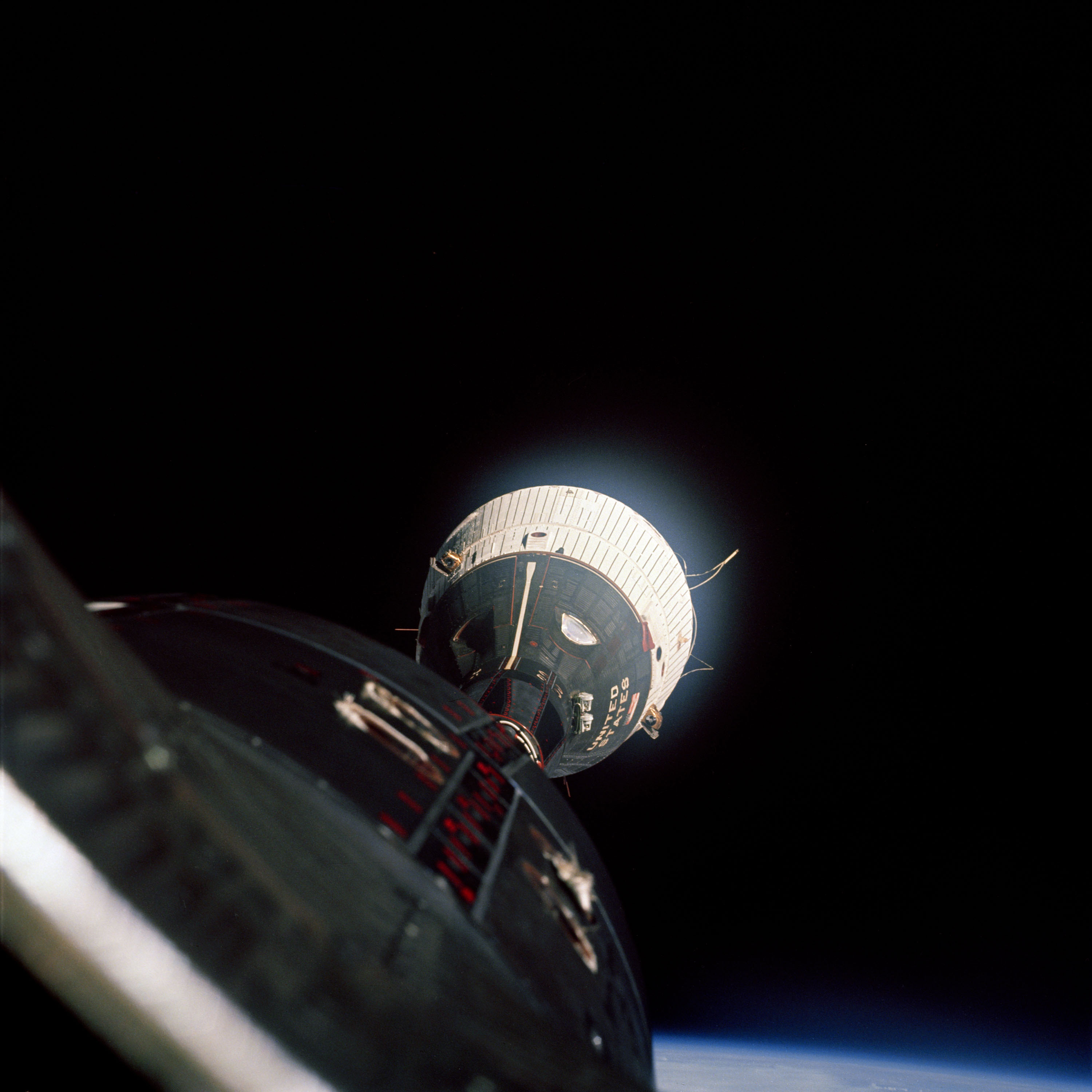
Gemini 7 photographed from Gemini 6 during their rendezvous on December 15, 1965.
NASA / Johnson Space Center (S65-63171) · NASA media-use guidelines · Original recordThe words
Beat Army
Schirra and Stafford displayed a Beat Army sign in their window during the rendezvous. Both were Naval Academy graduates, teasing West Point graduate Frank Borman.
Did you know?
The Army–Navy football game had already been played on November 27, 1965. Neither side won: it ended in a 7–7 tie.
Formation
After meeting in orbit, Gemini 6A and Gemini 7 held different positions beside one another. At one point, they flew nose to nose.
Fourteen Days
Gemini 7’s planned two-week flight extended the endurance testing begun on earlier Gemini missions. Borman and Lovell conducted experiments on living and working in weightlessness.
Frank Borman
Frank Borman commanded Gemini 7, with Jim Lovell as pilot. Both were making their first spaceflight after serving as the backup crew for Gemini 4.
Gemini Seven
Gemini 7 launched on December 4, 1965, for its long-duration mission. While Borman and Lovell continued their experiments, their spacecraft also became Gemini 6A’s rendezvous target.
Did you know?
Borman and Lovell wore lightweight pressure suits that could be removed and rolled up. The suits could then be stowed under their seats.
Gemini Six
Originally scheduled to meet an Agena target, Gemini 6 was revised after that vehicle failed to reach orbit. Schirra and Stafford launched as Gemini 6A on December 15, 1965.
Harmonica
Schirra carried a small harmonica aboard Gemini 6A. During the crew’s musical surprise, he played it while Stafford supplied the accompaniment on small bells.
Jingle Bells
The Gemini 6A crew performed Jingle Bells on December 16, 1965. Their harmonica and bells became the first musical instruments played in space.
Pad Abort
On December 12, 1965, Gemini 6A’s rocket engines shut down before liftoff. The crew remained aboard; investigators checked the prematurely released connector and found a dust cap left in an engine.
Rendezvous
An orbital meeting in which spacecraft match their position and motion.
Gemini 6A and Gemini 7 achieved the first space rendezvous on December 15, 1965. Matching their motion allowed them to remain together without docking.
Santa Claus
Before playing their music, Schirra and Stafford jokingly described an object traveling in a polar orbit. The pretend sighting set up their Santa Claus surprise for the listeners.
Sirius
During the approach, Schirra initially mistook Gemini 7 for the star Sirius. The distant spacecraft shone brightly because it reflected sunlight.
Tail Plug
An electrical connector at the base of a rocket.
A tail plug released prematurely during the December 12 launch attempt. It started a clock meant to signal liftoff, although the rocket had not left the pad.
Walter Schirra
Walter Schirra commanded Gemini 6A, with Tom Stafford as pilot. An original Mercury astronaut, he later commanded Apollo 7, the first crewed Apollo flight.
West Point
Frank Borman attended the U.S. Military Academy at West Point. He was the Army graduate among the four astronauts, giving the other crew’s window sign its target.
Sources
- Dual Gemini Flights Achieved Crucial Spaceflight MilestonesBob Granath; NASA Kennedy Space Center; December 4, 2015; academy rivalry, Schirra and musical instruments
- 55 Years Ago: The Spirit of 76 – The First Rendezvous in SpaceJohn Uri; NASA Johnson Space Center; December 8, 2020; Gemini VII endurance flight, rendezvous and music broadcast
- On the Shoulders of Titans: A History of Project GeminiBarton C. Hacker and James M. Grimwood; NASA SP-4203, 1977; printed pp. 283–285 and 287–288
- Gemini VINASA; Objectives and mission milestones, October–December 1965