
The Space Race
Puzzle 37 · Project Gemini · Page 57 in print
Gemini 8 Emergency
After the first docking in space, a stuck thruster spun Gemini 8 about once a second.
Jump to a word
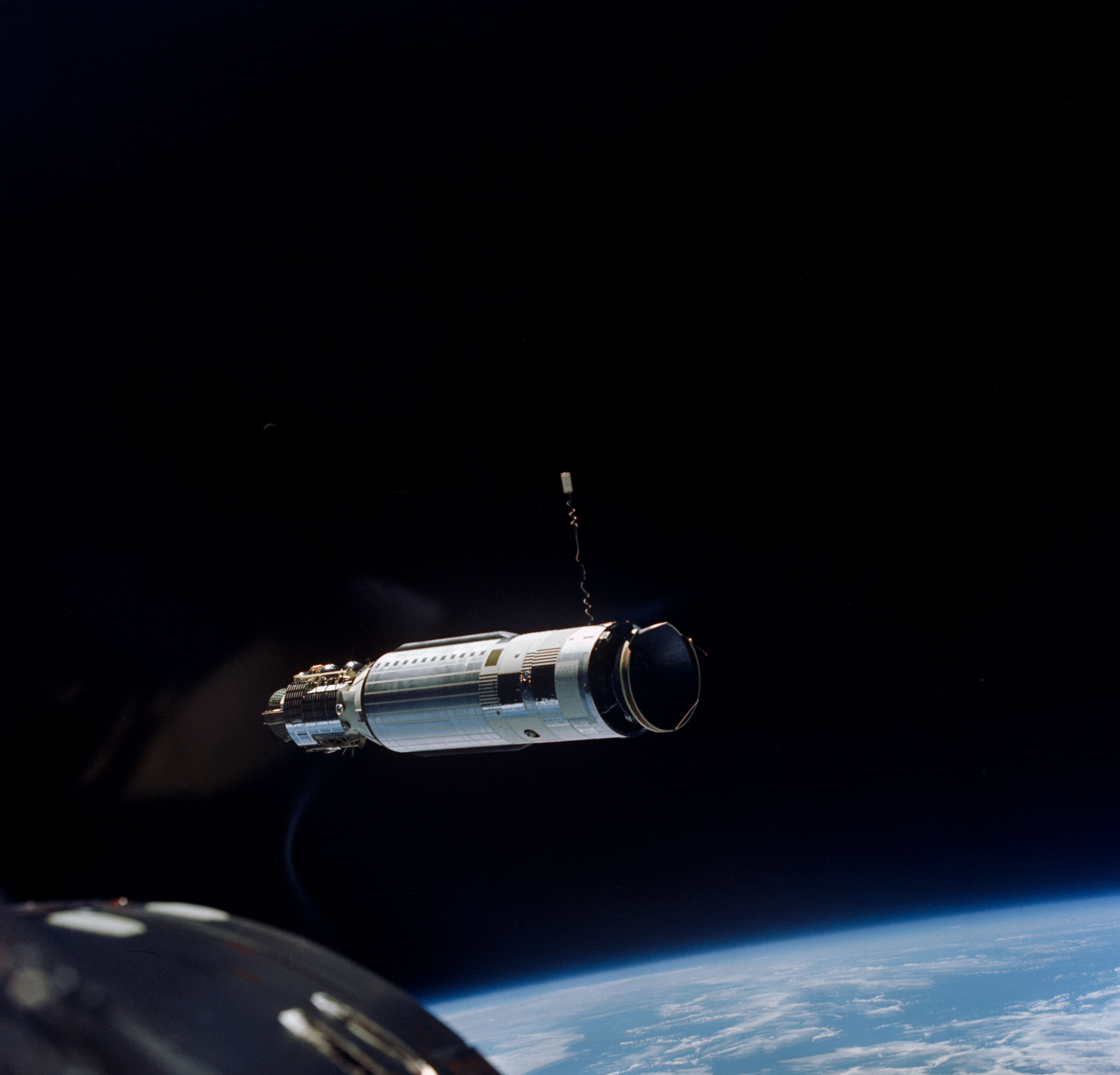
The Agena docking target photographed from Gemini 8 during rendezvous.
NASA / Johnson Space Center (S66-25781) · NASA media-use guidelines · Original recordThe words
Agena Eight
The Agena was launched separately as Gemini 8’s docking target. Armstrong and Scott caught up with it, inspected it during a fly-around, and joined the two vehicles.
Blurred Vision
As Gemini 8’s roll accelerated, Armstrong and Scott became dizzy and had trouble reading the overhead panel. Their blurred vision made controlling the spacecraft harder.
NASA Gemini history: emergency and redesign (opens a new tab)
David Scott
David Scott flew as Gemini 8’s pilot beside Neil Armstrong. During the approach to the Agena, he called out radar distances and closing rates.
Did you know?
Scott later flew aboard Apollo 9 as command module pilot. In 1971, he commanded Apollo 15, a mission that landed on the Moon.
Docking
The physical joining of two spacecraft in space.
On March 16, 1966, Gemini 8 achieved the first docking of two spacecraft in orbit. Armstrong and Scott joined their capsule to an uncrewed Agena target.
Did you know?
After its flight, McDonnell used the Gemini 8 capsule for ground tests in the Manned Orbiting Laboratory program. It was given to the Smithsonian in 1972.
End over End
Scott described the spacecraft as tumbling end over end when it regained radio contact with a tracking ship. The crew had already separated from the Agena.
NASA Gemini history: emergency and redesign (opens a new tab)
Gemini Eight
Gemini 8 was planned as a three-day mission, but a thruster malfunction forced an emergency return. Armstrong and Scott landed in the Pacific less than twelve hours after launch.
Leonard Mason
The destroyer USS Leonard F. Mason recovered Armstrong and Scott after their Pacific splashdown. Rescue swimmers assisted the crew while they waited for the ship.
Master Switch
After Gemini 8, McDonnell revised the attitude-control switch circuitry. It could cut electrical power to the thrusters themselves, rather than only to the control electronics.
NASA Gemini history: emergency and redesign (opens a new tab)
Mission Rules
Using the reentry-control thrusters required an early return under Gemini’s mission rules. That system was needed to position the spacecraft safely for its journey back through the atmosphere.
NASA Gemini history: emergency and redesign (opens a new tab)
Neil Armstrong
Neil Armstrong commanded Gemini 8 on his first spaceflight. Three years later, he commanded Apollo 11 and became the first person to step onto the Moon.
Nose Thrusters
The reentry-control thrusters were mounted in Gemini 8’s nose. They restored stability during the emergency after the spacecraft’s normal orbital control system could not stop the spin.
Okinawa
Rescue aircraft flew from Naha Air Base on Okinawa and from Tachikawa in Japan. Pararescuers reached the capsule and attached a flotation collar before the destroyer arrived.
Orbital Jets
Small rocket engines used to change a spacecraft’s motion.
Armstrong and Scott shut down Gemini 8’s orbital control system during the emergency. They then relied on a separate thruster system intended for reentry.
Stuck Thruster
A maneuvering thruster kept firing when it should have stopped. Its unwanted thrust drove the spacecraft’s roll, even after separation from the Agena.
NASA Gemini history: emergency and redesign (opens a new tab)
Undock Button
Scott pressed the undock button while Armstrong maneuvered Gemini 8 away from the Agena. The worsening roll after separation pointed to a problem aboard Gemini itself.
NASA Gemini history: emergency and redesign (opens a new tab)
Sources
- Gemini’s First Docking Turns to Wild Ride in OrbitBob Granath; NASA Kennedy Space Center; March 3, 2016; mission plan, Scott’s role, control systems and Pacific recovery
- Capsule, Gemini VIIISmithsonian National Air and Space Museum; object A19721289000; mission description and later ground testing
- On the Shoulders of Titans: A History of Project GeminiBarton C. Hacker and James M. Grimwood; NASA SP-4203, 1977; printed pp. 314–315 and 321
- Gemini VIIINASA; Armstrong biography and Mission Overview, Gemini 8 control systems