
The Space Race
Puzzle 35 · Project Gemini · Page 55 in print
Eight Days in Orbit
On the recovery ship, Pete Conrad tweaked Gordon Cooper’s eight-day beard.
Jump to a word
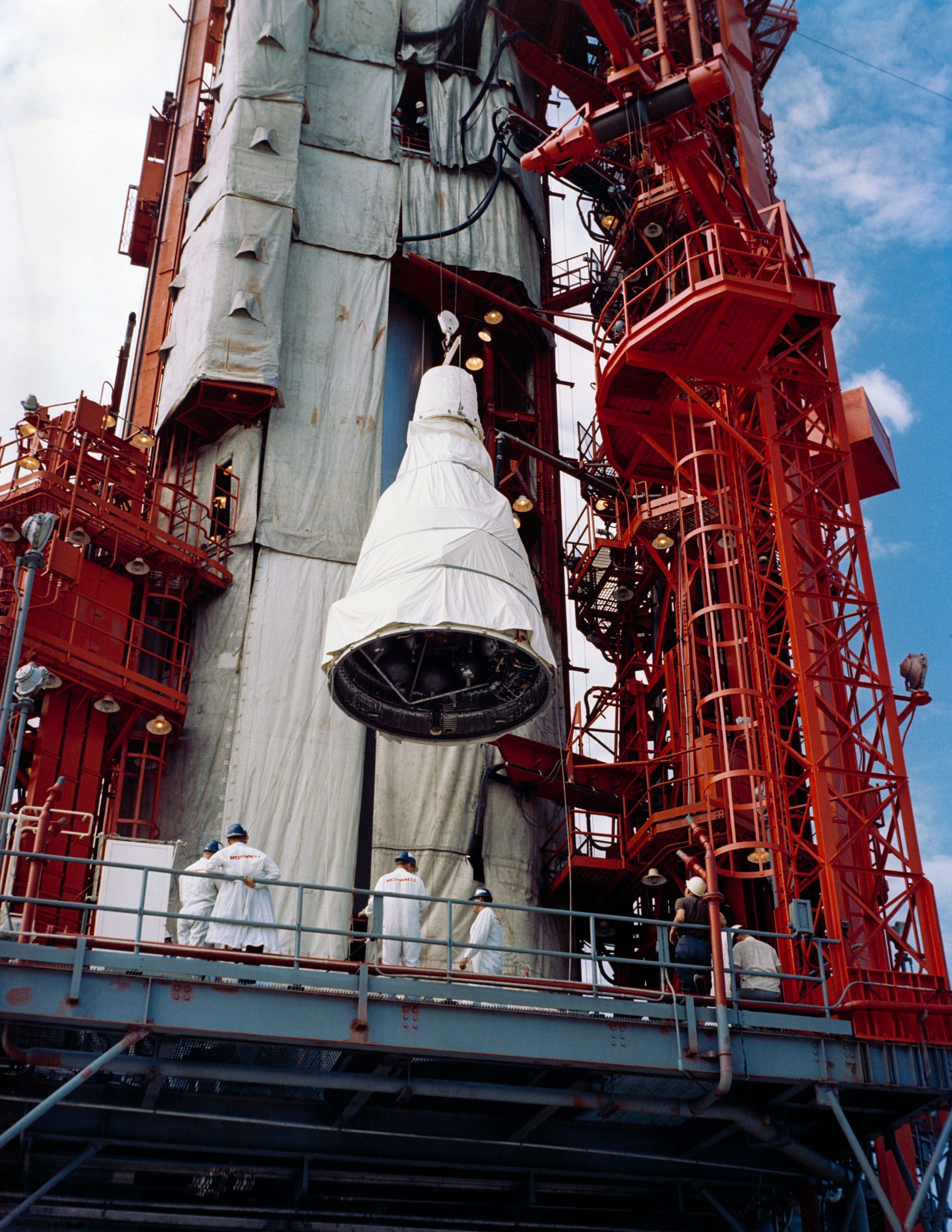
The Gemini 5 spacecraft is hoisted up the gantry at Pad 19 before being joined to its launch vehicle.
NASA / Johnson Space Center (S65-43446) · NASA media-use guidelines · Original recordThe words
Beard
After splashdown, Conrad playfully tugged Cooper’s beard for the cameras aboard USS Lake Champlain. Its growth marked their long stay in orbit.
Cooper
Gordon Cooper commanded Gemini 5 after flying Faith 7, the final Mercury mission. He brought experience of living and working alone in orbit.
Covered Wagon
Cooper’s patch design showed a Conestoga covered wagon. It represented the long journey that he and Conrad planned to make aboard Gemini 5.
Crew Patch
Cooper and Conrad designed an insignia for Gemini 5, beginning NASA’s tradition of patches for individual astronaut crews.
Did you know?
NASA approved the patch but had cloth sewn over its motto, “8 Days or Bust.” Officials worried that an early return would otherwise be described as a failure.
Eight Days
Eight days was considered the minimum time for a roundtrip Moon mission. Gemini 5 tested whether astronauts and spacecraft systems could function for that long.
Evaluation Pod
The crew released a small pod carrying radar equipment and flashing lights as a rendezvous target. Fuel-cell trouble forced them to abandon the planned approach.
Fuel Cell
A device that generates electricity through a chemical reaction.
Gemini 5 used fuel cells to supply electricity for its long flight. They combined hydrogen and oxygen, producing water as well as electrical power.
Gemini Five
Launched on August 21, 1965, Gemini 5 carried Cooper and Conrad on the third crewed Gemini flight. They returned to the Atlantic on August 29.
Goodwill Tour
After the flight, Cooper, Conrad and their families visited six nations on a goodwill tour assigned by President Lyndon Johnson, beginning on September 15, 1965.
Did you know?
In Athens, the Americans met Pavel Belyayev and Aleksei Leonov at the International Astronautical Congress. The Soviet crew had made the first spacewalk mission six months earlier.
Heater
A heater failed in the oxygen supply for Gemini 5’s fuel cells. Falling tank pressure interrupted the rendezvous exercise and prompted checks on the ground.
Pete Conrad
Pete Conrad made his first spaceflight as Gemini 5’s pilot. He later commanded Gemini 11, Apollo 12 and the first crewed Skylab mission.
Phantom Agena
After the pod exercise was canceled, Buzz Aldrin developed a replacement test. Cooper and Conrad practiced approaching a calculated location where a target spacecraft would be.
Power Down
The astronauts switched off nonessential equipment to conserve electricity while controllers assessed the fuel cells. Equipment was restored as the oxygen tank pressure stabilized.
Tropical Storm
A tropical storm threatened the planned recovery area. Controllers brought Gemini 5 home one orbit early on August 29, 1965, after nearly eight days in space.
Visual Acuity
The ability to distinguish fine visual detail.
Gemini 5’s vision tests used an instrument inside the capsule and large rectangular targets on Earth. Clouds, window glare and spacecraft orientation limited the ground observations.
Sources
- Gemini VNASA; mission summary, crew biographies, overview and recovery photograph caption
- Gemini V: Paving the Way for Long Duration SpaceflightBob Granath; NASA Kennedy Space Center; August 5, 2015; patch, pod and alternative rendezvous
- 55 Years Ago: Gemini 5 Sets a New RecordJohn Uri; NASA Johnson Space Center; August 28, 2020; duration, fuel cells, power conservation and goodwill tour
- The View from Above: The Gemini Visual Acuity ExperimentsNASA History Office; August 20, 2026; Putting Astronaut Vision to the Test