
The Space Race
Puzzle 34 · Project Gemini · Page 54 in print
Ed White's Spacewalk
When McDivitt called him in, Ed White sighed, “It’s the saddest moment of my life.”
Jump to a word
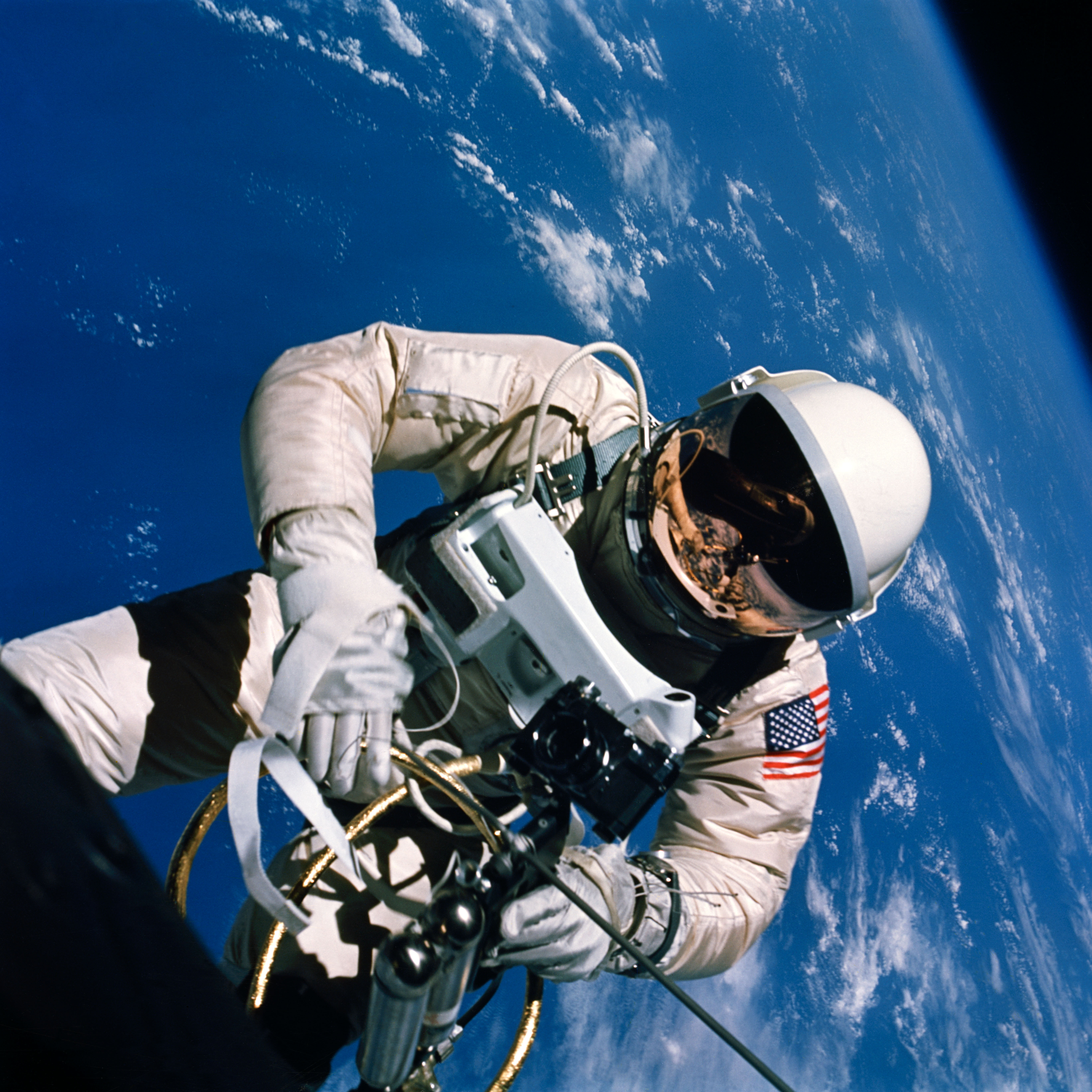
Edward H. White II outside Gemini 4 during his spacewalk.
NASA / Johnson Space Center (s65-30431) · NASA media-use guidelines · Original recordThe words
Contarex
A 35-millimeter camera model.
White’s Contarex camera was mounted on his hand-held maneuvering unit. The combined assembly was adapted for use with his spacesuit and helmet.
pp. 8–9 · NASA: White’s camera and maneuvering unit (opens a new tab)
Ed White
Ed White became the first American to walk in space on June 3, 1965. He floated outside Gemini 4 in a specially designed pressure suit.
Four Days
Gemini 4 stayed in Earth orbit for four days, longer than earlier American missions. It tested how the crew and equipment could perform beyond a short flight.
Gemini Four
Gemini 4 launched on June 3, 1965, with McDivitt and White. The flight combined an extended spacecraft test with the first American spacewalk.
Did you know?
It was the first American crewed flight controlled from the new center in Houston. Previous Mercury and Gemini flights had been controlled from Cape Kennedy.
NASA gallery: Gemini 4 and White’s visor (opens a new tab) · NASA: Gemini 4’s mission and recovery (opens a new tab)
Gold Visor
The gold-coated helmet visor shielded White from direct sunlight. It was part of the suit’s protection during his work outside the spacecraft.
Gulf of Mexico
White’s outing ended over the Gulf of Mexico. The end point reflected the spacecraft’s progress around Earth while he worked outside.
Hawaii
White left the capsule while Gemini 4 passed over the Pacific near Hawaii. McDivitt photographed him against the cloud-covered Earth.
James McDivitt
James McDivitt was Gemini 4’s command pilot. He remained inside the capsule and photographed White moving outside his window, recording the spacewalk from the spacecraft.
NASA: White’s suit and oxygen supply (opens a new tab) · NASA: the zip gun and McDivitt’s camera (opens a new tab)
Oxygen Pack
White wore an emergency oxygen pack in addition to the line connecting him to Gemini 4. The umbilical supplied oxygen and communications during the spacewalk.
NASA: White’s suit and oxygen supply (opens a new tab) · NASA EVA chronology: lines, glove and window (opens a new tab)
Saddest Moment
White felt comfortable outside and wanted more time. He later described the order to return as the saddest moment of his life.
Second Stage
The crew tried to approach Titan II’s spent second stage. They lacked radar for precise range measurements, and McDivitt eventually turned to the spacewalk.
Thermal Glove
A protective overglove escaped through Gemini 4’s open hatch. Once free, it continued orbiting Earth instead of returning inside the capsule.
Did you know?
The loose glove remained in orbit for a few months before reentering Earth’s atmosphere and burning up, according to NASA’s EVA chronology.
p. 3 · NASA EVA chronology: lines, glove and window (opens a new tab)
USS Wasp
USS Wasp was Gemini 4’s recovery carrier. Its helicopter crew collected McDivitt and White after splashdown and brought them aboard on June 7, 1965.
Windshield
White accidentally smeared McDivitt’s window during the spacewalk. From inside the capsule, McDivitt used that view to watch and photograph him.
NASA EVA chronology: lines, glove and window (opens a new tab) · NASA: the zip gun and McDivitt’s camera (opens a new tab)
Zip Gun
An informal name for the Hand-Held Maneuvering Unit.
White’s maneuvering device expelled pressurized oxygen to give him small pushes. After its supply ran out, he relied on body movements and the tether.
NASA: the zip gun and McDivitt’s camera (opens a new tab) · NASA gallery: Gemini 4 and White’s visor (opens a new tab)
Sources
- Gemini: A Bridge to the MoonNASA; Gemini gallery, crew and Ed White spacewalk sections
- June 3, 1965 – America’s First SpacewalkNASA; October 7, 2009; Edward White, emergency oxygen pack, umbilical and McDivitt’s role
- First American SpacewalkNASA; June 3, 2008; spacewalk route and early Pacific photographs
- Flashback: America’s First SpacewalkNASA; March 23, 2008; White’s later description of his comfort and the return order
- Gemini IV: Learning to Walk in SpaceBob Granath; NASA Kennedy Space Center; June 1, 2015; mission duration, second-stage pursuit, Houston control and recovery
- America’s First SpacewalkNASA HQ Web Team; June 3, 2025; Hand-Held Maneuvering Unit and McDivitt’s photography
- Walking to Olympus: An EVA ChronologyDavid S. F. Portree and Robert C. Treviño; NASA Monographs in Aerospace History No. 7, October 1997; printed pp. 2–4, Gemini 4 entry
- Photography Equipment and Techniques: A Survey of NASA DevelopmentsAlbert J. Derr, in association with the Franklin Institute Research Laboratories; NASA SP-5099, 1972; printed p. 8 and figure 9 on p. 9