
The Space Race
Puzzle 31 · Soviet Firsts · Page 49 in print
Luna 9 Soft Landing
Luna 9’s capsule opened four petals, then a camera with a revolving mirror took panoramas.
Jump to a word
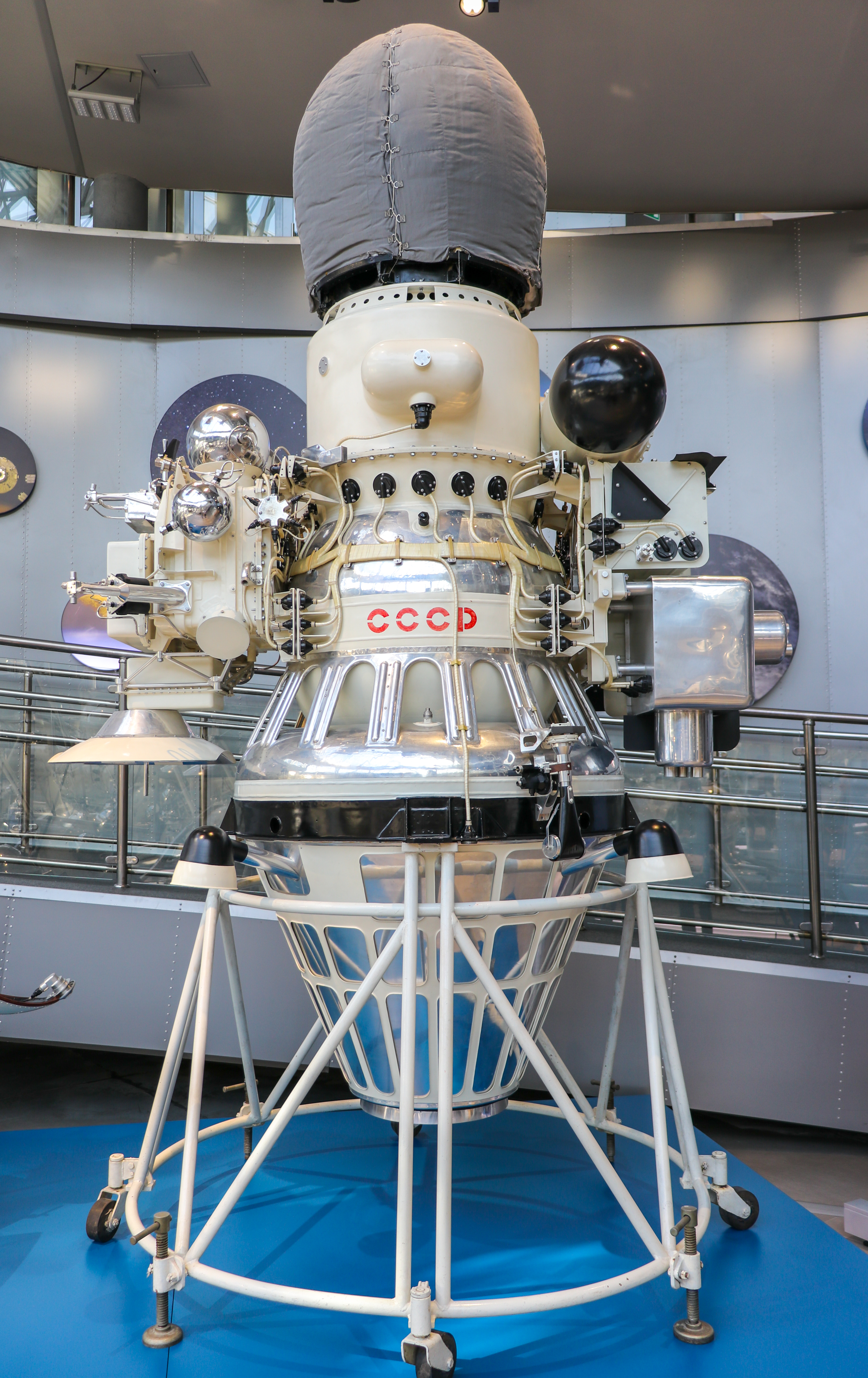
A Luna 9 museum model at the Tsiolkovsky Museum of the History of Cosmonautics in 2022.
Stolbovsky · CC BY 4.0 · Original recordImage changes
Display copies resized; original preserved.
The words
Airbags
Inflatable cushions surrounded Luna 9’s landing capsule, absorbing the impact. They opened after touchdown so the station could unfold its instruments.
pp. 55–56 · Siddiqi: Luna 9’s landing and photographs (opens a new tab)
Boom Sensor
A projecting sensor contacted the surface near touchdown. Its signal released the small landing capsule from the larger spacecraft.
p. 56 · Siddiqi: Luna 9’s landing and photographs (opens a new tab)
Daily Express
The Daily Express lent a picture receiver to Jodrell Bank. It turned Luna 9’s intercepted radio signals into printable photographs of the lunar surface.
Did you know?
The receiver was installed in the basement of Jodrell Bank’s Control Room. Its output helped put the Moon’s surface on newspaper front pages.
p. 55 · Jodrell Bank: the borrowed picture receiver (opens a new tab)
First Images
Luna 9 sent the first photographs from a spacecraft resting on the Moon. They showed nearby rocks and a ground-level horizon.
NASA: the camera and lunar landscape (opens a new tab) · Siddiqi: Luna 9’s landing and photographs (opens a new tab)
Lavochkin
The Lavochkin bureau built Luna 9, its first deep-space probe. The mission brought a new design organization into Soviet lunar exploration.
p. 55 · Siddiqi: Luna 9’s landing and photographs (opens a new tab)
Luna Nine
Luna 9’s work continued after its February 3 landing. The battery-powered station kept returning pictures and signals until contact ended on February 6, 1966.
Mirror
A revolving and tilting mirror directed views of the landscape into Luna 9’s television camera. It let a stationary lander survey its surroundings.
Molniya
Russian for lightning.
A Molniya-M rocket launched Luna 9 on January 31, 1966. Its upper stage sent the spacecraft toward the Moon.
Siddiqi: Luna 9’s landing and photographs (opens a new tab) · NASA: the word Molniya (opens a new tab)
Ocean of Storms
The Ocean of Storms was Luna 9’s landing region. From there, the capsule sent photographs of nearby rocks and the distant lunar horizon.
Panorama
Luna 9 photographed its surroundings under changing sunlight. Later pictures showed different shadows across the same ground.
Did you know?
A small change in the lander’s viewpoint offered the possibility of stereo photography: paired views that could help reveal the shape of the ground.
p. 56 · Siddiqi: Luna 9’s landing and photographs (opens a new tab)
Petals
Four spring-operated covers opened after landing to steady Luna 9’s capsule. Their unfolding exposed the camera that photographed the surrounding lunar landscape.
Quicksand
Quicksand described a fear about loose lunar dust swallowing a spacecraft. Luna 9’s survival showed that the ground at its landing site could support the capsule.
Reiner
Luna 9 landed west of Reiner and Marius craters. Reiner provided a recognizable lunar landmark for describing the probe’s landing area.
p. 56 · Siddiqi: Luna 9’s landing and photographs (opens a new tab)
Soft Landing
A landing gentle enough for the spacecraft to remain operational.
On February 3, 1966, Luna 9 achieved the first soft landing on another celestial body, opening a new phase of lunar exploration.
Thomas Gold
Thomas Gold proposed deep lunar dust deposits. Bruce Hapke later explained that this differed from his own model of how individual dust grains cling together.
Sources
- Beyond Earth: A Chronicle of Deep Space Exploration, 1958–2016Asif A. Siddiqi; NASA History Division, NASA SP-2018-4041, second edition, 2018; Luna 9 entry, printed pp. 55–56
- 3 FebruaryEuropean Space Agency; 1966 entry, Luna 9 soft landing and camera description
- Luna 9NASA; archived image description, NASA Identifier SPD-SLRSY-1907; posted on DVIDS on October 10, 2012
- Jodrell Bank Observatory: Nomination for Inclusion in the World Heritage ListJodrell Bank Observatory; World Heritage nomination document; section 2, Description, printed p. 55
- Fairy CastlesBruce Hapke, The History of the Fairy Castles, with an editorial introduction; NASA Apollo Lunar Surface Journal; last revised January 3, 2006
- Mars Molniya Orbit Atmospheric Resource MiningRobert P. Mueller and colleagues; NASA Innovative Advanced Concepts, Phase I final report, February 2017; printed p. 12, used only for the Russian word’s translation