
The Space Race
Puzzle 30 · Soviet Firsts · Page 48 in print
Leonov's Spacewalk
Voskhod 2 landed far off course in the Urals; its crew waited in the forest for rescue.
Jump to a word
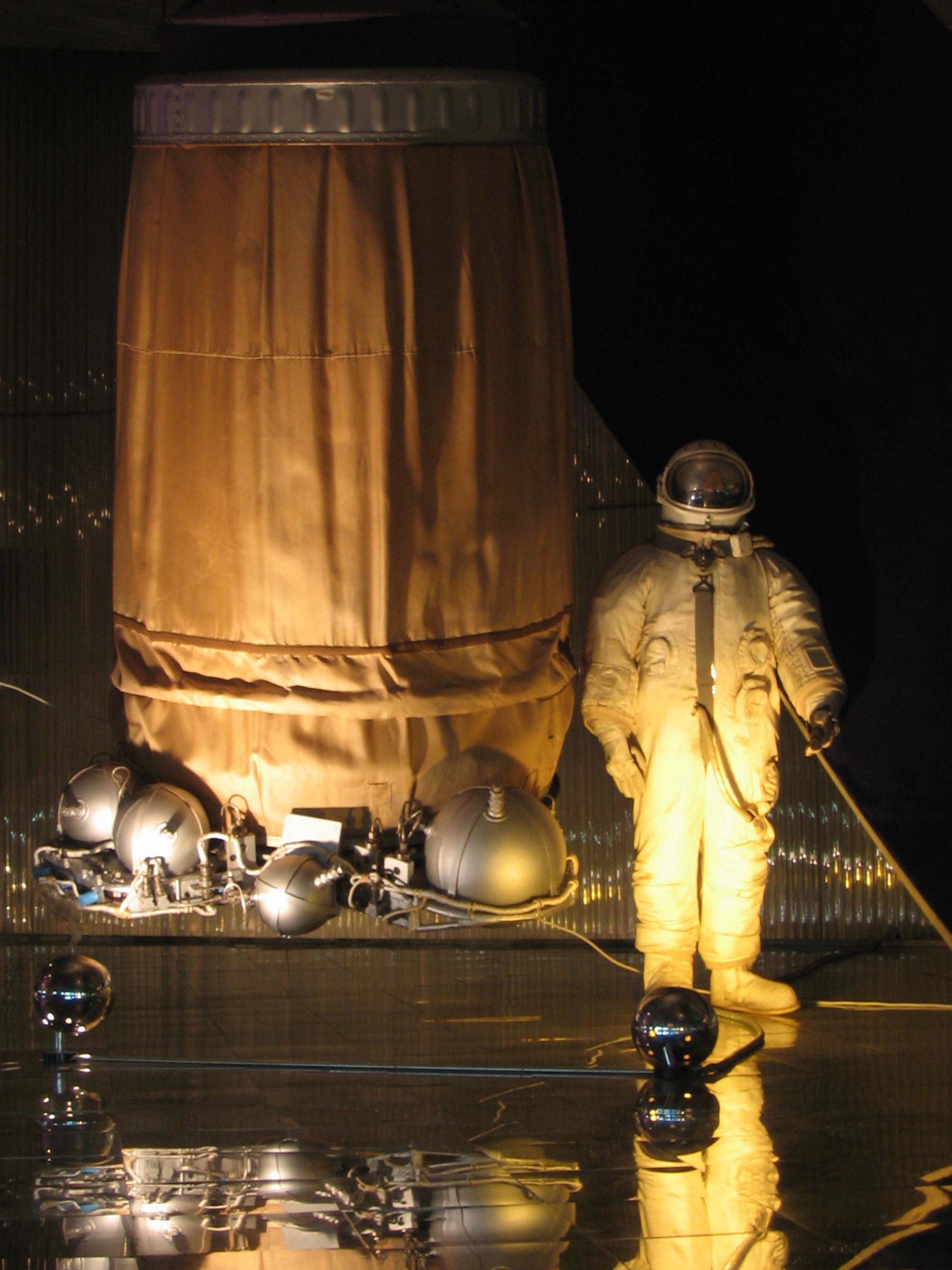
An airlock and Berkut spacesuit display at Moscow’s Memorial Museum of Cosmonautics in 2006.
Kucharek · Public domain (photographer’s dedication) · Original recordImage changes
Display copies resized; original preserved.
The words
Backpack
Leonov’s backpack supplied oxygen for breathing and cooling. Gas leaving the suit carried away heat, moisture, and exhaled carbon dioxide.
p. 1 · NASA EVA chronology: equipment and reports (opens a new tab)
Belyayev
Pavel Belyayev commanded Voskhod 2 while Leonov worked outside. When the automatic return system failed, he manually oriented the spacecraft for its descent to Earth.
Caspian Sea
The Caspian Sea marked the eastern extent of the view Leonov reported from space. His recollection paired it with Gibraltar to the west.
p. 1 · NASA EVA chronology: equipment and reports (opens a new tab)
Gibraltar
The Straits of Gibraltar were the western landmark in Leonov’s reported panorama. He described seeing from there to the Caspian Sea during his spacewalk.
p. 1 · NASA EVA chronology: equipment and reports (opens a new tab)
Heatstroke
NASA’s EVA chronology reports that Leonov nearly suffered heatstroke. Historian Anatoly Zak later highlighted Leonov’s postflight report, which described fatigue but denied major overheating.
NASA EVA chronology: equipment and reports (opens a new tab) · Zak: Leonov’s immediate postflight report (opens a new tab)
Leonov
Alexei Leonov became the first person to walk in space on March 18, 1965. He left Voskhod 2 wearing a pressure suit.
Did you know?
Before his flight, Leonov edited a satirical cosmonaut newsletter called Neptun, meaning Neptune. Painting was another of his interests.
ESA: Leonov and Voskhod 2 (opens a new tab) · Siddiqi: the crew and forest rescue (opens a new tab)
Spacesuit
Leonov later recalled a stiff, expanded suit that made reentry difficult. His immediate postflight report, discussed by historian Anatoly Zak, described a less dramatic return.
ESA: Leonov and Voskhod 2 (opens a new tab) · Zak: Leonov’s immediate postflight report (opens a new tab)
Spacewalk
Work outside a spacecraft, also called extravehicular activity or EVA.
Leonov’s excursion outside Voskhod 2 began the history of spacewalking. Later missions used this kind of work to maintain, repair, and assemble spacecraft and space stations.
Taiga
Cold northern forest, largely made up of conifers.
The crew landed in dense, snowy forest where helicopters could not set down beside the capsule. Rescuers reached them on skis before their evacuation.
Siddiqi: the crew and forest rescue (opens a new tab) · NatureWorks: the northern forest (opens a new tab)
Tether
A safety tether kept Leonov connected to Voskhod 2 while he floated outside. It allowed him to move away from the spacecraft without becoming separated.
Urals
Voskhod 2 landed far from its intended recovery area, near Perm. The crew spent two nights in the forest before they were flown out.
Valve
Leonov used a valve to reduce suit pressure during his return to the airlock. Zak’s account of his postflight report says this contingency had been considered before launch.
ESA: Leonov and Voskhod 2 (opens a new tab) · Zak: Leonov’s immediate postflight report (opens a new tab)
Volga Airlock
The inflatable Volga chamber let Leonov leave Voskhod 2 while the main cabin stayed pressurized. Its air-cooled equipment could not tolerate an emptied cabin.
Did you know?
Volga was designed, built, and tested in nine months, with work beginning in mid-1964 ahead of the March 1965 flight.
p. 1 · NASA EVA chronology: equipment and reports (opens a new tab)
Voskhod Two
Voskhod 2 carried Pavel Belyayev and Alexei Leonov in March 1965. Their mission combined the first spacewalk with a return that ended in a remote forest.
Wolves
Leonov’s memoir describes wolves and bears as inhabitants of the forest. His recollection conveys the crew’s concern about wildlife while awaiting rescue.
Sources
- Walking to Olympus: An EVA ChronologyDavid S. F. Portree and Robert C. Treviño; NASA Monographs in Aerospace History No. 7, October 1997; printed pp. 1–2
- Alexei Leonov, the first spacewalker, passes awayEuropean Space Agency; October 2019; historical spacewalk and Voskhod 2 passages
- Challenge to Apollo: The Soviet Union and the Space Race, 1945–1974Asif A. Siddiqi; NASA History Division, NASA/SP-2000-4408, 2000; printed pp. 451–452 and 458–459
- Alexei Leonov’s First Spacewalk Wasn’t Quite as Dramatic as We ThoughtAnatoly Zak; Air & Space Magazine, Smithsonian; March 26, 2020
- The Nightmare of Voskhod 2Alexei Leonov; Air & Space Magazine, January 2005; excerpt from Two Sides of the Moon, written with David Scott
- TaigaNew Hampshire PBS, NatureWorks; What Is the Taiga? and Ready for Snow! sections; used only for the forest definition
- Space Station 20th: Spacewalking HistoryJohn Uri; NASA Johnson Space Center; June 3, 2020; opening definition and historical account of Leonov’s EVA