
The Space Race
Puzzle 29 · Soviet Firsts · Page 47 in print
Voskhod 1
Boris Yegorov, the first physician in space, took blood samples from his crewmates.
Jump to a word
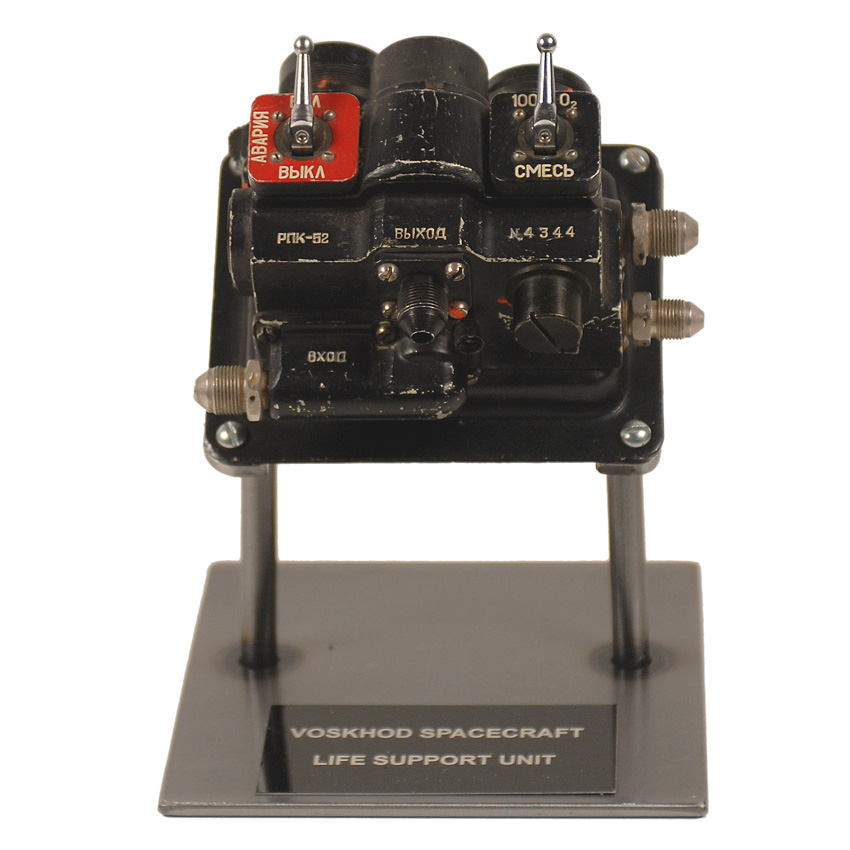
A Voskhod life-support unit, photographed in 2025.
A later artifact photograph, not an onboard mission view.
Steve Jurvetson · CC BY 4.0 · Original recordImage changes
Display copies resized; original preserved.
The words
Antarctica
Feoktistov described an aurora seen near Antarctica, with bright beams rising above the horizon. The sighting formed part of the crew’s observations of Earth and its atmosphere.
Cosmonautics museum: the three-person crew (opens a new tab)
Blood Samples
Yegorov took blood samples from his colleagues during Voskhod 1. The museum’s mission account places this work alongside measurements of blood pressure and breathing.
Cosmonautics museum: the three-person crew (opens a new tab)
Brezhnev
Leonid Brezhnev addressed the crew’s Moscow homecoming celebration on October 19, 1964. Soviet leadership had changed since their launch, when Khrushchev spoke with them in orbit.
NASA chronology: Voskhod’s flight and return (opens a new tab) · Chertok: Ruby and the return to Earth (opens a new tab)
Engineer
Feoktistov’s engineering role brought technical research into the cabin alongside piloting and medicine. He monitored equipment, observed Earth, and helped investigate navigation from space.
Did you know?
His experiments also included observing liquids in weightlessness and measuring the brightness of stars, combining several kinds of research in the same small spacecraft.
Cosmonautics museum: the three-person crew (opens a new tab)
Feoktistov
Konstantin Feoktistov helped design Vostok and worked on the Voskhod conversion. He then flew inside the adapted spacecraft, bringing direct design experience into its crew.
p. 409 · Siddiqi: Voskhod design and research (opens a new tab)
Komarov
Vladimir Komarov commanded Voskhod 1 when it launched on October 12, 1964. He shared the spacecraft with engineer Feoktistov and physician Yegorov—the first three-person space crew.
p. 348 · NASA chronology: Voskhod’s flight and return (opens a new tab)
Kustanay
Kustanay served as the crew’s first recovery stop after landing in Kazakhstan. Helicopters brought all three cosmonauts there from the landing area.
p. 241 · Chertok: Ruby and the return to Earth (opens a new tab)
Physician
As the crew’s physician, Yegorov observed his colleagues in weightlessness and tested functions such as vision and reflexes. Medicine was part of the flight program.
p. 424 · Siddiqi: Voskhod design and research (opens a new tab)
Retrorocket
Voskhod carried a reserve retrorocket to bring the spacecraft out of orbit if its main braking engine failed. This was separate from the rockets that softened touchdown.
p. 410 · Siddiqi: Voskhod design and research (opens a new tab)
Ruby
The English translation of Russian Rubin.
Ruby identified the Voskhod crew in radio communications. Chertok records Komarov answering ground control under this name as the flight approached its planned return.
pp. 240–241 · Chertok: Ruby and the return to Earth (opens a new tab)
Three Seats
Voskhod adapted the one-person Vostok capsule for three occupants. Removing the ejection seat made room, but required everyone to remain inside the capsule through landing.
pp. 409–410 · Siddiqi: Voskhod design and research (opens a new tab)
Tokyo Olympics
The crew sent greetings from orbit to the participants in the 1964 Tokyo Olympics. Their message linked the spaceflight with another international event taking place below.
Did you know?
They also radioed a greeting to the American people while passing over the United States, wishing them peace and happiness.
Cosmonautics museum: the three-person crew (opens a new tab) · NASA chronology: Voskhod’s flight and return (opens a new tab)
Voskhod
Russian for sunrise.
Voskhod was the Soviet program that adapted Vostok for new missions while Soyuz was still being developed. Its first crewed flight carried three people into orbit.
p. 385 · Siddiqi: Voskhod design and research (opens a new tab)
Woolen Suits
The crew wore lightweight woolen clothing rather than pressure suits. Three people in pressure suits would not fit inside the capsule, leaving them dependent on its sealed cabin.
NASA chronology: Voskhod’s flight and return (opens a new tab) · Siddiqi: Voskhod design and research (opens a new tab)
Yegorov
Boris Yegorov was the first physician to fly in space. On Voskhod 1, his medical specialty complemented the work of a pilot and an engineer.
p. 348 · NASA chronology: Voskhod’s flight and return (opens a new tab)
Sources
- Astronautics and Aeronautics, 1964: Chronology on Science, Technology, and PolicyNASA Historical Staff, Office of Policy Planning; NASA SP-4005, 1965; October 12–19 entries, printed pp. 348–356
- Challenge to Apollo: The Soviet Union and the Space Race, 1945–1974Asif A. Siddiqi; NASA History Division, NASA/SP-2000-4408, 2000; printed pp. 385, 409–410 and 423–425
- Rockets and People, Volume III: Hot Days of the Cold WarBoris E. Chertok; edited by Asif A. Siddiqi; NASA SP-2009-4110, 2009; printed pp. 240–241
- The Voskhod ThreeTsiolkovsky State Museum of the History of Cosmonautics; Google Arts & Culture exhibition for the flight’s fiftieth anniversary, 2014