
The Space Race
Puzzle 28 · Soviet Firsts · Page 46 in print
Tereshkova's Flight
In 48 orbits, Tereshkova logged more time in space than all Mercury astronauts combined.
Jump to a word
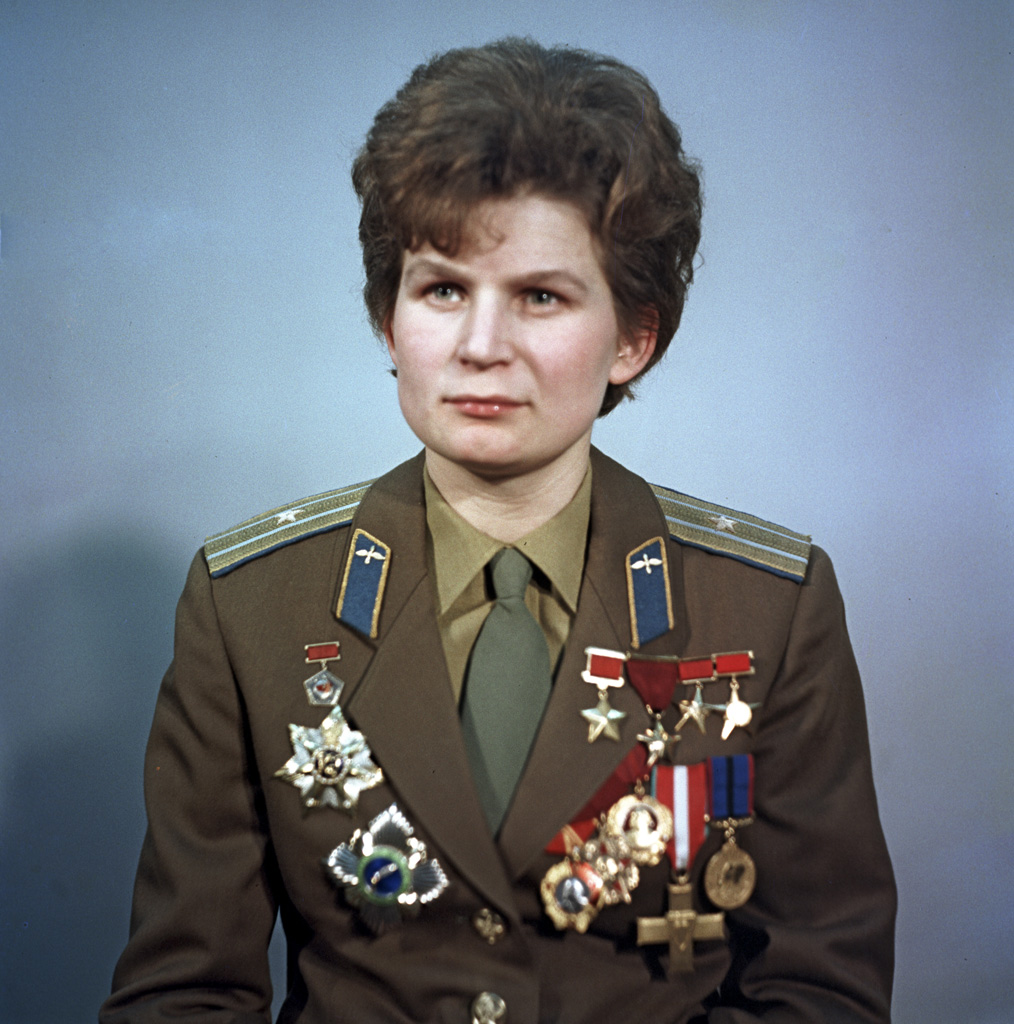
A 1969 portrait of Valentina Tereshkova.
Alexander Mokletsov / RIA Novosti (612748) · CC BY-SA 3.0 · Original recordImage changes
Display copies resized; original preserved.
The words
Bykovsky
Valery Bykovsky flew Vostok 5 alongside Tereshkova’s mission. His spacecraft’s lower orbit led controllers to shorten his planned flight to about five days.
pp. 223–224 · Chertok: Hawk and Seagull in orbit (opens a new tab)
Centrifuge
Tereshkova’s training included centrifuge tests. These machines prepare space travelers for the strong acceleration experienced during launch and return to Earth.
ESA: Tereshkova’s training and flight (opens a new tab) · ESA: what centrifuge training does (opens a new tab)
Chaika
Russian for seagull.
Chaika identified Tereshkova in radio communications during Vostok 6. After reaching orbit, she spoke with Bykovsky aboard the other spacecraft.
First Woman
On June 16, 1963, the twenty-six-year-old Tereshkova became the first woman in space. Vostok 6 carried her into orbit as part of the paired Soviet mission.
Did you know?
The next woman to fly in space was Svetlana Savitskaya, who traveled to the Salyut 7 space station in 1982.
Siddiqi: Vostok 5 and 6 (opens a new tab) · NASA: the first women in space (opens a new tab)
Flight Log
Tereshkova kept written notes during her nearly three days in orbit. They recorded the flight alongside the photographs she took from Vostok 6.
Flying Club
A local flying club gave Tereshkova her start in skydiving. She gained parachuting experience before entering the cosmonaut program, while working in a textile factory.
Did you know?
Tereshkova made her first parachute jump in May 1959, when she was twenty-two, several years before her spaceflight.
Hawk
The English translation of Russian Yastreb.
Hawk was Bykovsky’s radio name during Vostok 5. Chertok’s mission account uses this name for him and Seagull for Tereshkova aboard Vostok 6.
p. 223 · Chertok: Hawk and Seagull in orbit (opens a new tab)
Horizon
Tereshkova photographed Earth and its horizon from orbit. ESA reports that these photographs later helped identify aerosol layers in the atmosphere.
Kamanin
Nikolai Kamanin was responsible for cosmonaut training and favored Tereshkova for the first woman’s flight. His diary recorded that recommendation before her mission.
Parachutist
Parachuting mattered on Vostok because the cosmonaut left the capsule before touchdown. Tereshkova returned under her own parachute, separately from the descent capsule.
Solovyova
Irina Solovyova trained in the same five-woman group as Tereshkova and became her backup. Both women put on spacesuits before traveling to the launch pad.
Tereshkova
Valentina Tereshkova entered the Soviet cosmonaut program in a group of five women. She was the only member of that group to fly in space.
Textile Mill
Before becoming a cosmonaut, Tereshkova worked in a textile factory. Her background combined factory work with parachuting, rather than a career as a military test pilot.
Vostok Five
Vostok 5 launched with Bykovsky on June 14, 1963, two days before Tereshkova. It was the companion spacecraft with which she established radio contact in orbit.
Vostok Six
Vostok 6 was the last crewed flight of the Vostok series. When the paired missions ended, no further Vostok flights had approved plans.
Sources
- First woman in space: ValentinaEuropean Space Agency; biographical introduction and Flight of the Seagull section
- Sally Ride and Valentina Tereshkova: Changing the Course of Human Space ExplorationCody Knipfer; NASA History; June 14, 2013; Tereshkova biography and historical comparison
- Challenge to Apollo: The Soviet Union and the Space Race, 1945–1974Asif A. Siddiqi; NASA History Division, NASA/SP-2000-4408, 2000; printed pp. 361–373
- Rockets and People, Volume III: Hot Days of the Cold WarBoris E. Chertok; edited by Asif A. Siddiqi; NASA SP-2009-4110, 2009; printed pp. 223–224
- In for a spinEuropean Space Agency; August 4, 2023; general centrifuge-training explanation, not evidence of Tereshkova using this later machine