
The Space Race
Puzzle 27 · Soviet Firsts · Page 45 in print
The Group Flight
Popovich saw a real thunderstorm; controllers heard the code word for severe nausea.
Jump to a word
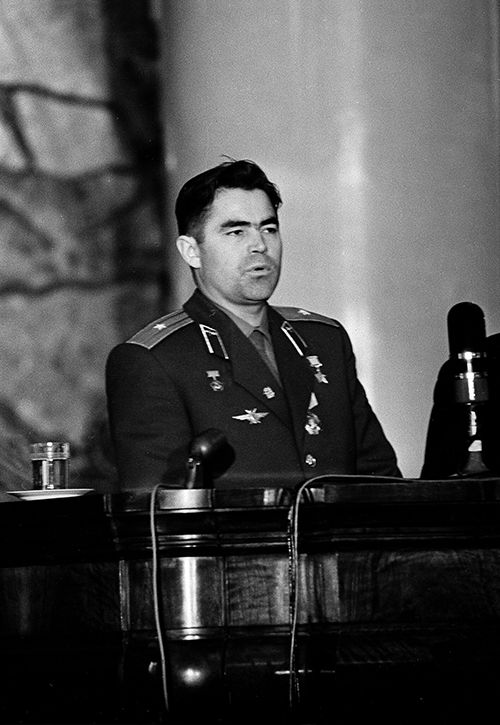
Andriyan Nikolayev speaks at a 1962 press conference following the Vostok 3 and 4 missions.
B. Yaroslavtsev / Moscow Main Archive / Mos.ru · CC BY 4.0 · Original recordImage changes
Display copies resized; original preserved.
The words
Close Approach
Their paths brought the two Vostoks close together, but the spacecraft could not change orbit to arrange a controlled rendezvous. They gradually drifted apart.
Zak: the close pass and radio conversation (opens a new tab)
Falcon
Sokol, Russian for falcon.
Nikolayev used Sokol as his radio call sign aboard Vostok 3. Ground listeners identified his transmissions by that name during the paired mission.
Grahn: the cosmonauts’ radio names (opens a new tab) · Call signs: the Russian bird names (opens a new tab)
Golden Eagle
Berkut, Russian for golden eagle.
Popovich used Berkut as his radio call sign on Vostok 4. In recorded radio exchanges, Nikolayev referred to contact with Berkut as the two flew in orbit.
Grahn: the cosmonauts’ radio names (opens a new tab) · Call signs: the Russian bird names (opens a new tab)
Group Flight
The group flight placed two cosmonauts in separate spacecraft above Earth at the same time. Vostok 3 launched first, followed by Vostok 4 the next day.
Karaganda
The Karaganda region of Kazakhstan was the landing area for the paired Vostok missions, which both returned on August 15, 1962.
Nikolayev
Nikolayev had worked as a lumberjack before becoming a Soviet Air Force pilot. He piloted Vostok 3 in the paired flight with Popovich.
p. 356 · Siddiqi: the group flight and its crew (opens a new tab)
Photo Lab
A ground photo lab developed film records of measurements transmitted from the spacecraft. Engineers studied them to assess onboard systems during the group flight.
Did you know?
Chertok recalled that engineers could wait three or four hours after a communications session for the developed film to reveal the spacecraft’s condition.
pp. 206–207 · Chertok: launch work and telemetry film (opens a new tab)
Popovich
Popovich was an experienced Soviet Air Force pilot before Vostok 4. During the group flight, his photographic work concentrated on Earth’s horizon and the boundary between day and night.
pp. 356, 358 · Siddiqi: the group flight and its crew (opens a new tab)
Roast Veal
Roast veal was among the solid dishes added to Nikolayev and Popovich’s menu. Their rations supplemented the earlier purees and liquids packed in tubes.
pp. 26–27 · NASA–USSR history: the Vostok menu (opens a new tab)
Telephone
Nikolayev spoke with Soviet leader Nikita Khrushchev during the flight. Radio noise made parts of the conversation difficult for him to hear.
Zak: the close pass and radio conversation (opens a new tab)
Television
Live television pictures let viewers on Earth watch Nikolayev inside Vostok 3. Cabin cameras extended the visual record beyond the cosmonaut’s spoken reports.
Did you know?
Popovich showed floating pencils and logbooks to television viewers, making weightlessness visible inside his small cabin.
pp. 357–358 · Siddiqi: the group flight and its crew (opens a new tab)
Thunderstorm
Popovich reported a real thunderstorm, but controllers understood a code phrase for severe motion sickness. The misunderstanding helped end debate over extending Vostok 4’s flight.
Siddiqi: the group flight and its crew (opens a new tab) · Chertok: launch work and telemetry film (opens a new tab)
Volynov
Boris Volynov was reserve for both Vostok missions. Bykovsky was Nikolayev’s named backup, and Komarov was Popovich’s; Volynov provided an additional trained replacement.
p. 356 · Siddiqi: the group flight and its crew (opens a new tab)
Vostok Four
Vostok 4 launched on August 12, 1962, a day after Vostok 3. Its arrival in orbit created the paired mission with two cosmonauts in separate capsules.
Vostok Three
Launching Vostok 3 was only the start of the ground team’s work. They prepared the same launch site for Popovich’s flight the following day.
pp. 204–206 · Chertok: launch work and telemetry film (opens a new tab)
Sources
- Project Mercury: A Chronology, Part III (B)NASA History Office, NASA SP-4001; August 11–12, 1962 entry and its cited congressional chronology
- Challenge to Apollo: The Soviet Union and the Space Race, 1945–1974Asif A. Siddiqi; NASA History Division, NASA/SP-2000-4408, 2000; printed pp. 356–360
- Rockets and People, Volume III: Hot Days of the Cold WarBoris E. Chertok; edited by Asif A. Siddiqi; NASA SP-2009-4110, 2009; printed pp. 204–207
- Vostok-3 and Vostok-4 missionsAnatoly Zak; RussianSpaceWeb; flight narrative and outcome discussion with cited historical sources
- Foundations of Space Biology and Medicine, Volume III: Space Medicine and BiotechnologyNASA and USSR Academy of Sciences; edited by Melvin Calvin and Oleg G. Gazenko; NASA SP-374, Volume III, 1975; Food and Water Supply, printed pp. 26–27
- The First Group SpaceflightBank of Russia; 2022 commemorative-coin historical description, Discover more; read in Chrome on October 25, 2026
- Vostok-3 and Vostok-4 and observations of their flight in radio interceptsSven Grahn; historical radio-observation study and transcribed monitoring records, archived at Jonathan McDowell’s site
- Spacecraft call signsWikipedia; Soviet and Russian spacecraft subsection; used only for the uncontested Sokol and Berkut word translations