
The Space Race
Puzzle 26 · Soviet Firsts · Page 44 in print
Titov's Day in Orbit
At 25, Gherman Titov became the youngest cosmonaut when he flew Vostok 2 in 1961.
Jump to a word
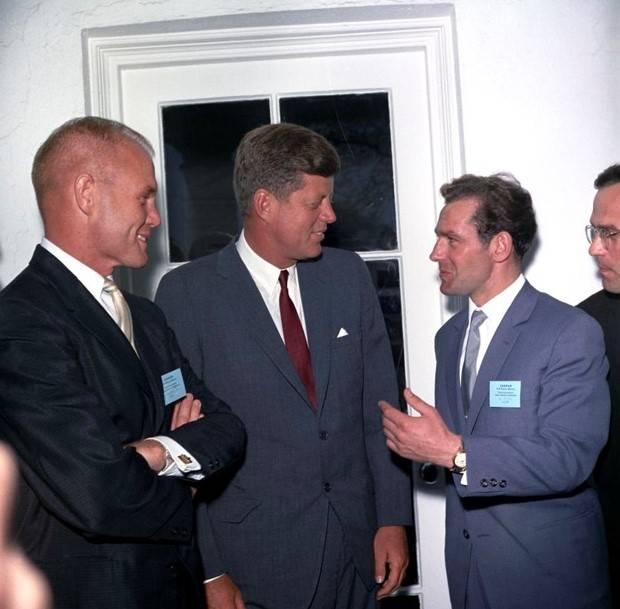
John Glenn, President John F. Kennedy and Gherman Titov at the White House on May 3, 1962.
Cecil Stoughton / White House Photographs / John F. Kennedy Presidential Library and Museum (ST-A35-1-62) · Public domain (U.S. government work) · Original recordImage changes
Display copies resized; original preserved.
The words
Alarm Clock
Engineer Boris Chertok recalled being assigned to develop specifications for a space alarm clock after Titov overslept. The episode exposed a practical problem in planning rest periods.
pp. 192–193 · Chertok: the space alarm-clock assignment (opens a new tab)
Backup Pilot
Titov had been Gagarin’s backup for Vostok 1. He moved from preparing for the first human mission to flying the second Soviet orbital flight.
Berlin Wall
Siddiqi links Titov’s launch deadline to Khrushchev’s Berlin plans. East Germany began sealing the border on August 13, 1961; people were later killed attempting to cross.
Siddiqi: Titov’s flight and its context (opens a new tab) · Berlin Wall Foundation: border and victims (opens a new tab)
Black Currant
Titov had little appetite during Vostok 2. He drank black-currant juice from a tube as he struggled with nausea during the extended flight.
Globus
Vostok’s Globus instrument used a rotating globe to display predicted position over Earth. Ground stations supplied the orbital information represented by the globe.
p. 17, Guidance and Navigation Equipment · U.S. assessment: the Globus display (opens a new tab)
Khabarovsk
Titov spoke with a ground station at Khabarovsk in the Soviet Far East. Contact depended on where Vostok 2 was along its orbit.
Krasny Kut
Titov returned near Krasny Kut in the Saratov region on August 7, 1961. He left the descending capsule and landed separately under a parachute.
p. 294 · Siddiqi: Titov’s flight and its context (opens a new tab)
Movie Camera
Titov filmed Earth’s horizon from Vostok 2 with a Konvas movie camera, recording views near the transitions between daylight and darkness.
Did you know?
The camera’s exposure meter malfunctioned, but Titov still recorded the horizon. His film was later released in the Soviet media.
p. 294 · Siddiqi: Titov’s flight and its context (opens a new tab)
Orientation
The direction a spacecraft faces.
Titov tested manual orientation during Vostok 2. Mission planners wanted to know whether a cosmonaut could work the spacecraft’s controls during a prolonged stay in weightlessness.
pp. 292–293 · Siddiqi: Titov’s flight and its context (opens a new tab)
Oryol
Russian for eagle, also written Orel.
Titov used Oryol as his radio call sign aboard Vostok 2. It identified him during communications with the ground stations following his orbital flight.
Overslept
Titov woke about 35 minutes after the scheduled end of his sleep period. His Vostok 2 flight showed that a person could oversleep in orbit.
Space Sickness
Titov experienced nausea, disorientation and loss of appetite during Vostok 2. Doctors discussed his symptoms after the flight as they considered the problems of longer missions.
pp. 292–295 · Siddiqi: Titov’s flight and its context (opens a new tab)
Titov
Gherman Titov flew Vostok 2 for more than a day in August 1961. In May 1962, he met John Glenn and President Kennedy in Washington.
Did you know?
John and Annie Glenn hosted Titov and his wife Tamara in Washington. Their sightseeing included the Lincoln Memorial and the U.S. Capitol.
Vostok Two
In August 1961, Vostok 2 carried Titov for more than a day, studying the effects of prolonged weightlessness. The flight greatly extended Gagarin’s single orbit.
Weightless
The apparent absence of weight during free fall.
Titov’s day in orbit let researchers study the human body during a longer period of weightlessness than Gagarin’s mission. Vostok 2 therefore extended the medical evidence from spaceflight.
Smithsonian: Vostok 2’s day-long study (opens a new tab) · NASA: why people float in orbit (opens a new tab)
Sources
- Gherman Titov, SovietSmithsonian National Air and Space Museum; poster collection record NASM A20150395000 and accompanying mission history
- Challenge to Apollo: The Soviet Union and the Space Race, 1945–1974Asif A. Siddiqi; NASA History Division, NASA/SP-2000-4408, 2000; printed pp. 292–295
- Rockets and People, Volume III: Hot Days of the Cold WarBoris E. Chertok; edited by Asif A. Siddiqi; NASA SP-2009-4110, 2009; printed pp. 192–193
- Vostok-2 mission: First day in spaceAnatoly Zak; RussianSpaceWeb; mission narrative with cited flight-report, memoir and historical sources
- Vostok Control EquipmentU.S. Air Force Missile Development Center, AFMDC 63-6229, December 1963; declassified November 13, 2014; National Archives; printed p. 17
- The Berlin WallBerlin Wall Foundation; opening history and Building the Wall in August 1961
- What Is Microgravity? (Grades 5-8)NASA STEM Team, February 15, 2012; definition, gravity in space and orbital free-fall explanation
- 60 Years Ago: Astronaut Glenn Meets Cosmonaut TitovJohn Uri; NASA Johnson Space Center, May 3, 2022; 1962 Washington visit