
The Space Race
Puzzle 25 · Soviet Firsts · Page 43 in print
Vostok 1
Gagarin ate in orbit: beef and liver paste from a tube, chocolate sauce for dessert.
Jump to a word
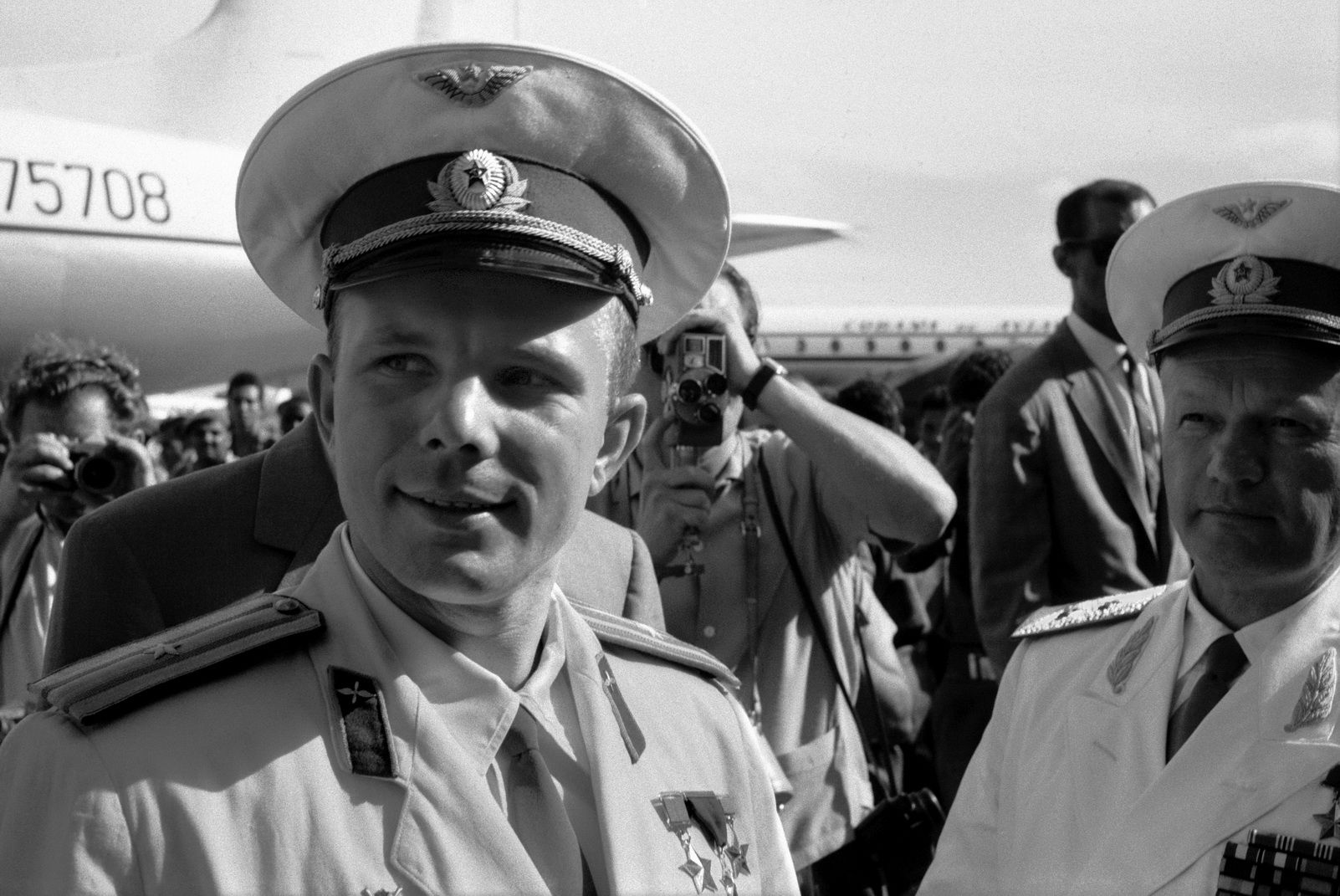
Yuri Gagarin at an airfield in June 1961.
Moscow Main Archive / Mos.ru · CC BY 4.0 · Original recordImage changes
Display copies resized; original preserved.
The words
Cedar
Kedr is Russian for cedar.
Gagarin used Kedr as his radio call sign during Vostok 1. Ground controllers used Zarya-1 for the launch-site station, distinguishing them from the cosmonaut.
Did you know?
While waiting in the launch capsule, Gagarin asked for some music over the radio. Korolev relayed the request to the ground team.
p. 275 · Siddiqi: Gagarin’s flight and welcome (opens a new tab)
Cosmonaut
The Russian term for a space traveler.
Gagarin became the first cosmonaut to fly in space. After Vostok 1, he helped prepare other cosmonauts as the training center’s deputy training director.
NASA: Gagarin’s flight and later life (opens a new tab) · NASA: space-word glossary (opens a new tab)
Descent Module
Vostok 1’s spherical descent module carried Gagarin back through the atmosphere. During reentry, cables briefly kept it attached to the equipment module before the two sections separated.
Ejection Seat
Gagarin left the returning Vostok capsule in an ejection seat. He then descended under his own parachute, landing separately from the spacecraft.
Engels
Engels, a town in the Saratov region, provided a reference point for locating Gagarin’s landing. He and the capsule came down southwest of it.
Gagarin
Yuri Gagarin became the first human to fly in space on April 12, 1961. He died with flight instructor Vladimir Seryogin in a training-aircraft crash on March 27, 1968.
Khrushchev
Before Gagarin’s launch, Soviet leader Nikita Khrushchev proposed a Kremlin reception and Red Square parade. His April 11, 1961 note presented spaceflight as both a Soviet and a human achievement.
pp. 1–3 · Khrushchev’s note before the launch (opens a new tab)
Levitan
Radio announcer Yuri Levitan read the TASS report of Gagarin’s mission while the cosmonaut was still in space. The announcement identified the pilot and his spacecraft, Vostok.
p. 278 · Siddiqi: Gagarin’s flight and welcome (opens a new tab)
Liver Paste
Gagarin ate beef and liver paste squeezed from a tube during Vostok 1. The meal provided early evidence that a person could swallow food while weightless.
Did you know?
John Glenn later became the first American to eat in space. He ate applesauce from a tube resembling a toothpaste tube.
Major
Gagarin received a promotion from senior lieutenant directly to major in connection with Vostok 1. Major was the rank used in the public flight announcement.
Siddiqi: Gagarin’s flight and welcome (opens a new tab) · ESA: the flight announcement (opens a new tab)
Poyekhali
Russian for “Let’s go!”
Gagarin’s launch call became associated with the beginning of human spaceflight. He spoke the word as Vostok 1 left Baikonur on April 12, 1961.
Red Square
Gagarin returned to Moscow on April 14, 1961. A motorcade brought him to Red Square, where Soviet leaders joined the public celebration of Vostok 1.
p. 282 · Siddiqi: Gagarin’s flight and welcome (opens a new tab)
Saratov
Gagarin recognized the Volga River as he descended into the Saratov region. He had practiced parachute jumping there during his earlier training.
p. 281 · Siddiqi: Gagarin’s flight and welcome (opens a new tab)
Single Orbit
Gagarin’s first spaceflight made a single circuit of Earth. His mission preceded the longer Vostok flights on which other cosmonauts spent several days in space.
Vostok One
Vostok 1 launched from Baikonur on April 12, 1961, carrying Gagarin into Earth orbit. Automatic systems oriented the spacecraft for its return while he reported conditions by radio.
Sources
- The flight of Vostok 1European Space Agency; launch, orbital flight, reentry and landing narrative
- Remembering Yuri Gagarin 50 Years LaterJohn Uri; NASA Johnson Space Center, March 27, 2018
- Food on the International Space StationJohn Uri; NASA Johnson Space Center, August 14, 2020; opening early-spaceflight food history
- “I see Earth! It is so beautiful!”European Space Agency; April 12, 2011, 50th-anniversary account; quoted flight announcement
- Challenge to Apollo: The Soviet Union and the Space Race, 1945–1974Asif A. Siddiqi; NASA History Division, NASA/SP-2000-4408, 2000; printed pp. 275, 278, 281–282
- Proposals in connection with the launch of the “Vostok” spacecraft with Yuri GagarinNikita S. Khrushchev, dictated April 11, 1961; translated by Sarah Dunn for the National Security Archive, George Washington University
- International Space Station Activity BookNASA; printed p. 10, space-word glossary, COSMONAUT entry