
The Space Race
Puzzle 32 · Soviet Firsts · Page 50 in print
The Lunokhod Rovers
The Soviets later revealed that an American scientist’s photos helped guide Lunokhod 2.
Jump to a word
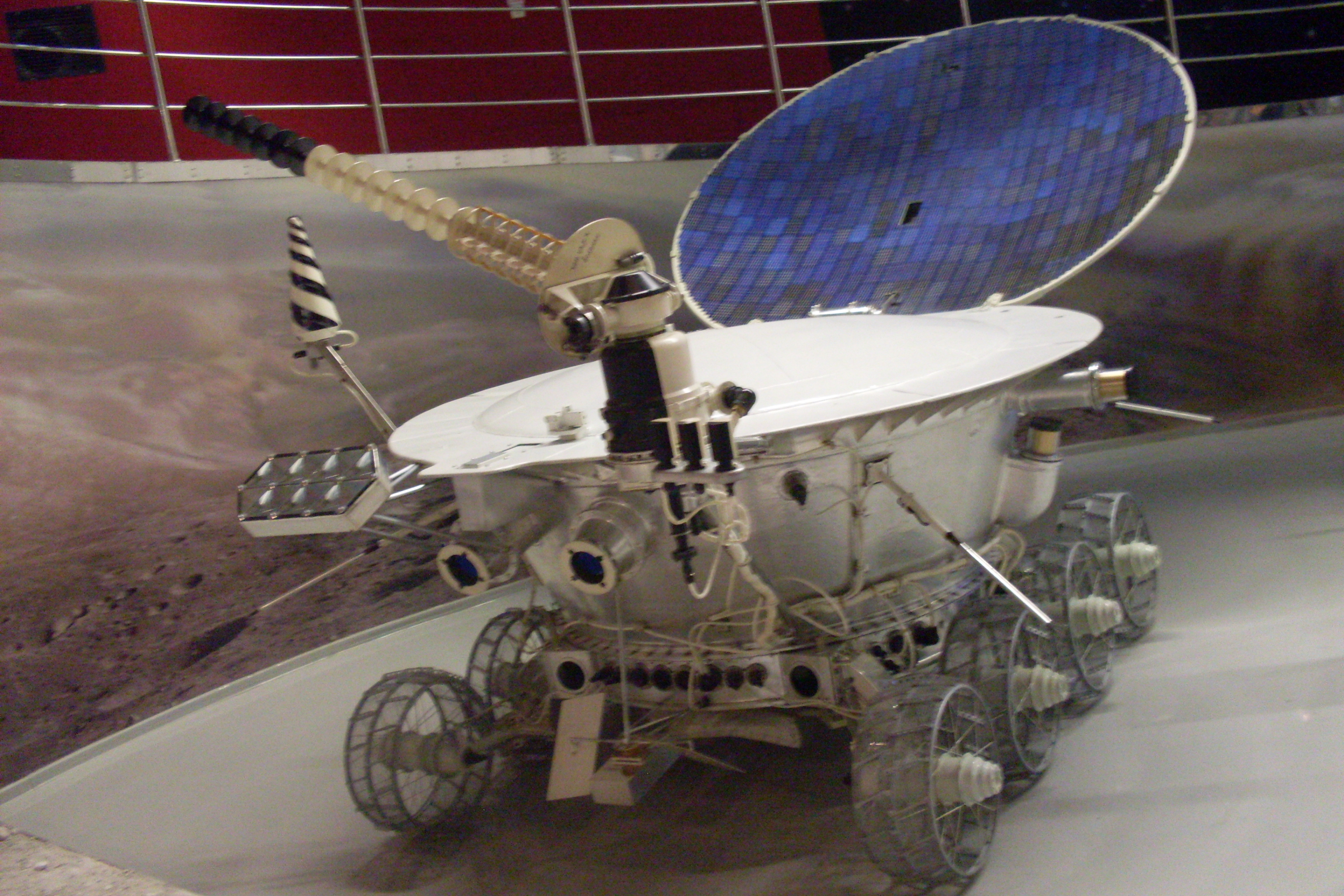
A full-size Lunokhod 1 model at Moscow’s Memorial Museum of Astronautics in 2011.
Armael · CC0 1.0 · Original recordImage changes
Display copies resized; original preserved.
The words
Babakin
As head of the Lavochkin bureau, Babakin directed the rover project. Chassis specialist Aleksandr Kemurdzhian worked with him on its redesign.
pp. 529–530 · Siddiqi: rover designers and ground crews (opens a new tab)
Crimea
Earth-based teams in Crimea directed the rover’s movements. Their work was shared among a driver, navigator, engineer, commander, and antenna operator.
p. 741, note 139 · Siddiqi: rover designers and ground crews (opens a new tab)
Eight Wheels
Eight independently powered wheels supported Lunokhod’s rounded instrument compartment. This wheeled chassis carried cameras and scientific equipment across the lunar surface.
pp. 72–73 · JPL: wheels, solar power and night heating (opens a new tab)
Latypov
Latypov drove Lunokhod 1 off its landing platform on November 17, 1970. The vehicle descended a ramp and began exploring under commands from Earth.
p. 97 · NASA mission history: the two Lunokhods (opens a new tab)
Le Monnier
Lunokhod 2 explored Le Monnier crater after Luna 21 landed there in January 1973. The rover examined soil and took panoramic photographs along its route.
pp. 113–114 · NASA mission history: the two Lunokhods (opens a new tab)
Luna Seventeen
Luna 17 delivered Lunokhod 1 to the Moon in November 1970. The lander lowered ramps so the rover could drive down onto the surface.
p. 97 · NASA mission history: the two Lunokhods (opens a new tab)
Lunar Night
The rovers worked through daylight and paused when the Sun set. Their survival depended on keeping their instrument compartments warm until the next sunrise.
pp. 72–74 · JPL: wheels, solar power and night heating (opens a new tab)
Lunokhod
Russian for moonwalker.
The Lunokhod rovers were mobile scientific stations sent to the Moon by the Soviet Union. Their cameras and instruments investigated the surface without an onboard crew.
Mare Imbrium
The Moon’s Sea of Rains.
Lunokhod 1 explored the basalt plain of Mare Imbrium. Orbital photographs later showed its winding wheel tracks and the lander that brought it to the Moon.
LROC: Lunokhod 1 and its tracks (opens a new tab) · LROC: the Sea of Rains (opens a new tab)
Polonium
A polonium-210 radioisotope source supplied heat through the lunar night. It protected internal equipment while the solar-powered rover waited for daylight.
pp. 72–74 · JPL: wheels, solar power and night heating (opens a new tab)
Proton
Proton-K rockets with Blok D upper stages launched the two rover missions: Luna 17 in 1970 and Luna 21 in 1973.
pp. 97, 113 · NASA mission history: the two Lunokhods (opens a new tab)
Reflector
The French-built laser reflectors bounced light back toward Earth. Observatories used the returned signals to measure the distance between Earth and the Moon.
Did you know?
In April 2010, the Apache Point team recovered Lunokhod 1’s laser reflector after decades without reliable observations. Lunar orbiter images helped locate it.
LROC: Lunokhod 1 and its tracks (opens a new tab) · Siddiqi: rover designers and ground crews (opens a new tab) · APOLLO: recovering the lunar reflector (opens a new tab)
Remote Control
Operators on Earth sent movement commands using television pictures from the rovers. Different cameras helped with navigation and recorded detailed panoramas for scientific study.
Did you know?
At a 1973 Moscow conference, an American scientist shared photographs taken before Apollo 17’s landing. Soviet accounts said Lunokhod 2’s drivers later used them.
Solar Panel
A solar panel lined the inside of the hinged lid. Open in daylight, it supplied electricity and recharged the rover’s batteries.
pp. 73–74 · JPL: wheels, solar power and night heating (opens a new tab)
Time Lag
Commands took time to reach the Moon, and the crew had to wait for confirmation of a maneuver. Steering therefore depended on delayed information.
p. 741 · Siddiqi: rover designers and ground crews (opens a new tab)
Sources
- Beyond Earth: A Chronicle of Deep Space Exploration, 1958–2016Asif A. Siddiqi; NASA History Division, NASA SP-2018-4041, second edition, 2018; printed pp. 97–98 and 113–114
- Challenge to Apollo: The Soviet Union and the Space Race, 1945–1974, Part 2Asif A. Siddiqi; NASA History Division, NASA/SP-2000-4408, 2000; printed pp. 529–530 and 741, including note 139
- Extreme Environment Technologies for Future Space Science MissionsElizabeth Kolawa and colleagues; NASA–Jet Propulsion Laboratory, JPL D-32832; September 19, 2007; printed pp. 72–74
- Survive the Night DustNASA Technical Reports Server, document 20220018433; December 2022 presentation; slides numbered 16–18
- Lunokhod 1 RevisitedJeff Plescia; Lunar Reconnaissance Orbiter Camera, NASA/GSFC/Arizona State University; March 14, 2012
- Chang'e 3 Lander and Rover From AboveLunar Reconnaissance Orbiter Camera, NASA/GSFC/Arizona State University; opening description of Mare Imbrium, used only for the place-name equivalent
- Lunar RetroreflectorsApache Point Observatory Lunar Laser-ranging Operation (APOLLO); Corner Cube Prisms and Lunokhod sections; dated April 2010 recovery account