
The Space Race
Puzzle 22 · The Mercury Seven · Page 38 in print
Aurora 7
Slayton named the capsule Delta 7; Carpenter, flying in his place, chose Aurora 7.
Jump to a word
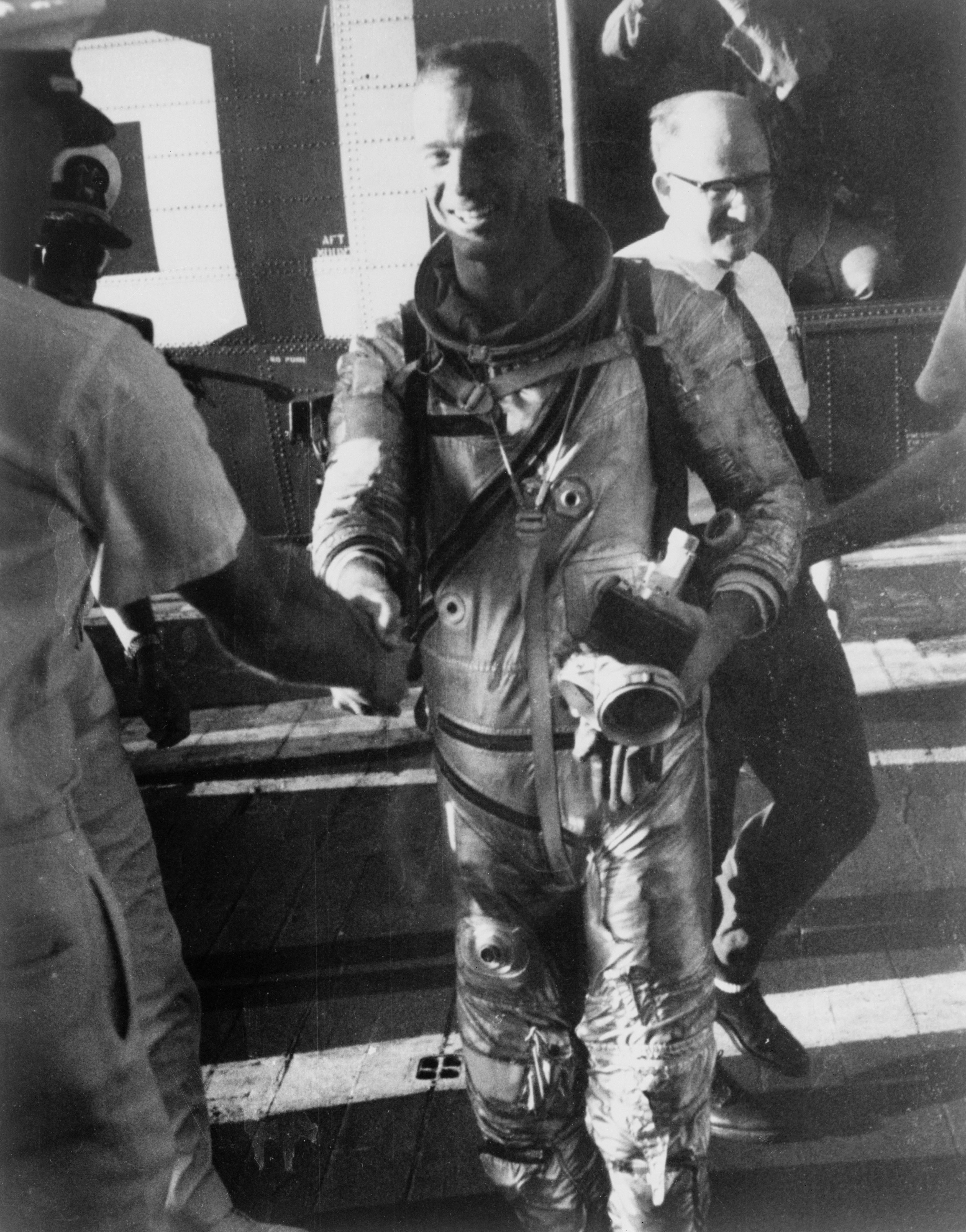
Scott Carpenter aboard USS Intrepid after the Aurora 7 mission.
NASA / Johnson Space Center (s62-04027) · NASA media-use guidelines · Original recordThe words
Airglow
A faint light emitted by gases in Earth’s upper atmosphere.
Carpenter observed a narrow luminous band above Earth’s horizon. His reports continued the study of the airglow that Glenn had seen on the preceding Mercury mission.
NASA history: Aurora 7 in flight (opens a new tab) · NASA: the light of the upper atmosphere (opens a new tab)
Aurora
Aurora 7 was Carpenter’s name for the Mercury spacecraft that carried him around Earth three times on May 24, 1962.
Balloon
A tethered balloon tested color visibility and atmospheric drag during Carpenter’s second orbit. It inflated only partly, limiting the experiment’s success.
Did you know?
The balloon was painted in five colors so experimenters could compare how they looked in space. A seam tore before it inflated fully.
NASA: Aurora 7 mission record (opens a new tab) · NASA: Carpenter’s flight and recovery (opens a new tab)
Boulder
Carpenter was born and raised in Boulder, Colorado. He graduated from Boulder High School in 1943 and later studied aeronautical engineering at the University of Colorado.
Did you know?
Carpenter left the university in 1949 one course requirement short of graduating. It awarded him his bachelor’s degree in 1962, after Aurora 7.
CU Boulder: Carpenter’s hometown and degree (opens a new tab)
Carpenter
Scott Carpenter became the second American to orbit Earth on May 24, 1962. During his three-orbit flight, he photographed Earth and carried out scientific experiments.
Delta
Deke Slayton had named the spacecraft Delta 7. After doctors grounded him because of a heart irregularity, NASA assigned Carpenter to the flight; Carpenter chose Aurora 7.
Fuel Shortage
Unintended use of powerful steering jets and simultaneous operation of two control systems increased fuel consumption. The supply ran out during reentry, leaving the capsule without powered attitude control.
pp. 6–7, Fuel Usage · NASA flight report: controls and fuel (opens a new tab)
Grand Turk
After arriving aboard Intrepid, Carpenter flew to Grand Turk Island in the Turks and Caicos Islands. There he underwent medical examinations and two days of technical debriefings.
Life Raft
After the off-target splashdown, Carpenter left the listing capsule and waited in a life raft tied to it. Recovery aircraft found him before a helicopter arrived.
Overshoot
Aurora 7 landed beyond its planned recovery area. Misalignment during the braking burn, a late start and lower-than-expected retrorocket thrust all contributed to the overshoot.
Pararescue
Two Air Force pararescue men parachuted into the sea and swam to Carpenter. They helped secure a flotation collar around Aurora 7 while awaiting the recovery helicopters.
Peroxide
Aurora 7 used hydrogen peroxide as fuel for its small steering thrusters. These jets changed the capsule’s orientation; their dwindling fuel supply became a concern during the flight.
pp. 450, 453–454 · NASA history: Aurora 7 in flight (opens a new tab)
Retrofire
Firing rockets to slow a spacecraft out of orbit.
Aurora 7’s retrorockets began firing late during the return maneuver. The delay was one of several factors that carried the capsule beyond its planned landing point.
USS Intrepid
The aircraft carrier USS Intrepid was Aurora 7’s prime recovery ship. Its helicopters retrieved Carpenter, while the USS John R. Pierce later recovered the capsule.
Yaw Error
A sideways error in the direction a spacecraft faces.
Aurora 7 was turned sideways from the intended direction during retrofire. Its braking thrust therefore did not act directly along the flight path, contributing to the landing overshoot.
Sources
- 60 Years Ago: Scott Carpenter Orbits the Earth aboard Aurora 7John Uri; NASA Johnson Space Center, May 24, 2022
- Mercury Atlas 7: Aurora 7NASA; mission overview, landing and mission highlights
- This New Ocean: A History of Project MercuryLoyd S. Swenson, Jr., James M. Grimwood and Charles C. Alexander; NASA SP-4201, 1998 edition; printed pp. 450–455
- Why NASA Watches Airglow, the Colors of the (Upper Atmospheric) WindLina Tran; NASA Goddard Space Flight Center, October 22, 2018
- CU astronaut-alumnus Scott Carpenter looks back at 50th anniversary of Aurora 7 missionUniversity of Colorado Boulder, May 21, 2012; interview and university history
- Results of the Second U.S. Manned Orbital Space Flight, May 24, 1962NASA SP-6; John H. Boynton and E. M. Fields, Spacecraft and Launch-Vehicle Performance, printed pp. 1, 6–7