
The Space Race
Puzzle 23 · The Mercury Seven · Page 39 in print
Sigma 7
Schirra named Sigma 7 for the Greek letter engineers use to symbolize summation.
Jump to a word
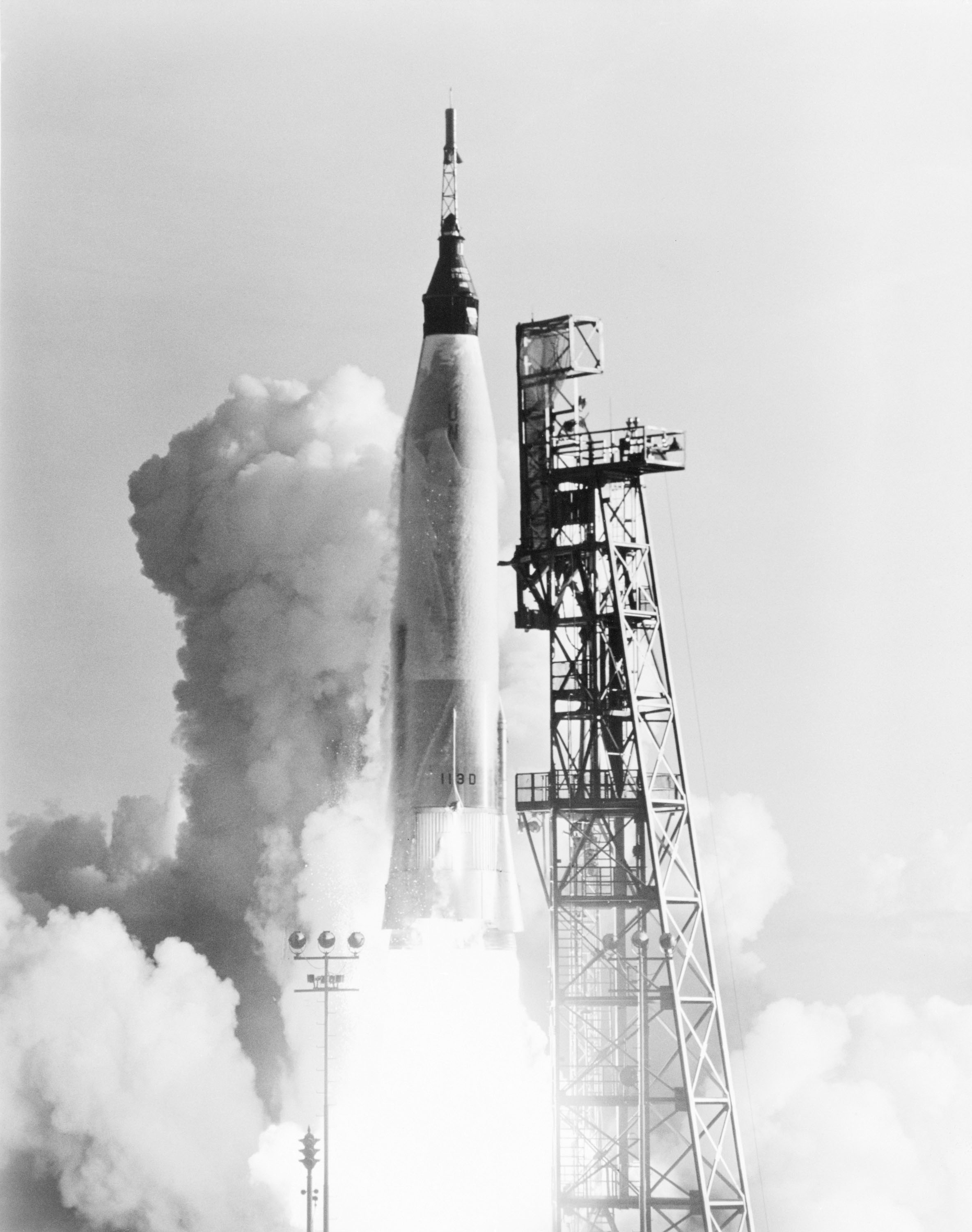
The Mercury-Atlas 8 launch carrying Sigma 7 on October 3, 1962.
NASA / Johnson Space Center (S62-06006) · NASA media-use guidelines · Original recordThe words
Coolant Valve
Schirra’s suit became too warm early in the flight. He brought the temperature under control; postflight investigators found that dried lubricant had restricted flow through a coolant valve.
pp. 476, 484 · NASA history: Schirra’s suit and hatch (opens a new tab)
Dosimeter
An instrument that measures accumulated exposure to radiation.
Sigma 7 carried several dosimeters to record Schirra’s radiation exposure. Some could be read during flight, while others were placed in his helmet liner and clothing.
pp. 83–84, Special Studies · NASA report: tests and Schirra’s account (opens a new tab)
Free Drift
Flight without active control of a spacecraft’s orientation.
Schirra used free drift for part of Sigma 7’s flight to conserve steering fuel. It also gave him time to observe Earth and take photographs.
Fuel Economy
Schirra’s smooth maneuvers and careful use of the steering controls kept fuel consumption below the flight plan’s prediction. The results helped NASA assess Mercury’s ability to make longer flights.
pp. 95–96 · NASA report: tests and Schirra’s account (opens a new tab)
Greek Letter
The capital Greek letter sigma, Σ, is used for summation in mathematics. Schirra chose it as an engineering symbol for his Mercury flight.
Hackensack
Hackensack, New Jersey, was Schirra’s birthplace. After Sigma 7, welcome-home celebrations took him through Hackensack and his hometown of Oradell.
Hasselblad
Schirra carried a modified Hasselblad 500C camera aboard Sigma 7. The photographs he brought back began a long association between Hasselblad cameras and American spaceflight.
Did you know?
The camera began as a standard consumer model. Its black finish helped reduce reflections when Schirra photographed the view from orbit.
Pacific Ocean
Sigma 7 became the first crewed Mercury mission to splash down in the Pacific Ocean, where Kearsarge waited northeast of Midway Island.
Plunger
Once Sigma 7 was aboard Kearsarge, Schirra used the plunger that released its explosive side hatch. The action left a superficial injury on his hand.
p. 484 · NASA history: Schirra’s suit and hatch (opens a new tab)
Sigma
Sigma 7 was the capsule flown by Schirra on Mercury-Atlas 8. The number honored the seven astronauts selected for Project Mercury.
Did you know?
During launch preparations, Schirra found a dummy ignition key in his capsule. He recalled it as one of the small gestures from people preparing his flight.
NASA report: tests and Schirra’s account (opens a new tab) · NASA: Sigma 7 mission record (opens a new tab)
Six Orbits
Schirra completed six Earth orbits on October 3, 1962. The mission tested Mercury’s spacecraft, tracking network and support teams over a longer flight than the earlier three-orbit missions.
Summation
Schirra said Sigma represented the combined efforts of the Mercury team. The name acknowledged the many people whose work went into the spacecraft and mission.
p. 96, Pilot’s Flight Report · NASA report: tests and Schirra’s account (opens a new tab)
USS Kearsarge
USS Kearsarge recovered Sigma 7 with Schirra still inside. The carrier then provided a place for his medical examinations and technical debriefings as it sailed toward Hawaii.
Wally Schirra
Schirra piloted Sigma 7 and later commanded Gemini 6A and Apollo 7, flying in all three of the early American human-spaceflight programs.
Whale Boat
A motor whaleboat from Kearsarge carried a line to Sigma 7. Schirra remained inside the capsule while sailors prepared to hoist it onto the carrier.
Sources
- 60 Years Ago: Astronaut Schirra Orbits the Earth Six Times Aboard Sigma 7John Uri; NASA Johnson Space Center, October 3, 2022
- Mercury-Atlas 8: Sigma 7NASA; mission facts, objectives and recovery photographs
- This New Ocean: A History of Project MercuryLoyd S. Swenson, Jr., James M. Grimwood and Charles C. Alexander; NASA SP-4201, 1998 edition; printed pp. 476, 483–484
- First U.S. Manned Six-Pass Orbital Mission (Mercury-Atlas 8, Spacecraft 16): Description and Performance AnalysisEdited by John H. Boynton; NASA TN D-4807, September 1968; printed pp. 83–84, 94–96
- Historic Partnership Captures Our ImaginationNASA Spinoff, 2008; Originating Technology/NASA Contribution
- Mercury Seven Astronaut BiographiesNASA History; Tara Gray’s Walter “Wally” Schirra biography; Mercury, Gemini 6A and Apollo 7 passages