
The Space Race
Puzzle 21 · The Mercury Seven · Page 37 in print
Friendship 7
Glenn’s flight was always planned as three orbits; the heat-shield scare did not shorten it.
Jump to a word
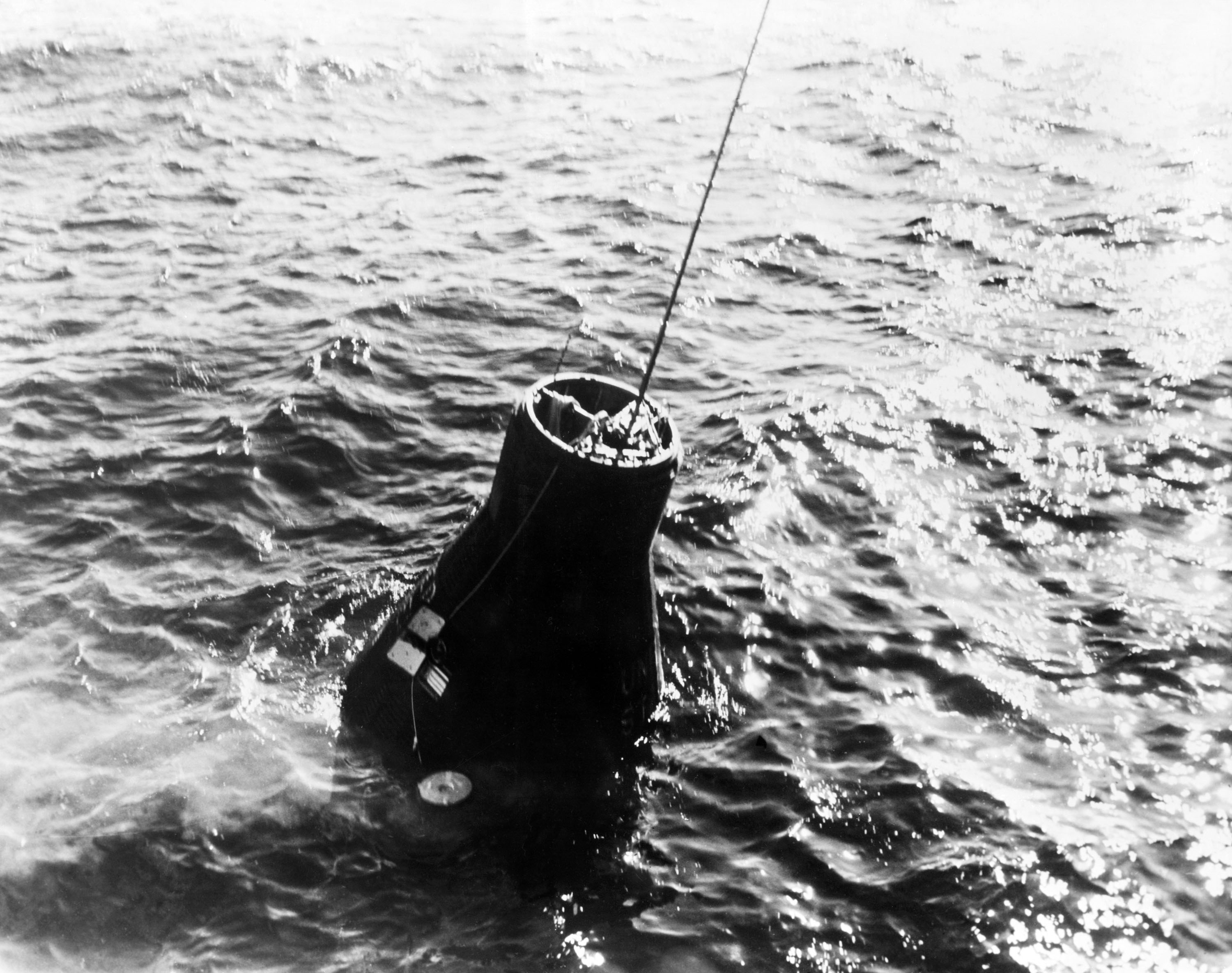
Friendship 7 during recovery from the Atlantic.
NASA / Johnson Space Center (S62-00941) · NASA media-use guidelines · Original recordThe words
Applesauce
Glenn ate applesauce from a tube during Friendship 7. Eating in orbit was part of the mission’s investigation of how the human body functioned in weightlessness.
Fireflies
At orbital sunrise, Glenn saw bright specks outside Friendship 7. The objects he called fireflies were ice particles traveling with the capsule and illuminated by sunlight.
Fly by Wire
Control commands sent electrically.
Glenn found fly-by-wire useful when Friendship 7’s automatic orientation control developed problems. It helped him keep the capsule pointed correctly during the flight.
pp. 196–197, 429 · NASA history: Mercury control and tracking (opens a new tab)
Friendship
Glenn named his Mercury spacecraft Friendship 7. It carried him on the Mercury-Atlas 6 mission, the first American orbital spaceflight.
Did you know?
Artist Cecilia “Cece” Bibby painted the Friendship 7 name on the capsule before launch, with Glenn watching the work.
Godspeed
Scott Carpenter’s recorded send-off for Glenn was “Godspeed, John Glenn.” Glenn did not hear the words during his 1962 flight.
Did you know?
Carpenter’s wish was repeated on tape when Glenn returned to space aboard Discovery in 1998.
Booth: Carpenter’s recorded send-off (opens a new tab) · NASA: Carpenter’s 1998 send-off (opens a new tab)
John Glenn
On February 20, 1962, Glenn became the first American to orbit Earth. He returned to space aboard Discovery in 1998, 36 years after Friendship 7.
Joint Session
Glenn addressed Congress about Friendship 7 on February 26, 1962. House records classify the appearance as a joint meeting of the two houses.
Photograph PA2012.04.0032 · House records: Glenn’s joint meeting (opens a new tab)
Landing Bag
Mercury’s landing bag cushioned the capsule at splashdown. A faulty signal suggested premature deployment, raising concern that Glenn’s heat shield was no longer secured.
pp. 429, 436 · NASA: Glenn’s flight and recovery (opens a new tab) · NASA history: Mercury control and tracking (opens a new tab)
Muchea
At the Muchea tracking station in Western Australia, Gordon Cooper spoke with Glenn as Friendship 7 passed overhead. The station belonged to Mercury’s worldwide tracking network.
Australian archives: Muchea station (opens a new tab) · NASA history: Mercury control and tracking (opens a new tab)
New Concord
Glenn grew up in New Concord, Ohio, where his family moved when he was two. The town welcomed John and Annie home with a parade on March 3, 1962.
Did you know?
The Glenn family’s house was moved when U.S. Route 40 was widened in the early 1940s. It was relocated elsewhere in New Concord.
Perth
Perth residents turned on their lights in salute to Glenn’s 1962 flight. From orbit, he saw the bright area around the city.
Retropack
A pack of rockets used to slow the spacecraft.
Controllers kept Friendship 7’s retropack attached for reentry because of the heat-shield warning. They hoped its straps would hold a loose shield in place.
pp. 429, 431–432 · NASA history: Mercury control and tracking (opens a new tab)
Sunset
As Friendship 7 crossed the Indian Ocean, Glenn watched the Sun set. He described orange and blue layers spreading along the horizon.
p. 428 · NASA history: Mercury control and tracking (opens a new tab)
Three Orbits
Friendship 7’s planned mission was three orbits. Glenn completed all three; the heat-shield warning did not cut short a seven-orbit flight.
USS Noa
The destroyer USS Noa recovered Friendship 7 with Glenn still inside. Sailors lifted the capsule aboard, and Glenn later transferred by helicopter to the carrier USS Randolph.
Sources
- 60 Years Ago: John Glenn, the First American to Orbit the Earth aboard Friendship 7John Uri; NASA Johnson Space Center, February 18, 2022
- The Myth of John Glenn’s Seven-Orbit MissionMichael Neufeld; Smithsonian National Air and Space Museum, February 20, 2022
- This New Ocean: A History of Project MercuryLoyd S. Swenson, Jr., James M. Grimwood and Charles C. Alexander; NASA SP-4201, 1998 edition; printed pp. 196–197, 428–432 and 436
- John Glenn: Biographical SketchOhio State University Libraries; John Glenn Archives, biographical sketch
- Astronaut John Glenn Addresses a Joint Meeting of CongressU.S. House of Representatives, History, Art & Archives; NASA photograph PA2012.04.0032, February 26, 1962
- Correcting the John Glenn “Seven-Orbit” MythRick Booth; NASA History Division News & Notes, volume 38, numbers 2 and 3, second and third quarters 2021, pp. 15–17
- John Glenn: Discovery LaunchNASA Astronomy Picture of the Day; October 30, 1998
- People of Perth again asked to turn on their lights for astronaut John Glenn [Audio]Western Australian Government; archived Richard Court government media statement, October 1998
- Group photograph of Mercury astronauts presented to Muchea Tracking StationCollections WA; National Archives of Australia collection, record cwa-org-140-9257087