
The Space Race
Puzzle 20 · The Mercury Seven · Page 36 in print
Liberty Bell 7
A crack was painted on Liberty Bell 7 as a tribute to the original Liberty Bell.
Jump to a word
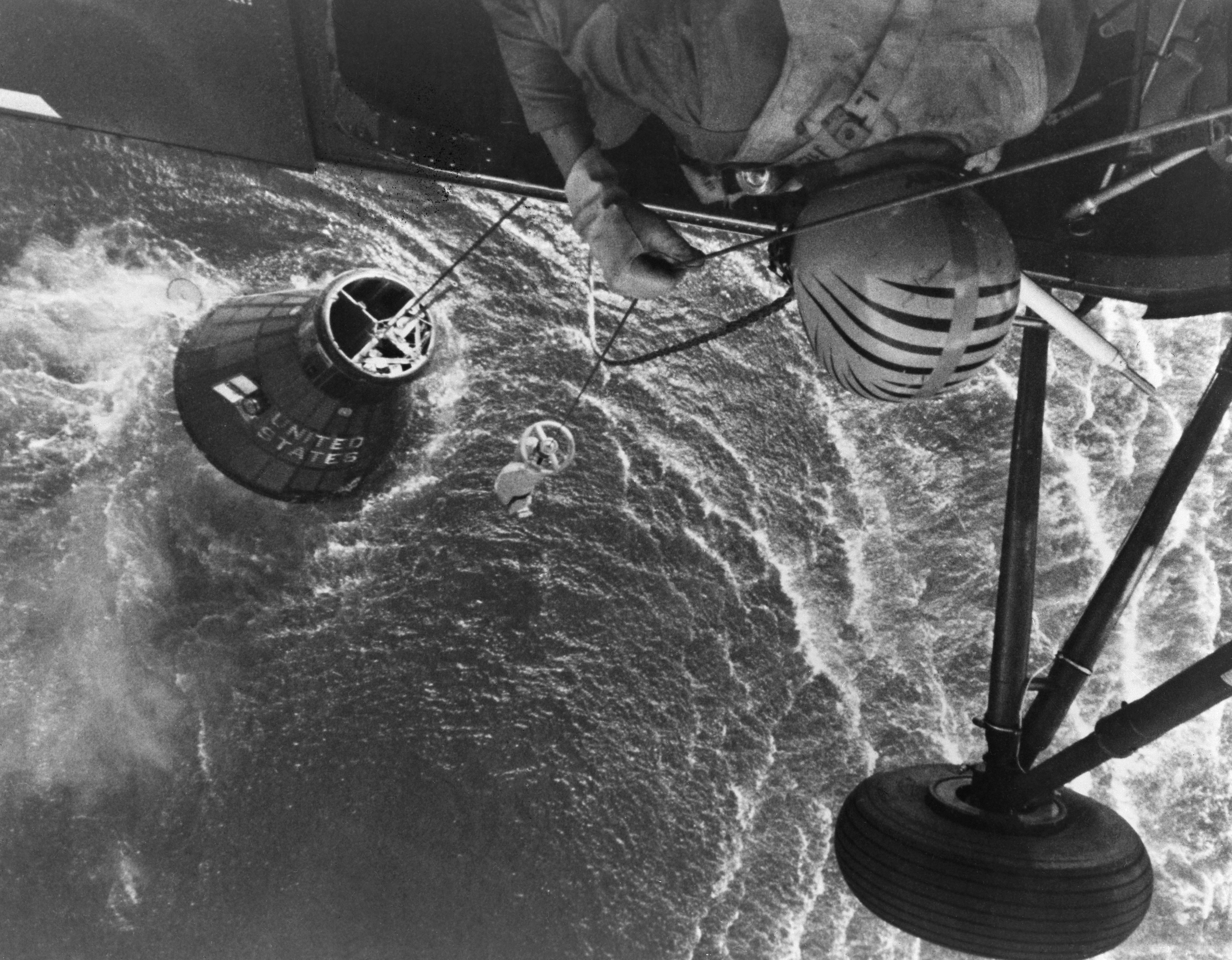
A helicopter attempts to recover Liberty Bell 7 after splashdown.
NASA / Johnson Space Center (s61-02824) · NASA media-use guidelines · Original recordThe words
Cosmosphere
After its 1999 recovery, Liberty Bell 7 went to the Cosmosphere in Hutchinson, Kansas. Conservators cleaned and preserved the capsule while retaining its historic appearance.
Did you know?
The restoration took place in view of museum visitors. A live webcam also allowed people elsewhere to watch the conservation work.
Cosmosphere: the search and preservation (opens a new tab) · Smithsonian: Liberty Bell 7’s recovery (opens a new tab)
Curt Newport
Deep-sea salvage expert Curt Newport worked with the Cosmosphere on the search. In 1999, his Oceaneering team recovered Liberty Bell 7.
Did you know?
Search planners combined ship logs and interviews with weather and tide studies to narrow the area where Liberty Bell 7 might have sunk.
Cosmosphere: the search and preservation (opens a new tab) · Smithsonian: Liberty Bell 7’s recovery (opens a new tab)
Gus Grissom
Grissom became the second American in space aboard Liberty Bell 7 on July 21, 1961. He later commanded Gemini 3 and died in the Apollo 1 launch-pad fire in 1967.
Horse Collar
A sling for hoisting a person from water.
A helicopter crew hoisted Grissom to safety with a horse collar after water entered his suit and made staying afloat difficult.
p. 375 · NASA history: Grissom’s flight and rescue (opens a new tab)
Hunt Club
Hunt Club was used in radio calls between Grissom and the recovery helicopters. Numbers following the name identified individual aircraft in the mission transcript.
Recovery transcript · NASA archive: Liberty Bell 7 radio calls (opens a new tab)
Igniter
A device that initiates an explosive charge.
The igniter belonged to Liberty Bell 7’s explosive hatch system. After the premature opening, investigators tested the hatch assembly but could not reproduce the failure.
pp. 367, 376 · NASA history: Grissom’s flight and rescue (opens a new tab)
Liberty Bell
Grissom chose Liberty Bell 7 as the call sign for his bell-shaped spacecraft. The name invoked the original bell and its association with freedom.
Mission Fun Facts · Cosmosphere: the capsule’s markings (opens a new tab)
Ocean Floor
Liberty Bell 7 lay about 16,000 feet (4,900 m) below the Atlantic for nearly 38 years, until the 1999 expedition located it.
Painted Crack
The spacecraft carried a painted imitation of the original Liberty Bell’s crack. The marking connected Grissom’s capsule with the historic bell recalled in its name.
Mission Fun Facts · Cosmosphere: the capsule’s markings (opens a new tab)
Picture Window
Liberty Bell 7 replaced Freedom 7’s two small portholes with a larger window above the astronaut. It gave Grissom a wider view during the flight.
Roll of Dimes
Grissom recalled carrying rolls of dimes for friends’ children. While struggling to stay afloat, he wished he could discard the souvenirs in his suit.
Grissom biography, note 26 · NASA: Grissom’s account of his souvenirs (opens a new tab)
Salvage
Liberty Bell 7 was raised from the Atlantic on July 20, 1999. The spacecraft returned to Port Canaveral the next day, nearly 38 years after its flight.
Recovery Fun Facts · Cosmosphere: the capsule’s markings (opens a new tab)
Side Hatch
The hatch ejected after splashdown, letting seawater into Liberty Bell 7. Grissom escaped into the ocean; NASA’s postflight investigation did not establish what triggered it.
pp. 373, 376–377 · NASA history: Grissom’s flight and rescue (opens a new tab)
USS Randolph
USS Randolph was the aircraft carrier supporting the recovery. Grissom was brought aboard, received medical checks and began debriefing after his rescue from the ocean.
Smithsonian: Liberty Bell 7’s recovery (opens a new tab) · NASA history: Grissom’s flight and rescue (opens a new tab)
Waterlogged
Seawater flooding Liberty Bell 7 made it too heavy for the recovery helicopter to carry. The crew released the capsule, which sank into the Atlantic.
p. 375 · NASA history: Grissom’s flight and rescue (opens a new tab)
Sources
- Liberty Bell 7: The Peril and Promise of Space ExplorationCosmosphere; flight, expedition and conservation account; read in Chrome on October 25, 2026
- The Sinking of Liberty Bell 7: Gus Grissom’s Near-Fatal MissionMichael J. Neufeld; Smithsonian National Air and Space Museum, July 21, 2021
- This New Ocean: A History of Project MercuryLoyd S. Swenson, Jr., James M. Grimwood and Charles C. Alexander; NASA SP-4201, 1998 edition; printed pp. 366–377
- Liberty Bell 7 Fun FactsCosmosphere; 60th-anniversary account; read in Chrome on October 25, 2026
- Mercury Seven Astronaut BiographiesNASA History; Grissom biography, Liberty Bell 7 flight/recovery passages and cited recollections
- MR-4 Mission JournalJohn Pfannerstill’s Space Chronicle, hosted by NASA History; last modified January 26, 1999; radio transcript and identified pilot-report excerpts