
The Space Race
Puzzle 19 · The Mercury Seven · Page 35 in print
Freedom 7
Irritated by launch delays, Shepard reportedly told controllers to “light this candle.”
Jump to a word
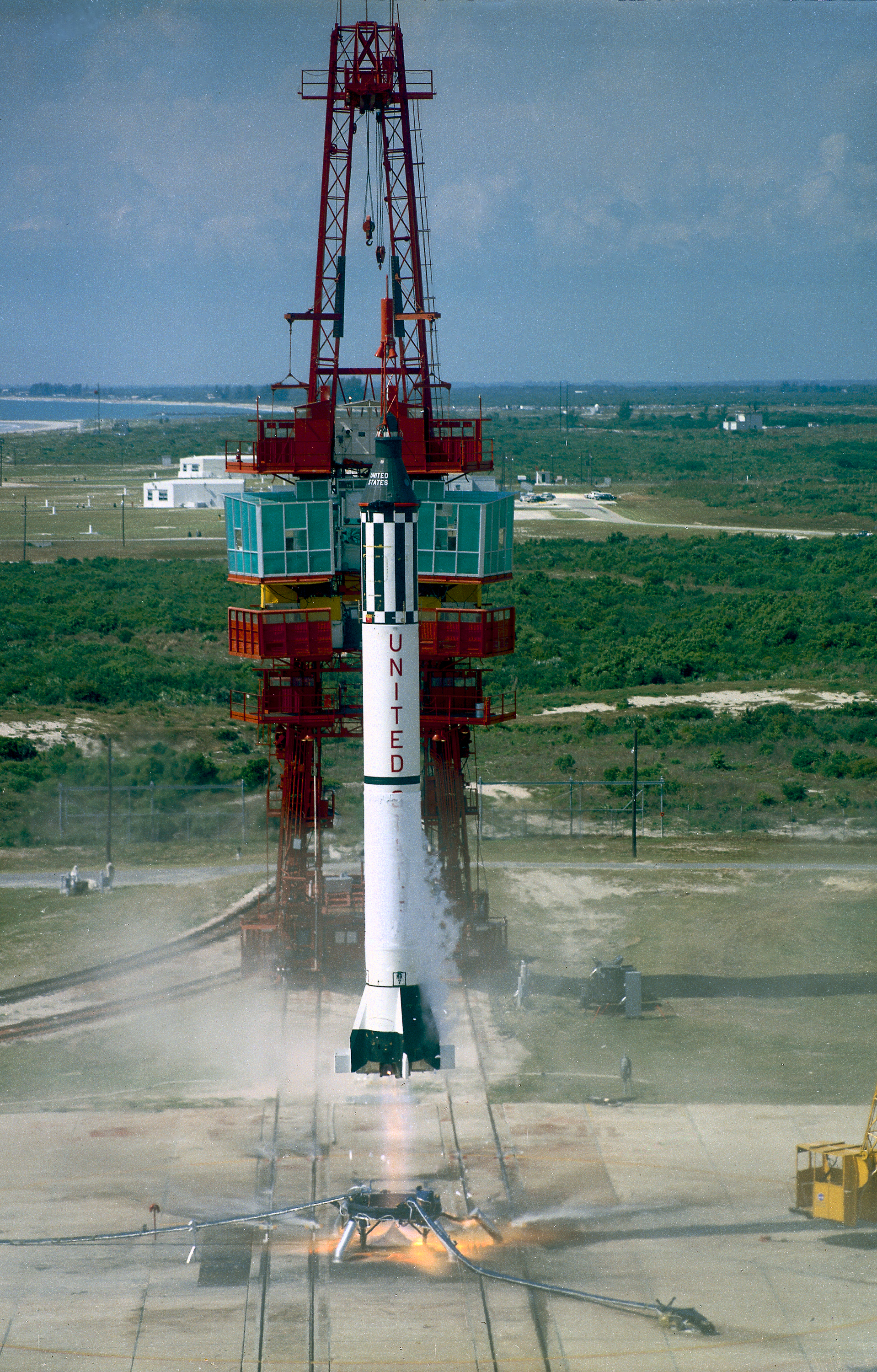
Freedom 7’s Mercury-Redstone rocket lifts off on May 5, 1961.
NASA / Marshall Space Flight Center (6100884) · NASA media-use guidelines · Original recordThe words
Alan Shepard
Shepard piloted Freedom 7 in 1961. He returned to space ten years later as commander of Apollo 14, walking on the Moon in 1971.
Cherry Picker
The cherry picker was a mobile exit tower beside the Mercury rocket. It offered the astronaut an emergency route away from the pad before launch.
Did you know?
The mobile tower was delivered to Cape Canaveral on October 24, 1960, months before Shepard’s flight.
NASA chronology: the cherry picker (opens a new tab) · NASA history: Mercury’s ground teams (opens a new tab)
Chris Kraft
Christopher C. Kraft served as flight director and designed the Mercury Control Center at Cape Canaveral. The center’s team monitored Shepard and Freedom 7 throughout the mission.
Complex Five
Shepard’s Mercury-Redstone rocket lifted off from Launch Pad 5 at Cape Canaveral, Florida, on May 5, 1961. The pad supported the first American human spaceflight.
Control Stick
A control stick in Shepard’s right hand operated small jets that changed Freedom 7’s orientation. It let him test how the capsule responded to his movements.
Did you know?
Shepard studied a photographic chart of his instrument panel before flight because the capsule’s cramped interior made extended study awkward.
Object A19670175000 · Smithsonian: Shepard’s instrument panel (opens a new tab)
First American
Shepard became the first American in space on May 5, 1961. Yuri Gagarin had made the first human spaceflight on April 12, less than a month earlier.
Freedom
Freedom 7 was the name Shepard gave his Mercury capsule. NASA designated the mission Mercury-Redstone 3, or MR-3.
Did you know?
NASA transferred Freedom 7 to the Smithsonian in October 1961. It was the first human spacecraft added to the National Collection.
Object A19620021000 · Smithsonian: the Freedom 7 capsule (opens a new tab)
Grand Bahama
After an initial medical examination aboard the recovery ship, Shepard traveled to Grand Bahama Island. Medical and technical specialists there questioned him about the flight and spacecraft performance.
p. 358 · NASA history: Mercury’s ground teams (opens a new tab)
Lake Champlain
The aircraft carrier USS Lake Champlain served as Freedom 7’s recovery ship. A helicopter brought Shepard and his capsule aboard after their Atlantic splashdown.
Manual Control
During the weightless part of his flight, Shepard took over control of Freedom 7’s orientation. He tested the capsule’s response while the ground team followed his progress.
McDonnell
McDonnell Aircraft Corporation of St. Louis built Mercury spacecraft for NASA. Its single-seat Freedom 7 capsule carried Shepard on the program’s first human flight.
Smithsonian: the Freedom 7 capsule (opens a new tab) · NASA: Shepard’s flight and recovery (opens a new tab)
Portholes
Freedom 7 had small portholes that gave Shepard a limited view. Later Mercury capsules used a larger window in front of the astronaut’s head.
Smithsonian: the Freedom 7 capsule (opens a new tab) · Smithsonian: Shepard’s instrument panel (opens a new tab)
Rose Garden
President John F. Kennedy presented Shepard with NASA’s Distinguished Service Medal in the White House Rose Garden on May 8, 1961.
Photograph F08_002_01 · NASA: Shepard’s White House medal (opens a new tab)
Suborbital
Freedom 7 reached space and returned to Earth without completing an orbit. Its entire flight lasted about fifteen minutes.
Mission Facts; Orbit · NASA: Freedom 7 mission facts (opens a new tab)
Trajectory
The path a spacecraft follows.
Freedom 7 splashed down about 300 miles (480 km) from Cape Canaveral. Its suborbital trajectory took Shepard into space and returned him to the sea.
Object A19620021000 · Smithsonian: the Freedom 7 capsule (opens a new tab)
Sources
- Mercury Capsule MR-3, "Freedom 7"Smithsonian National Air and Space Museum; object A19620021000
- May 5, 1961: Alan Shepard Becomes the First American in SpaceJohn Uri; NASA Johnson Space Center, May 5, 2021
- Light This Candle: What You Need to Know About Alan Shepard's Historic SpaceflightAmy Stamm; Smithsonian National Air and Space Museum, April 30, 2021
- Mercury-Redstone 3: Freedom 7NASA; Mission Facts and Orbit summary
- Training Diagram, ShepardSmithsonian National Air and Space Museum; object A19670175000, summary and long description
- Project Mercury – A Chronology, Part II (B)NASA History; Research and Development Phase, January 1960 through May 5, 1961; July 1960 entry and figure 40
- This New Ocean: A History of Project MercuryLoyd S. Swenson, Jr., James M. Grimwood and Charles C. Alexander; NASA SP-4201, 1998 edition; printed pp. 330, 342 and 352–360 consulted
- 058 Mercury Astronauts Meeting President KennedyNASA photograph F08_002_01; Cosmosphere collection, digitized by Fort Hays State University, 2021; photograph dated May 8, 1961