
The Space Race
Puzzle 18 · The Mercury Seven · Page 34 in print
Ham the Astrochimp
Ham was named for Holloman Aerospace Medical Center, the New Mexico lab that trained him.
Jump to a word
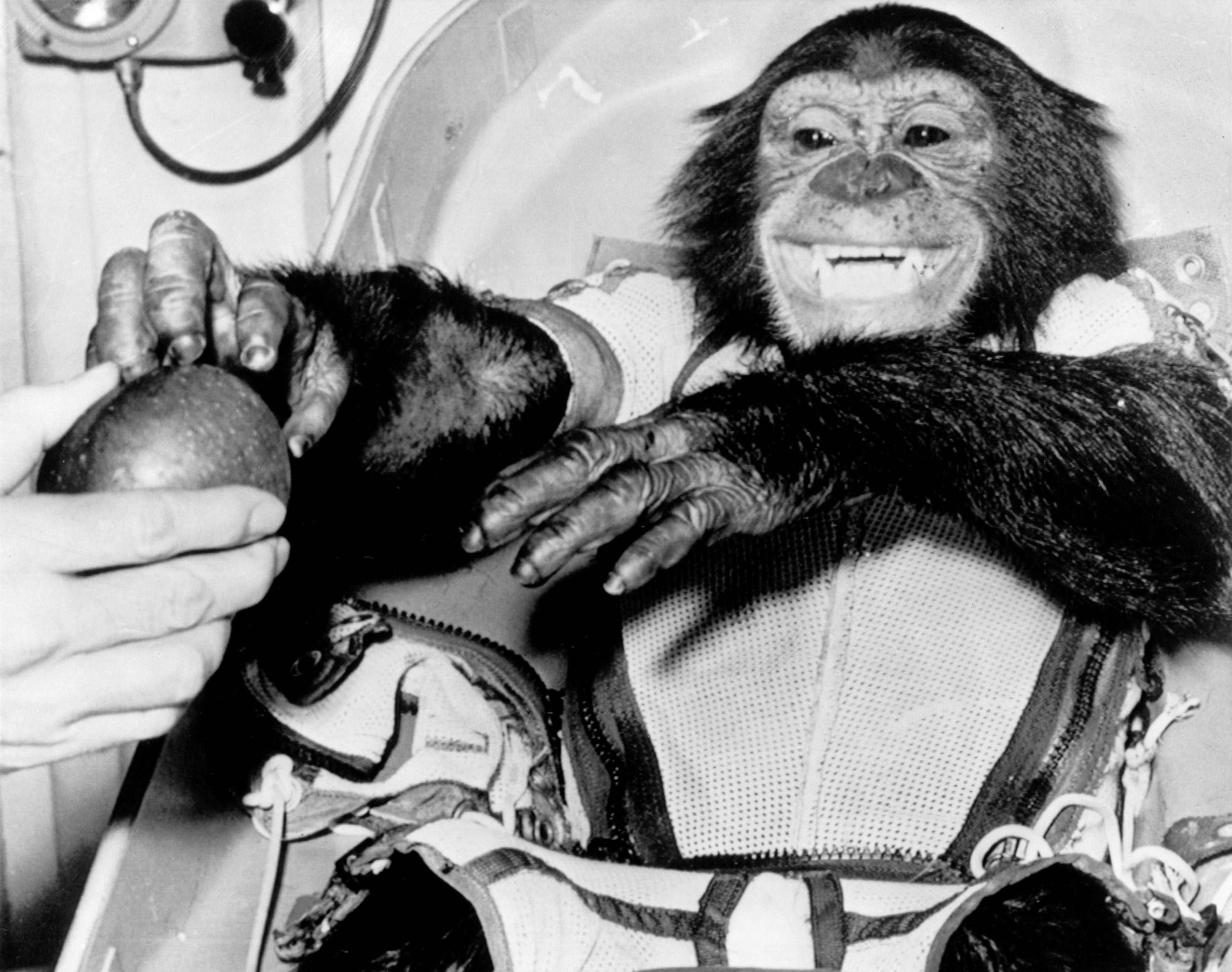
Ham after recovery from the Mercury-Redstone 2 flight.
NASA / Johnson Space Center (S63-18198) · NASA media-use guidelines · Original recordThe words
Alamogordo
After Ham died in 1983, his skeleton was retained for research. His other remains were buried at the International Space Hall of Fame in Alamogordo, New Mexico.
Astrochimp
Ham flew aboard Mercury-Redstone 2 on January 31, 1961, before the first American astronaut flight. His suborbital journey reached space without circling Earth.
Did you know?
A second chimpanzee, Enos, flew an orbital Mercury mission on November 29, 1961. His flight preceded John Glenn’s orbital mission.
NASA: Ham and his trainers (opens a new tab) · NASA: Mercury chimpanzee flight results (opens a new tab)
Banana Pellet
Banana pellets rewarded Ham’s correct training responses. Electrical shocks were also used when the chimpanzees failed to respond as required.
Blue Light
A blue light warned Ham to respond to a lever during flight. Failure to respond brought an electrical shock; researchers recorded his responses as a measure of performance.
p. 21 · NASA: Mercury chimpanzee flight results (opens a new tab)
Cabin Pressure
Ham’s Mercury spacecraft partly lost cabin pressure during flight. His separate pressurized couch protected his breathing, but after splashdown the spacecraft also began taking on water.
Cameroon
Ham was born in 1957 in the French Cameroons in West Africa. Trappers captured him before he was transported to the United States.
Chimpanzee
Researchers studied Ham’s learned behavior during spaceflight. He survived the mission, but the medical report found dehydration after his flight and prolonged restraint.
pp. 21–23, 29–31 · NASA: Mercury chimpanzee flight results (opens a new tab)
Holloman
Ham trained at Holloman Air Force Base in New Mexico. His name was an acronym for the Holloman Aerospace Medical Center, the laboratory that prepared him for flight.
Did you know?
Ham’s laboratory designation was Number 65, a name used in accounts of his preparations for spaceflight.
North Carolina: Ham’s historical marker (opens a new tab) · Smithsonian: Ham’s training and flight (opens a new tab)
Joseph Brady
Behavioral scientist Joseph V. Brady worked with NASA to design ways of studying chimpanzee behavior in flight. His work connected the Walter Reed research team with Mercury’s animal program.
Brady the Scientist · Thompson: Brady’s behavioral research (opens a new tab)
Lever
Ham operated levers on a test panel inside his couch. Researchers recorded his responses during launch, weightlessness and reentry to study how spaceflight affected learned behavior.
pp. 21–23 · NASA: Mercury chimpanzee flight results (opens a new tab)
National Zoo
Ham lived for many years alone at the National Zoo in Washington, D.C. In 1980, he moved to the North Carolina Zoo to live among other chimpanzees.
North Carolina: Ham’s years after flight (opens a new tab) · Smithsonian: Ham’s training and flight (opens a new tab)
New Mexico
Ham’s preparations began at Holloman in New Mexico and continued at Cape Canaveral in Florida. NASA records part of his training at the Cape’s Hangar S.
North Carolina: Ham’s historical marker (opens a new tab) · NASA: Ham and his trainers (opens a new tab)
Rare Bird Farm
Ham was sent to a Florida bird farm after his capture. In 1959, the U.S. Air Force acquired him and moved him to Holloman.
Reaction Time
The delay between a signal and a response.
NASA compared Ham’s in-flight blue-light responses with his preflight performance. Reaction times stayed close to the earlier average, although performance on the other lever task declined after reentry.
pp. 21–23 · NASA: Mercury chimpanzee flight results (opens a new tab)
USS Donner
The USS Donner served as Ham’s recovery ship after his Atlantic splashdown. NASA’s mission account pictures him aboard the ship following the Mercury-Redstone 2 flight.
Sources
- Mercury Primate Capsule and Ham the AstrochimpSmithsonian National Air and Space Museum; November 10, 2015
- Ham the Astrochimp (K-70)North Carolina Department of Natural and Cultural Resources; January 14, 2026
- May 5, 1961: Alan Shepard Becomes the First American in SpaceJohn Uri; NASA Johnson Space Center, May 5, 2021
- Chimpanzee Ham with TrainersNASA; January 31, 1961 image article
- Results of the Project Mercury Ballistic and Orbital Chimpanzee FlightsJames P. Henry and John D. Mosely, editors; NASA SP-39, 1963; foreword, acknowledgments and printed pp. 21–23, 29–31
- Astrochimp Ham’s Retirement Years in AsheboroNorth Carolina Department of Natural and Cultural Resources; September 25, 2016
- Joseph V. Brady: Synthesis Reunites What Analysis Has DividedTravis Thompson; The Behavior Analyst 35(2), Fall 2012, pp. 197–208; DOI 10.1007/BF03392278, full text at PubMed Central