
The Space Race
Puzzle 17 · The Mercury Seven · Page 33 in print
The Mercury Seven
Asked if they felt sure of returning from space, all seven raised a hand; Glenn raised both.
Jump to a word
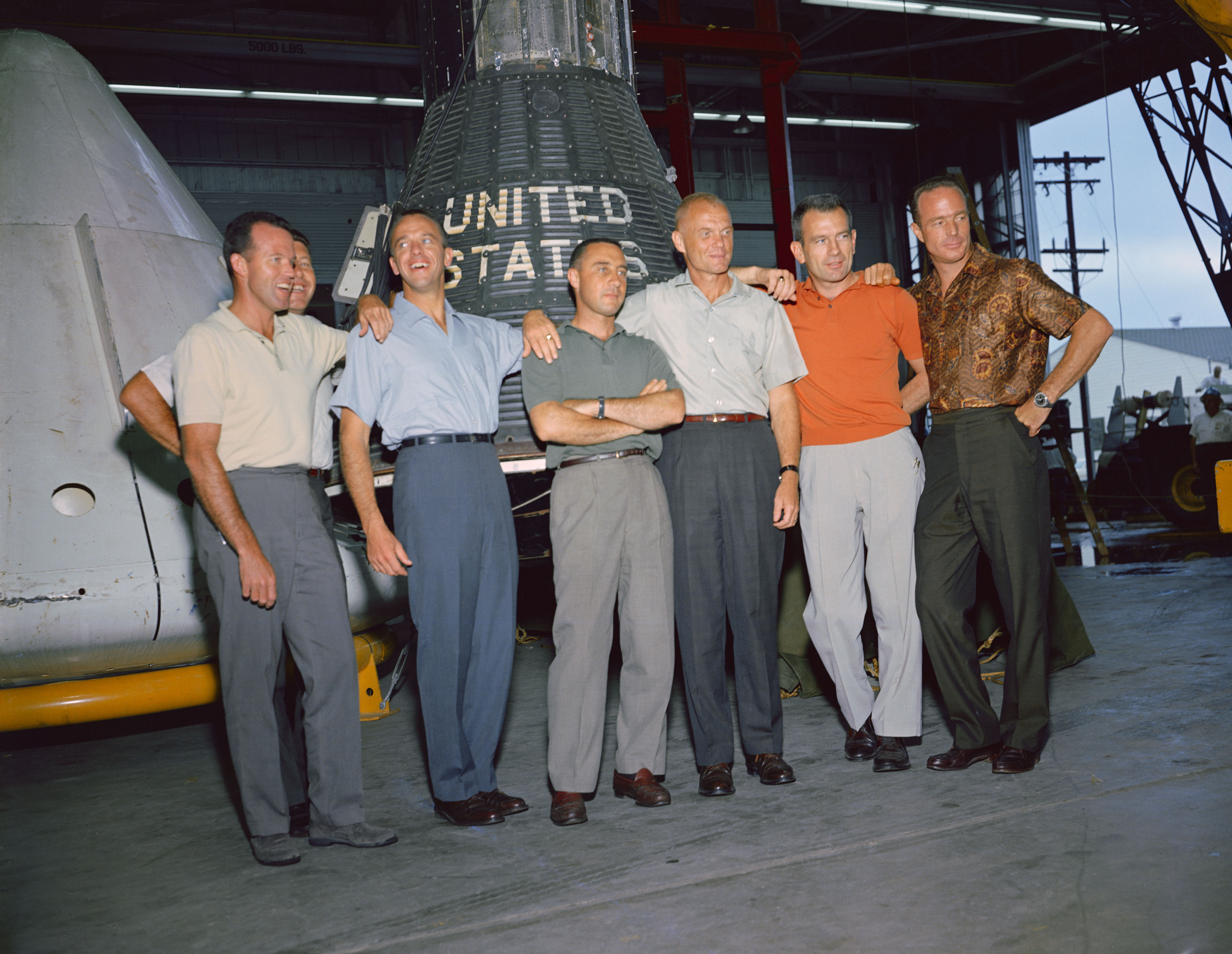
The original Mercury astronauts together at the Manned Spacecraft Center in Houston.
NASA / Johnson Space Center (s63-18853) · NASA media-use guidelines · Original recordThe words
Albuquerque
Mercury candidates underwent comprehensive medical examinations at the Lovelace Clinic in Albuquerque, New Mexico. They then continued to Ohio for a separate round of stress testing.
Astronaut
From Greek words meaning star sailor.
NASA used astronaut as the professional title for members selected for its astronaut corps. The Mercury Seven formed the agency’s first class in 1959.
Contour Couch
Each Mercury astronaut had a fiberglass couch cast to fit his body. Its shape helped support him under the forces of launch and reentry.
Did you know?
The Smithsonian’s Shepard couch came from the Mercury Procedures Trainer, a simulator. The contractor transferred it to the museum on NASA’s behalf in 1968.
Object A19690076000 · Smithsonian: Shepard’s training couch (opens a new tab)
Deke Slayton
An irregular heartbeat led NASA to ground Slayton in 1962, keeping him from a Mercury flight. Cleared again in 1972, he first reached space aboard Apollo-Soyuz in July 1975.
Gilruth
Robert R. Gilruth led the Space Task Group at Langley, responsible for Project Mercury. He became its project manager when the group was formally established on November 5, 1958.
Heat Chamber
During Mercury selection in 1959, candidates underwent heat-chamber testing at Wright-Patterson. Doctors measured how their hearts and other body functions responded to the heat.
pp. 53–55 · Link: Mercury selection tests, pp. 53–56 (opens a new tab)
Life Magazine
NASA arranged exclusive LIFE magazine coverage of the Mercury astronauts as they prepared for spaceflight. The agreement also brought their wives into the magazine’s coverage.
Mercury Seven
NASA selected the seven astronauts on April 2, 1959, then introduced them to the public on April 9. The press conference took place in Washington, D.C.
Did you know?
The introductory press conference took place in the ballroom of the Dolley Madison House, which served as NASA’s first headquarters.
NASA: selecting the Mercury Seven (opens a new tab) · NASA: the Mercury Seven meet the press (opens a new tab)
Right Stuff
Tom Wolfe’s The Right Stuff was first published in 1979. The book looked back at Project Mercury and the people who took part in it.
Did you know?
The Right Stuff became the basis for a 1983 film with the same title, extending the book’s account of the early space program to movie audiences.
Book Details · Macmillan: The Right Stuff (opens a new tab)
Silver Suit
Alan Shepard’s Mercury pressure suit was a modified U.S. Navy Mark IV flight suit. Its silver coating was intended to make him easier to spot during an emergency rescue.
Stress Tests
At Wright-Patterson Air Force Base in Ohio, Mercury candidates faced tests of their reactions to physical stress. This selection stage followed their medical examinations at Lovelace.
Test Pilot
President Eisenhower directed NASA to choose the first astronauts from military test pilots. Existing service records, medical screening and security clearances helped the agency conduct its selection.
Tilt Table
The tilt-table test assessed how a candidate’s heart adapted to an inclined body position. It was one of the physical stress tests used during Mercury selection in 1959.
p. 55 · Link: Mercury selection tests, pp. 53–56 (opens a new tab)
Tom Wolfe
Wolfe’s account included engineers and pilots alongside the astronauts. His book explored the physical and psychological demands surrounding America’s first human spaceflight program.
Book Details · Macmillan: The Right Stuff (opens a new tab)
Treadmill
Mercury candidates walked on a treadmill under increasing workload at Wright-Patterson. The test helped doctors assess their physical fitness as part of astronaut selection in 1959.
pp. 55–56 · Link: Mercury selection tests, pp. 53–56 (opens a new tab)
Sources
- 65 Years Ago: NASA Selects America’s First AstronautsJohn Uri; NASA Johnson Space Center, April 2, 2024
- Light This Candle: What You Need to Know About Alan Shepard's Historic SpaceflightAmy Stamm; Smithsonian National Air and Space Museum, April 30, 2021
- 60 Years Ago: NASA Introduces Mercury 7 AstronautsJohn Uri; NASA Johnson Space Center, April 9, 2019
- AstronautsNASA; introductory terminology paragraph and first-class fact
- Couch, Mercury Procedures Trainer, ShepardSmithsonian National Air and Space Museum; object A19690076000
- 60 and 50 Years Ago: Astronaut Slayton Grounded in 1962, Reinstated in 1972John Uri; NASA Johnson Space Center, March 14, 2022
- 65 Years Ago: NASA Formally Establishes The Space Task GroupJohn Uri; NASA Johnson Space Center, November 6, 2023
- Space Medicine in Project MercuryMae Mills Link; NASA SP-4003, 1965; printed pp. 53–56
- The Right StuffMacmillan Academic / Picador; Book Details for ISBN 9781250338358, 2024 reissue