
The Space Race
Puzzle 16 · Rockets and Launch Pads · Page 30 in print
Baikonur Cosmodrome
The Soviets hid their rocket base by naming it after Baikonur, a distant mining town.
Jump to a word
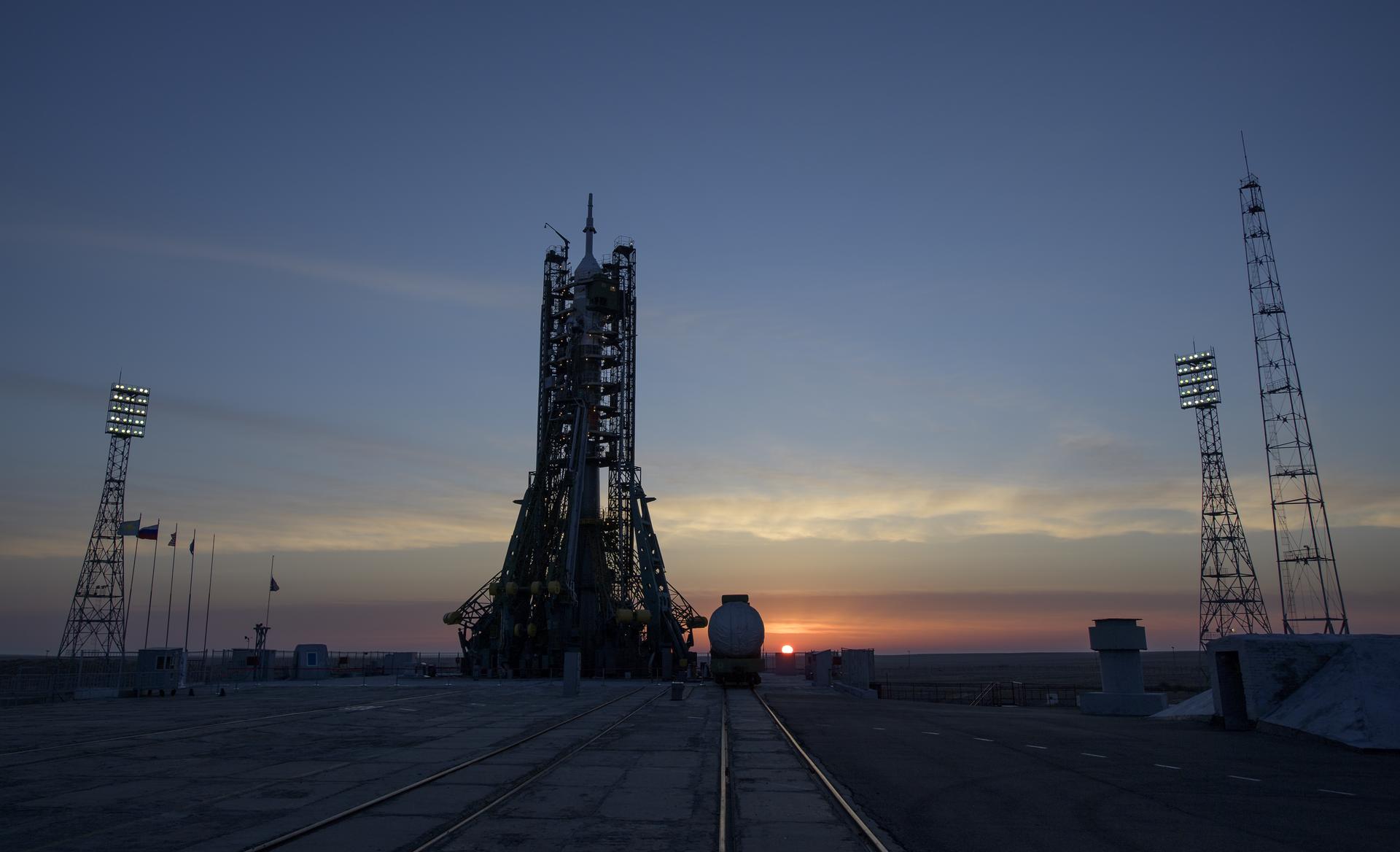
A Soyuz rocket on launch site 1 at Baikonur in a later view from March 2019.
NASA / Bill Ingalls (NHQ201903140002) · NASA media-use guidelines · Original recordImage changes
Display copies resized; original preserved.
The words
Aral Sea
A U-2 photographed the Soviet launch range east of the Aral Sea on August 5, 1957. American analysts identified the site as Tyuratam.
pp. 135–137 · CIA history: finding the launch range (opens a new tab)
Baikonur
ESA attributes the name Baikonur to an attempt to conceal the launch complex’s location by borrowing a distant mining town’s name.
Barmin
Vladimir Barmin led the design of the R-7’s launch complex. His organization developed the support system used for Sputnik and later members of the rocket family.
Did you know?
Siddiqi credits Vasily Mishin with the initial idea for the R-7’s unusual launch support. Barmin’s organization developed the launch complex around that concept.
pp. 131–132 · Siddiqi: the R-7 launch range (opens a new tab)
Cosmodrome
A space-launch base.
Construction at Baikonur began in 1955 as a secret missile-test site. The complex later launched Earth satellites, scientific spacecraft and human missions.
Dugouts
Dugouts gave early personnel and families shelter at Tyuratam while permanent housing was scarce. Many also lived in railway cars or tents amid severe heat.
pp. 310–311 · Chertok: early life and the R-16 accident (opens a new tab)
Kazakhstan
Baikonur was built in the Kazakh Soviet republic. The cosmodrome lies in Kazakhstan, which became an independent country after the Soviet Union dissolved.
Kyzylorda
Kyzylorda was the region selected for the new Soviet launch range. Its location near the Syr Darya and the Moscow–Tashkent railway helped determine the choice.
pp. 133–135 · Siddiqi: the R-7 launch range (opens a new tab)
Leninsk
Renamed Baikonur on December 20, 1995.
Leninsk became a city in 1966 after developing from the settlement of Leninskiy, the cosmodrome’s administrative center.
Facts 9–11 · Kazakhstan archive: Leninsk’s names (opens a new tab)
Nedelin
Marshal Mitrofan Nedelin led the Soviet Strategic Rocket Forces. He and many others died in the R-16 launch-pad fire on October 24, 1960.
pp. 605–607, 618–625, 634 · Chertok: early life and the R-16 accident (opens a new tab)
Periscope
During Sputnik’s launch, personnel in the command bunker watched the pad through periscopes. These instruments gave them a view while they remained inside the bunker.
Railway
The R-7 traveled horizontally by rail from its assembly building to Pad 1, where it was raised upright for launch.
Did you know?
ESA recounts that Korolev and his team walked in front of the rocket carrying Sputnik as it moved by rail toward Launch Pad 1.
ESA: Baikonur’s early launches (opens a new tab) · Siddiqi: the R-7 launch range (opens a new tab)
Site One
Launch Pad 1 sent Sputnik 1 into orbit on October 4, 1957. Yuri Gagarin began the first human spaceflight from the same pad on April 12, 1961.
Steppe
Baikonur was built in the flat grasslands of Kazakhstan. The continental climate meant long, cold winters and hot, dry summers for people working at the launch base.
Syr Darya
Early construction crews lacked dependable drinking water despite the nearby Syr Darya. Chertok recalled that its water was not potable and local wells were salty.
p. 311 · Chertok: early life and the R-16 accident (opens a new tab)
Tulip
Four support arms held the R-7 near its middle and opened outward at liftoff. Engineers nicknamed the system Tyulpan, Russian for “tulip,” after its petal-like motion.
pp. 131–132 · Siddiqi: the R-7 launch range (opens a new tab)
Sources
- Baikonur: Steppe into SpaceEuropean Space Agency; May 1, 2002
- Baikonur CosmodromeEuropean Space Agency; page dated December 31, 2003, with earlier mission-planning text
- Challenge to Apollo: The Soviet Union and the Space Race, 1945–1974Asif A. Siddiqi; NASA/SP-2000-4408, 2000; printed pp. 131–137 and 166
- Rockets and People, Volume II: Creating a Rocket IndustryBoris Chertok; Asif Siddiqi, series editor; NASA SP-2006-4110, June 2006; printed pp. 310–311, 604–607, 618–625 and 634
- The Central Intelligence Agency and Overhead Reconnaissance: The U-2 and OXCART Programs, 1954–1974Gregory W. Pedlow and Donald E. Welzenbach; CIA History Staff, 1992; declassified copy at the U.S. National Archives, chapter 3, pp. 135–137
- Звездные старты Байконура (к 60-летию первого полета человека в космос)Archive of the President of the Republic of Kazakhstan; 2021 virtual exhibition, introduction facts 9–11; Russian original