
The Space Race
Puzzle 15 · Rockets and Launch Pads · Page 29 in print
Launch Complex 39
Pad 39B was built mostly as a backup; only Apollo 10 flew from it in the Apollo program.
Jump to a word
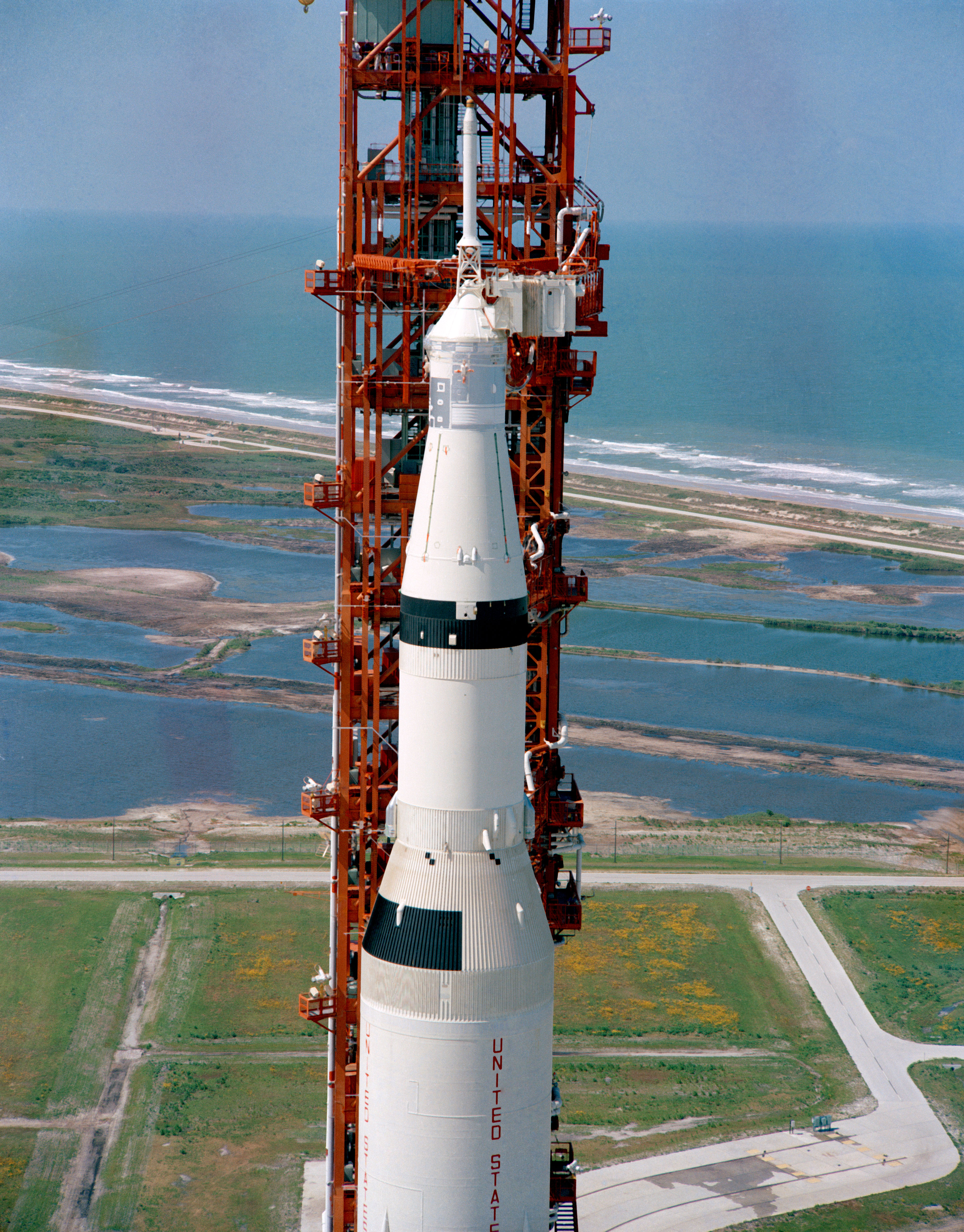
Apollo 10’s Saturn V at Launch Complex 39B on May 4, 1969.
NASA / Johnson Space Center (S69-33854) · NASA media-use guidelines · Original recordThe words
Banana River
A canal linked the Banana River’s Saturn barge channel to a turning basin near the VAB, allowing large rocket hardware to arrive by water.
pp. 247–250 · Moonport: launch facilities and operations (opens a new tab)
Cape Kennedy
Cape Canaveral was renamed Cape Kennedy after the President’s assassination in 1963. The Canaveral name returned for federal use in 1973.
pp. 146–148 · Moonport: launch facilities and operations (opens a new tab)
Crawler
NASA’s tracked crawler-transporters carried the upright Saturn V and its mobile launcher between the VAB and the pads. Keeping the load level was central to their job.
Flame Trench
A deflector beneath the rocket sent exhaust from Saturn V’s five first-stage engines along the flame trench. The trench helped determine the pad’s raised layout.
Moonport: launch facilities and operations (opens a new tab) · NASA: early Pad 39A construction (opens a new tab)
High Bay
High bays supplied the vertical space needed to stack Saturn V. The VAB contained four high bays, along with cranes, a low bay and a transfer aisle.
Did you know?
The large American flag on the VAB was first painted in 1976 for the Bicentennial Exposition on Space and Technology.
Marion
The Marion Power Shovel Company built Kennedy’s two crawler-transporters. NASA drew on the company’s experience with large coal-mining machinery for the Apollo ground-transport problem.
Merritt Island
NASA selected Merritt Island, north of Cape Canaveral, for Launch Complex 39. The new site provided room for the large assembly building and Saturn V launch facilities.
Did you know?
After Apollo, Pad 39B launched Skylab crews on smaller Saturn IB rockets. A raised support nicknamed the milk stool aligned them with the existing tower.
Moonport
Moonport described an Apollo base where rockets were assembled indoors, then moved to a pad for final checks, fueling and launch.
p. 83; pp. 280–281 · Moonport: launch facilities and operations (opens a new tab)
Press Site
NASA built a press site at Complex 39 with trailers and a grandstand. It was ready for reporters covering Apollo 4’s launch in 1967.
Did you know?
In 1975, the Society of Professional Journalists, Sigma Delta Chi, recognized the site as a Historic Site in Journalism, honoring Apollo-era reporting.
p. 4 · NASA: the launch-complex press site (opens a new tab)
River Rock
River rock covered the crawlerway where the transporter’s tracks ran. As the stones crushed, they absorbed vibration and had to be replaced.
Rollout
Apollo 4’s flight-ready Saturn V rolled from the VAB to Pad 39A on August 26, 1967. The crawler carried the rocket, mobile launcher and tower together.
Swing Arms
Nine swing arms carried service lines from the mobile launch tower to Saturn V. They moved clear of the vehicle as it launched.
pp. 281–283 · Moonport: launch facilities and operations (opens a new tab)
Titusville
Titusville, Brevard County’s seat, housed the spaceport’s land-acquisition office. Some owners faced condemnation proceedings when purchase negotiations failed.
pp. 97–98 · Moonport: launch facilities and operations (opens a new tab)
Transfer Aisle
The VAB’s transfer aisle provided floor space for moving and handling rocket stages. A crane lifted Apollo 11’s first stage from there into High Bay 1.
Umbilical
Saturn V’s umbilicals connected ground equipment to the rocket through bundles of electrical cables and fluid lines carried by the tower’s service arms.
pp. 281–283 · Moonport: launch facilities and operations (opens a new tab)
Sources
- Launch Complex 39: From Saturn to Shuttle to SpaceX and SLSMichael Neufeld; National Air and Space Museum, May 22, 2020
- Early Construction of Launch Pad 39ANASA; May 20, 2022, caption for November 2, 1965 photograph
- 55 Years Ago: Apollo 4, the First Flight Saturn V, Rolls Out to the Launch PadJohn Uri; NASA Johnson Space Center, August 25, 2022
- Moonport: A History of Apollo Launch Facilities and OperationsCharles D. Benson and William Barnaby Faherty; NASA SP-4204, 1978; printed pp. 83, 97–98, 146–148, 235, 247–250 and 281–283
- The CrawlersNASA’s Curious Universe, episode 6; November 16, 2020; transcript with John Giles, Sam Dove and Breanna Rohloff
- Kennedy at 60: Vehicle Assembly Building Ready for New Era of Launch VehiclesLinda Herridge; NASA Kennedy Space Center, January 13, 2022
- In 1969… Saturn V First Stage For Apollo 11 MissionNASA; March 8, 2012, caption for February 21, 1969 photograph
- The Press Site at KSCNASA Kennedy Space Center; NASA Facts FS-2006-03-009-KSC, p. 4, History of the Press Site