
The Space Race
Puzzle 14 · Rockets and Launch Pads · Page 28 in print
The Soviet N-1
The Soviet N-1 clustered 30 rocket engines in its first stage alone.
Jump to a word
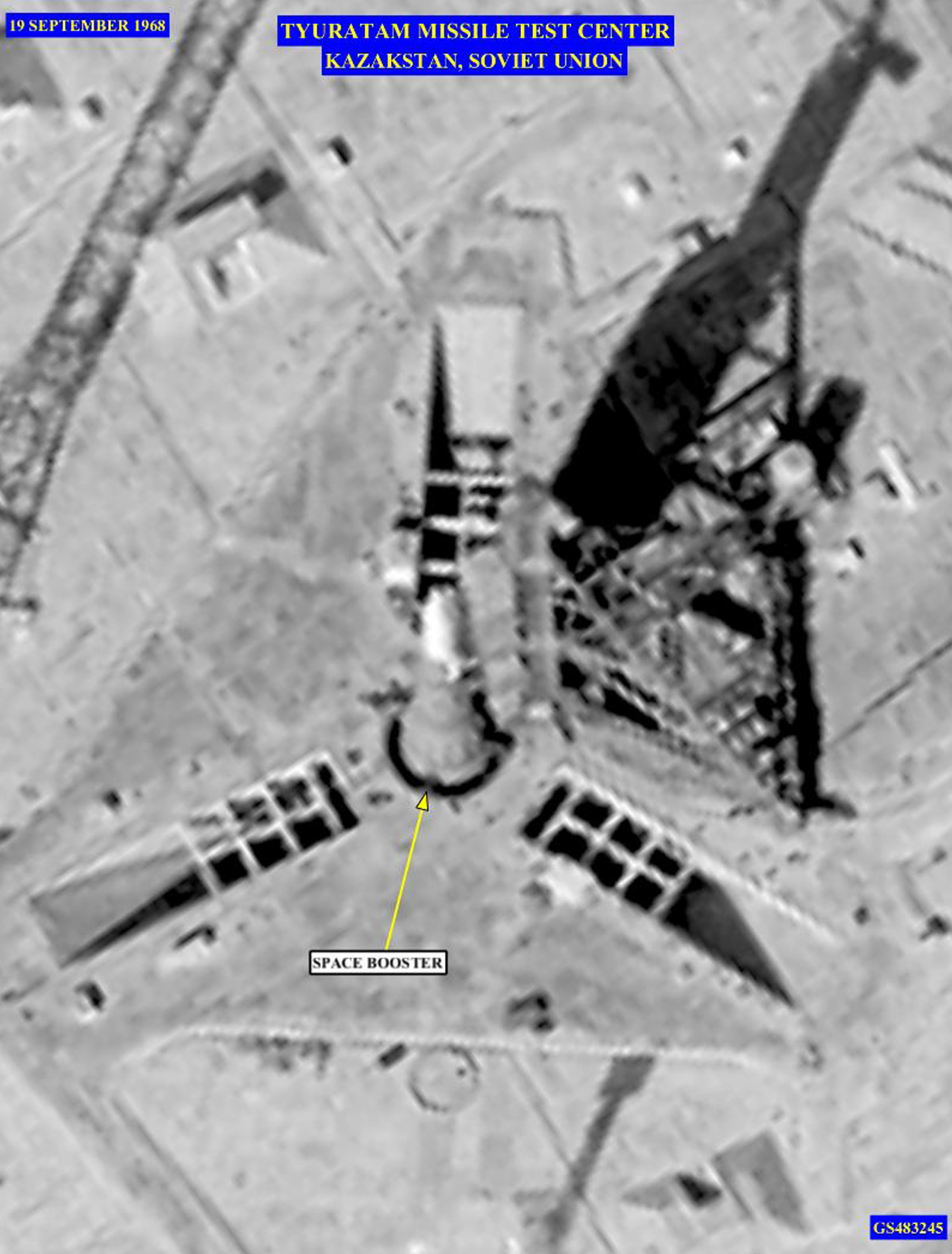
The N-1 launch complex at Baikonur in an annotated KH-8 reconnaissance photograph from September 1968.
U.S. Air Force / National Reconnaissance Office · Public domain (U.S. government work) · Original recordImage changes
Display copies resized; original preserved.
The words
Chelomei
Chelomei’s UR-700 was a rival heavy-rocket proposal to the N-1. Chertok’s memoirs describe Glushko’s support for it during disputes over the lunar program.
pp. 82–83, 222 · Chertok: designers and lunar reviews (opens a new tab)
Chertok
Boris Chertok was a deputy chief designer at OKB-1. He helped coordinate the lunar spacecraft’s systems and later described the program in his memoirs.
Did you know?
During the Soviet period, Chertok sometimes published under the name Boris Yevseyev. His own identity and institutional details were restricted by state secrecy.
p. xi; pp. 126–130 · Chertok: designers and lunar reviews (opens a new tab)
Closed Cycle
The N-1’s engines used staged combustion. In normal operation, turbine-driving gas flowed into the main combustion chamber, giving the system its closed-cycle description.
Siddiqi: N-1 engines and lunar hardware (opens a new tab) · ESA: closed-cycle engine principles (opens a new tab)
Engine Cluster
The N-1’s first stage used 30 engines. All four test failures occurred in this stage, preventing the rocket from completing its planned climb toward space.
Escape System
During the uncrewed July 1969 test, the N-1’s escape system pulled the spacecraft’s descent module clear of the failing rocket and to safety.
Fireball
The N-1 fell back onto its launch pad and exploded during its second test in July 1969. The explosion destroyed the pad and delayed the program.
Grid Fins
The N-1 carried four lattice-shaped stabilizers near the base of its first stage. These grid fins were part of the rocket’s external aerodynamic layout.
pp. 476, 485 · Siddiqi: N-1 engines and lunar hardware (opens a new tab)
Keldysh
Keldysh chaired expert reviews of the N1-L3 program. His commission approved a design in December 1964, while later meetings examined systems and weight limits.
p. 99; pp. 126–130 · Chertok: designers and lunar reviews (opens a new tab)
Kuibyshev
Samara, the city’s restored name since 1991.
Kuibyshev was the home of Kuznetsov’s OKB-276 engine bureau. Its engineers developed the N-1’s engines while working with Korolev’s rocket organization.
Siddiqi: N-1 engines and lunar hardware (opens a new tab) · Samara University: the city’s names (opens a new tab)
Kuznetsov
Engine designer Nikolay Kuznetsov led OKB-276, which supplied the engines for the N-1’s first three stages. They burned kerosene with liquid oxygen.
pp. 387, 485 · Siddiqi: N-1 engines and lunar hardware (opens a new tab)
Launch Failure
Work on the N-1 stopped in 1974 after four failed uncrewed flight tests. No cosmonauts flew aboard the rocket.
Lunniy Korabl
Russian for “lunar ship.”
The LK lander was intended to carry one cosmonaut to the Moon’s surface. A second crew member would remain in lunar orbit aboard the LOK spacecraft.
pp. xiv, 476, 488–489 · Siddiqi: N-1 engines and lunar hardware (opens a new tab)
Mishin
Vasily Mishin succeeded Korolev after his death in 1966. He inherited responsibility for the Soviet crewed lunar program, including the N-1 rocket.
Did you know?
Mishin kept private diaries from 1960 to 1974. Their notes and sketches later helped museum historians examine the Soviet lunar program’s decisions.
Spherical Tank
The N-1’s first three stages carried spherical propellant tanks suspended inside an external frame. The tanks were separate from the rocket’s outer load-bearing structure.
pp. 485–486 · Siddiqi: N-1 engines and lunar hardware (opens a new tab)
Ustinov
Ustinov was a Central Committee secretary responsible for defense-industry matters. In 1966, he called for a review of the lunar program’s progress.
pp. 134–136 · Chertok: designers and lunar reviews (opens a new tab)
Sources
- A Soviet Moonshot: Interpreting the Diaries of Vasily MishinNational Air and Space Museum; November 5, 2021
- Challenge to Apollo: The Soviet Union and the Space Race, 1945–1974Asif A. Siddiqi; NASA/SP-2000-4408, 2000; printed pp. 387–388, 476 and 485–489
- Rockets and People, Volume IV: The Moon RaceBoris Chertok; Asif Siddiqi, series editor; NASA SP-2011-4110, 2011; printed pp. xi, 82–83, 99, 126–130 and 134–136
- 50 Years Ago: National Goal Nears FulfillmentJohn Uri; NASA Johnson Space Center, July 9, 2019; N-1 launch account and captions
- SamaraSamara National Research University; English regional information, city naming paragraph
- First hot firing of European staged-combustion demonstration engineEuropean Space Agency; February 26, 2008; Choice of technology section