
The Great Stories of the Old Testament
Puzzle 06 · Creation and Primeval History · Page 18 in print
The Rainbow Covenant
After the flood, God blesses Noah’s family and sets the bow in the cloud as a covenant sign.
Jump to a word
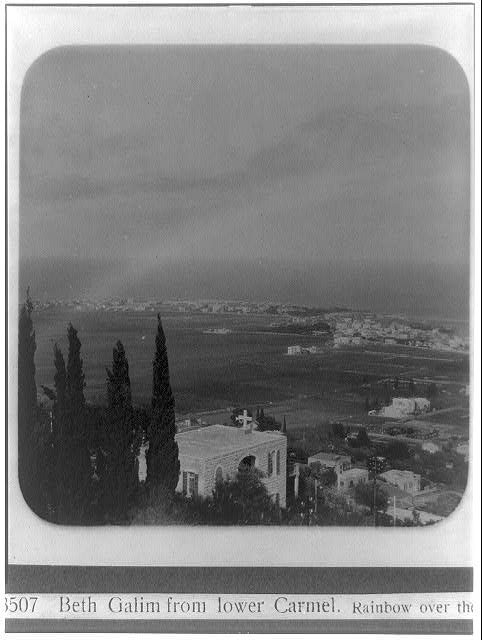
Rainbow over the plain near Haifa, photographed from lower Mount Carmel, 1920–1933.
A photographed rainbow makes the covenant’s visible sign concrete; it is not a photograph of Noah’s rainbow.
American Colony Photo Department / Matson Photo Service; G. Eric and Edith Matson Photograph Collection, Library of Congress. · No known restrictions on publication · Original recordImage changes
Resized proportionally to at most 1440px and JPEG compressed; no crop or content alteration.
The words
Blessed
God blesses Noah and his sons at the start of the chapter, linking the blessing with the command to multiply.
Blood
God permits living creatures as food but forbids eating flesh with its blood, which the verse identifies with its life.
Cold
Cold appears beside heat in God’s promise after Noah’s sacrifice; the changing conditions will continue while the earth remains.
Covenant
A solemn agreement or binding promise.
God promises that floodwaters will not again cut off all flesh or destroy the earth, making this promise to Noah and living creatures.
Genesis 9:9–11 (opens a new tab) · Strong’s H1285 (covenant) (opens a new tab)
Day and Night
The promise includes the alternation of day and night, alongside harvests and seasons, for as long as the earth remains.
Established
God establishes the covenant with Noah’s family and their descendants, then includes the living creatures that came from the ark.
Fruitful
Genesis repeats the command to be fruitful and multiply: it opens Noah’s blessing and returns after the instructions about life and blood.
Genesis 9:1 (opens a new tab) · Genesis 9:4–7 (opens a new tab)
Green Herb
God compares the grant of moving, living creatures for food with the green herb, saying that all are given to Noah’s family.
Heat
Heat is paired with cold in the promise that follows the flood; it belongs to the earth’s continuing rhythms.
Perpetual
God says the covenant sign is for perpetual generations, extending it beyond Noah to those who come after him.
Rainbow
God sets the bow in the cloud as a sign of the promise that a flood will not again destroy all flesh.
Did you know?
The Hebrew word qesheth can mean a bow used for shooting as well as the bow in the cloud.
Genesis 9:13–15 (opens a new tab) · Strong’s H7198 (bow) (opens a new tab)
Replenish
To fill or populate.
Noah and his sons are told to replenish the earth as part of the command to be fruitful and multiply.
Did you know?
The KJV uses the same command in Genesis 1, before the flood story, when God tells the first humans to replenish the earth.
Genesis 9:1 (opens a new tab) · Genesis 1:28 (opens a new tab) · Strong’s H4390 (fill) (opens a new tab)
Seedtime
Seedtime is paired with harvest in the promise: sowing and gathering crops will continue while the earth remains.
Did you know?
Ecclesiastes also pairs actions of cultivation: its poem names a time to plant and a time to pull up what was planted.
Genesis 8:22 (opens a new tab) · Ecclesiastes 3:2 (opens a new tab)
Token
A sign or visible reminder.
The bow serves as the token of the covenant between God and the earth, making the promise visible in the cloud.
Genesis 9:12–13 (opens a new tab) · Strong’s H226 (sign, token) (opens a new tab)
Winter
Winter is paired with summer, placing the yearly seasons alongside the daily rhythm of day and night.
Did you know?
Psalm 74 also names summer and winter, alongside the earth’s borders, as part of what God has made.
Genesis 8:22 (opens a new tab) · Psalm 74:17 (opens a new tab)
Sources
- Genesis 9:1 (King James Version)King James Version, passage navigation via Bible Gateway
- Genesis 9:3-4 (King James Version)King James Version, passage navigation via Bible Gateway
- Genesis 8:20-22 (King James Version)King James Version, passage navigation via Bible Gateway
- Strong’s Hebrew 1285: berithBible Hub
- Genesis 9:9-11 (King James Version)King James Version, passage navigation via Bible Gateway
- Genesis 8:22 (King James Version)King James Version, passage navigation via Bible Gateway
- Genesis 9:8-11 (King James Version)King James Version, passage navigation via Bible Gateway
- Genesis 9:1-3 (King James Version)King James Version, passage navigation via Bible Gateway
- Genesis 9:12 (King James Version)King James Version, passage navigation via Bible Gateway
- Strong’s Hebrew 7198: qeshethBible Hub
- Genesis 9:13-15 (King James Version)King James Version, passage navigation via Bible Gateway
- Strong’s Hebrew 4390: maleBible Hub
- Genesis 1:28 (King James Version)King James Version, passage navigation via Bible Gateway
- Ecclesiastes 3:2 (King James Version)King James Version, passage navigation via Bible Gateway
- Strong’s Hebrew 226: othBible Hub
- Genesis 9:12-13 (King James Version)King James Version, passage navigation via Bible Gateway
- Psalm 74:17 (King James Version)King James Version, passage navigation via Bible Gateway
- Genesis 9:4-7 (King James Version)King James Version, passage navigation via Bible Gateway