
The Great Stories of the Old Testament
Puzzle 07 · Creation and Primeval History · Page 19 in print
The Tower of Babel
The builders seek a city and a name; their language is confused and they are scattered. Nimrod belongs to the neighbouring account of kingdoms.
Jump to a word
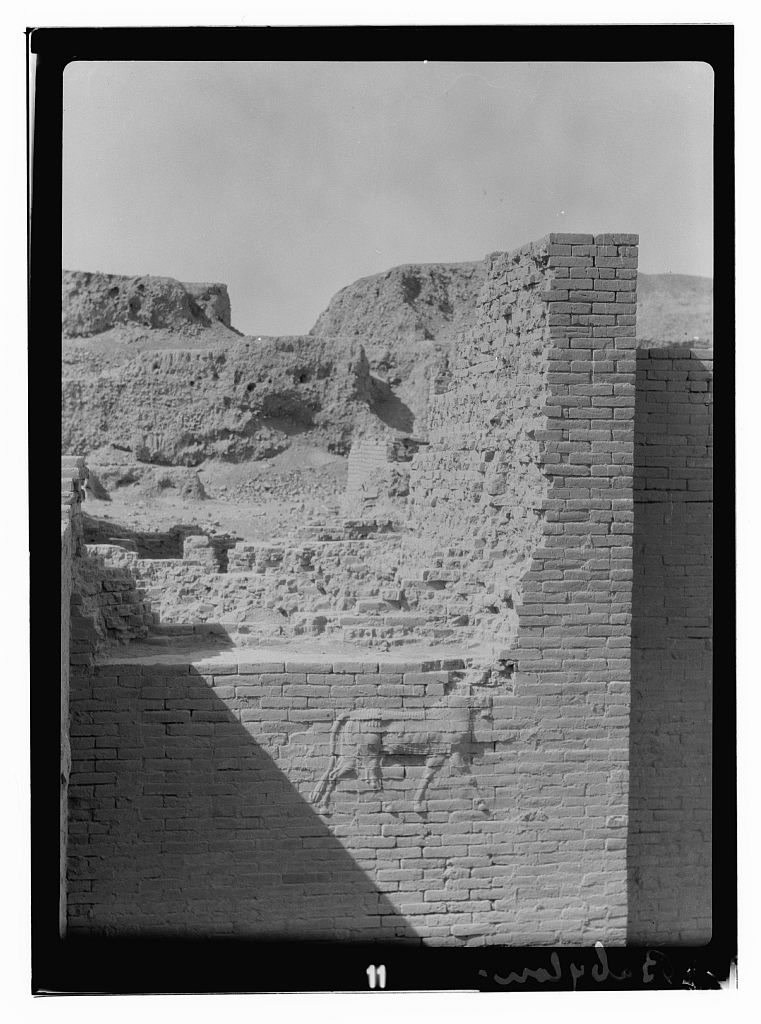
Brickwork and ruins at Babylon, 1932.
The later ruins supply geographical context for Babel’s wider Mesopotamian setting, not an identification of the tower.
American Colony (Jerusalem). Photo Department; G. Eric and Edith Matson Photograph Collection, Library of Congress. · No known restrictions on publication · Original recordImage changes
Resized proportionally to at most 1440px and JPEG compressed; no crop or content alteration.
The words
Babel
The name also rendered Babylon in English Bibles.
Genesis links the city’s name with God confounding the people’s language there and scattering them across the earth.
Genesis 11:9 (opens a new tab) · Strong’s H894 (Babel, Babylon) (opens a new tab)
Brick
The builders make bricks and burn them thoroughly, using the resulting material in place of stone for their city and tower.
Did you know?
The British Museum holds a brick of Nebuchadnezzar II with bitumen on its back, a physical example of the two materials used together.
Genesis 11:3–4 (opens a new tab) · British Museum: brick 90064 (opens a new tab)
City
The builders want a city as well as a tower, hoping the settlement and shared name will keep them from being scattered.
Confound
To confuse or mix together.
God confounds the builders’ language so that they do not understand one another; the city’s construction then stops.
Genesis 11:7–8 (opens a new tab) · Strong’s H1101 (mix, confuse) (opens a new tab)
Journeyed
The KJV describes the people as journeying from the east to a plain in Shinar, where they settle.
Did you know?
The NET Bible translates the direction as eastward but lists from the east and in the east as other readings.
Genesis 11:2 (opens a new tab) · NET Bible: Genesis 11:1–9 (opens a new tab)
Language
The account begins with shared language and speech; later, God confounds it so the builders can no longer understand one another.
Did you know?
The Hebrew describes speech through the image of a single lip; the NET Bible explains this as a common language.
Genesis 11:1 (opens a new tab) · Genesis 11:7 (opens a new tab) · NET Bible: Genesis 11:1–9 (opens a new tab)
Mighty
Nimrod is called a mighty one in the earth and a mighty hunter before the LORD in the chapter preceding the tower story.
Morter
Mortar: a binding material for joining bricks or stones.
The builders use slime for morter while using baked brick instead of stone; the verse pairs each building material with its substitute.
Genesis 11:3 (opens a new tab) · Webster’s 1828: mortar (opens a new tab)
Name
The builders want to make a name for themselves, seeking renown while expressing fear of being scattered across the earth.
Nimrod
Genesis names Nimrod as Cush’s son and lists Babel among the beginnings of his kingdom; the tower passage does not name him.
Genesis 10:8–10 (opens a new tab) · Genesis 11:1–9 (opens a new tab)
Plain
The travelers find a plain in Shinar and settle there; the city and tower are the building project they plan afterward.
Scattered
The builders fear being scattered, but that is the outcome: the LORD disperses them across the earth and they stop building.
Genesis 11:4 (opens a new tab) · Genesis 11:8 (opens a new tab)
Shinar
Shinar is the land where the travelers settle and build; the preceding chapter also places the beginnings of Nimrod’s kingdom there.
Did you know?
Daniel also calls the land Shinar when it describes temple vessels placed in the house of the Babylonian king’s god.
Genesis 11:2 (opens a new tab) · Genesis 10:10 (opens a new tab) · Daniel 1:1–2 (opens a new tab)
Slime
Here, bitumen or tar, used to bind bricks.
The builders use slime for morter, pairing it with baked brick in the two substitutions listed in the verse.
Genesis 11:3 (opens a new tab) · NET Bible: Genesis 11:1–9 (opens a new tab)
Tower
The builders plan a tower with its top reaching heaven; the LORD comes down to see their city and tower.
Sources
- Strong’s Hebrew 894: BabelBible Hub
- Genesis 11:9 (King James Version)King James Version, passage navigation via Bible Gateway
- Brick of Nebuchadnezzar II, museum number 90064British Museum
- Genesis 11:3-4 (King James Version)King James Version, passage navigation via Bible Gateway
- Genesis 11:4 (King James Version)King James Version, passage navigation via Bible Gateway
- Strong’s Hebrew 1101: balalBible Hub
- Genesis 11:7-8 (King James Version)King James Version, passage navigation via Bible Gateway
- Genesis 11:1–9 (NET Bible), translation and notesNET Bible, via Bible Gateway
- Genesis 11:2 (King James Version)King James Version, passage navigation via Bible Gateway
- Genesis 11:1 (King James Version)King James Version, passage navigation via Bible Gateway
- Genesis 11:7 (King James Version)King James Version, passage navigation via Bible Gateway
- Genesis 10:8-9 (King James Version)King James Version, passage navigation via Bible Gateway
- MortarWebster’s Dictionary 1828
- Genesis 11:3 (King James Version)King James Version, passage navigation via Bible Gateway
- Genesis 10:8-10 (King James Version)King James Version, passage navigation via Bible Gateway
- Genesis 11:1-9 (King James Version)King James Version, passage navigation via Bible Gateway
- Genesis 11:2-4 (King James Version)King James Version, passage navigation via Bible Gateway
- Genesis 11:8 (King James Version)King James Version, passage navigation via Bible Gateway
- Genesis 10:10 (King James Version)King James Version, passage navigation via Bible Gateway
- Genesis 11:4-5 (King James Version)King James Version, passage navigation via Bible Gateway
- Daniel 1:1-2 (King James Version)King James Version, passage navigation via Bible Gateway