
The Great Stories of the Old Testament
Puzzle 02 · Creation and Primeval History · Page 14 in print
The Forbidden Fruit
The forbidden fruit leads to shame, judgment and expulsion; the text never identifies the fruit as an apple.
Jump to a word
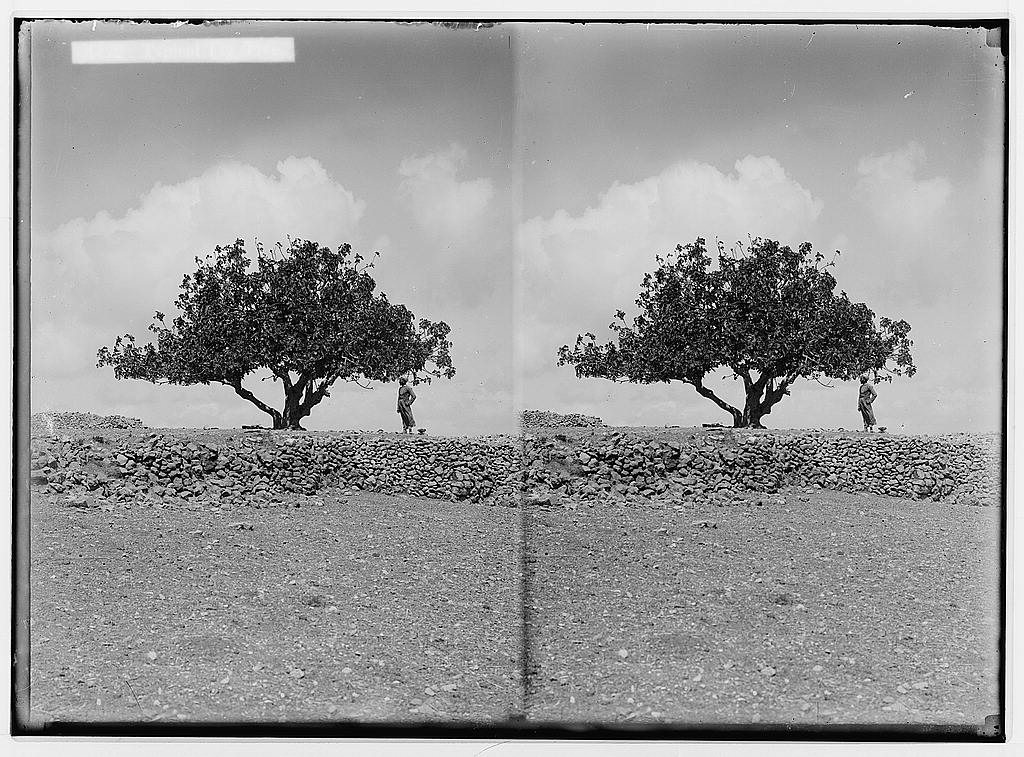
Fig tree before locust damage, photographed in 1915.
A real fig tree connects with the leaves sewn into coverings; it is not identified as the tree bearing the forbidden fruit.
American Colony (Jerusalem). Photo Department; G. Eric and Edith Matson Photograph Collection, Library of Congress. · No known restrictions on publication · Original recordImage changes
Resized proportionally to at most 1440px and JPEG compressed; no crop or content alteration.
The words
Apron
The couple’s first clothing is their own work: they “made themselves aprons,” coverings worn around the waist.
Did you know?
The King James Bible kept William Tyndale’s word, “aprons.” The Geneva Bible of 1560 said “breeches,” which earned it the nickname “Breeches Bible.”
Genesis 3:7 (opens a new tab) · Strong’s H2290 (chagorah) (opens a new tab) · Geneva Bible (1599), Genesis 3:7 (opens a new tab) · Wikipedia: Geneva Bible (opens a new tab) · Bible Gateway: about the Geneva Bible (opens a new tab)
Bruise
In older English, to crush. Webster’s 1828 dictionary defines it “to crush by beating or pounding.”
The serpent’s judgment ends with these words: “it shall bruise thy head, and thou shalt bruise his heel.”
Did you know?
Hebrew uses one rare verb, shuph, for both blows. It appears only twice more; in Job 9:17 the blow comes from a storm: “he breaketh me with a tempest.”
Genesis 3:15 (opens a new tab) · Webster’s 1828: bruise (opens a new tab) · Strong’s H7779 (shuph) (opens a new tab) · NET Bible note, Genesis 3:15 (opens a new tab) · Job 9:17 (opens a new tab)
Coats
Tunics, shirt-like garments worn next to the skin, rather than outer coats.
Unlike the aprons they sewed themselves, these are God’s work: he “clothed them” just before the man is sent “forth from the garden of Eden.”
Did you know?
The Hebrew word, kethoneth, is the same one used for Joseph’s “coat of many colours” in Genesis 37:3, the story of puzzle 16.
Genesis 3:21, 23 (opens a new tab) · Strong’s H3801 (kethoneth) (opens a new tab) · Genesis 37:3 (opens a new tab)
Curse
Genesis 3 uses “cursed” only twice, for the serpent and for the ground: “cursed is the ground for thy sake.” The man and woman are not called cursed.
Did you know?
After the flood, Genesis 8:21 says, “the LORD said in his heart, I will not again curse the ground any more for man’s sake.”
Genesis 3:14, 17 (opens a new tab) · Genesis 8:21 (opens a new tab)
Dust
Dust appears in two of God’s judgments: the serpent will eat it, and Adam hears, “dust thou art, and unto dust shalt thou return.”
Did you know?
The graveside words “earth to earth, ashes to ashes, dust to dust” are not found in the King James Bible. They come from the Book of Common Prayer’s burial service.
Genesis 3:14, 19 (opens a new tab) · Church of England: BCP burial service (opens a new tab) · Wiktionary: ashes to ashes, dust to dust (opens a new tab) · Bible Gateway: KJV search, “ashes to ashes” (opens a new tab)
Eyes
The woman eats, then her husband, and “the eyes of them both were opened.”
Did you know?
The Hebrew verb for “opened,” paqach, is used for eyes and once for ears. In 2 Kings 6:17, God opens the eyes of Elisha’s servant to “horses and chariots of fire.”
Genesis 3:6–7 (opens a new tab) · Strong’s H6491 (paqach) (opens a new tab) · 2 Kings 6:15–17 (opens a new tab)
Fig Leaves
To cover themselves, the couple “sewed fig leaves together.” This is the Bible’s first mention of the fig, and the only one in Genesis.
Did you know?
Thanks to this verse, “fig leaf” came to mean any flimsy cover. The American Heritage Dictionary defines it as “a usually insufficient concealment or camouflage.”
Genesis 3:7 (opens a new tab) · Bible Gateway: KJV search, “fig” (opens a new tab) · American Heritage Dictionary: fig leaf (opens a new tab) · Wiktionary: fig leaf (opens a new tab)
Flaming Sword
When the man is driven out, God places “Cherubims, and a flaming sword which turned every way” at the garden. Genesis never says who holds the sword.
Did you know?
John Milton’s Paradise Lost (1667) ends with this scene: as Adam and Eve leave, “The brandisht Sword of God before them blaz’d / Fierce as a Comet.”
Genesis 3:24 (opens a new tab) · Milton, Paradise Lost (Gutenberg) (opens a new tab) · Britannica: Paradise Lost (opens a new tab)
Fruit
Every tree is open to them but one “in the midst of the garden.” From it “she took of the fruit thereof, and did eat.”
Did you know?
Genesis Rabbah, a rabbinic commentary from the mid-first millennium C.E., weighs wheat, grapes, citrons and figs. Scholar Azzan Yadin-Israel argues the apple first appears in 12th-century French art.
Genesis 3:2–3, 6 (opens a new tab) · TheTorah.com: Yadin-Israel on the apple (opens a new tab) · Wikipedia: Forbidden fruit (opens a new tab)
Hide
When they hear God “walking in the garden in the cool of the day,” Adam and his wife hide “amongst the trees of the garden.”
Did you know?
Adam’s answer, “I was afraid, because I was naked; and I hid myself,” is the Bible’s first use of yare, the Hebrew verb “to fear.”
Genesis 3:8, 10 (opens a new tab) · Strong’s H3372 (yare) (opens a new tab) · Bible Gateway: KJV search, “afraid” (opens a new tab)
Naked
Before the fruit, “they were both naked, the man and his wife, and were not ashamed.” After it, “they knew that they were naked.”
Genesis 3:7 (opens a new tab) · Genesis 2:25 (opens a new tab)
Seed
In the judgment on the serpent, God puts “enmity between thee and the woman, and between thy seed and her seed.”
Did you know?
The Hebrew word, zera, from the verb “to sow,” means both plant seed and descendants. It first appears in Genesis 1:11: “the herb yielding seed.”
Genesis 3:15 (opens a new tab) · Strong’s H2233 (zera) (opens a new tab) · Genesis 1:11 (opens a new tab)
Subtil
An older spelling of “subtle,” in its old sense of sly or cunning.
Genesis 3 opens with the serpent, “more subtil than any beast of the field which the LORD God had made.” Genesis never names it Satan.
Did you know?
The Hebrew has a wordplay English loses: the couple are arummim, “naked,” in Genesis 2:25, and one verse later the serpent is arum, “subtil.”
Genesis 3:1 (opens a new tab) · Genesis 2:25 (opens a new tab) · Wiktionary: subtil (opens a new tab) · American Heritage Dictionary: subtle (opens a new tab) · Webster’s 1828: subtil (opens a new tab) · Strong’s H6175 (arum) (opens a new tab) · Strong’s H6174 (arom) (opens a new tab) · NET Bible note, Genesis 3:1 (opens a new tab) · Bible Gateway: KJV search, “Satan” (opens a new tab) · Wikipedia: Serpents in the Bible (opens a new tab)
Sweat
God tells Adam that bread will cost him hard labor: “In the sweat of thy face shalt thou eat bread.”
Did you know?
Abraham Lincoln echoed this verse in his Second Inaugural Address, March 4, 1865: it may seem strange, he said, that men should ask God’s help “in wringing their bread from the sweat of other men’s faces.”
Genesis 3:19 (opens a new tab) · Park Service: Lincoln’s Second Inaugural (opens a new tab) · Wikipedia: Lincoln’s second inaugural (opens a new tab)
Thorns
Adam’s farming will be a struggle: the cursed ground will yield “Thorns also and thistles,” and he will “eat the herb of the field.”
Did you know?
The Hebrew pair, qots and dardar, “thorns” and “thistles,” appears together only once more: in Hosea 10:8, “the thorn and the thistle shall come up on their altars.”
Genesis 3:17–18 (opens a new tab) · Strong’s H6975 (qots) (opens a new tab) · Strong’s H1863 (dardar) (opens a new tab) · Hosea 10:8 (opens a new tab)
Sources
- Genesis 3:1-24 (King James Version)King James Version, passage navigation via Bible Gateway
- Strong’s Hebrew 2290: chagowr (belt, girdle)Bible Hub
- Genesis 3:7 (1599 Geneva Bible)1599 Geneva Bible, via Bible Gateway
- Geneva Bible: Breeches BibleWikipedia
- 1599 Geneva Bible (GNV): version informationBible Gateway
- BruiseWebster’s Dictionary 1828
- Strong’s Hebrew 7779: shuph (to bruise, crush)Bible Hub
- Genesis 3:15 (New English Translation), translator’s noteNET Bible, via Bible Gateway
- Job 9:17 (King James Version)King James Version, passage navigation via Bible Gateway
- Strong’s Hebrew 3801: kethoneth (tunic)Bible Hub
- Genesis 37:3 (King James Version)King James Version, passage navigation via Bible Gateway
- Genesis 8:21 (King James Version)King James Version, passage navigation via Bible Gateway
- At the Burial of the Dead (Book of Common Prayer)The Church of England
- ashes to ashes, dust to dustWiktionary
- Keyword search, King James Version: “ashes to ashes”Bible Gateway
- Strong’s Hebrew 6491: paqach (to open the eyes)Bible Hub
- 2 Kings 6:15-17 (King James Version)King James Version, passage navigation via Bible Gateway
- Keyword search, King James Version: “fig”Bible Gateway
- Fig leafAmerican Heritage Dictionary of the English Language
- fig leafWiktionary
- Paradise Lost, by John Milton (ten-book text)Project Gutenberg
- Paradise Lost: epic poem by MiltonEncyclopaedia Britannica
- How the Forbidden Fruit Became an AppleTheTorah.com
- Forbidden fruit: AppleWikipedia
- Strong’s Hebrew 3372: yare (to fear, be afraid)Bible Hub
- Keyword search, King James Version: “afraid”Bible Gateway
- Genesis 2:25 (King James Version)King James Version, passage navigation via Bible Gateway
- Strong’s Hebrew 2233: zera (seed, offspring)Bible Hub
- Genesis 1:11 (King James Version)King James Version, passage navigation via Bible Gateway
- subtilWiktionary
- SubtleAmerican Heritage Dictionary of the English Language
- SubtilWebster’s Dictionary 1828
- Strong’s Hebrew 6175: arum (crafty, shrewd)Bible Hub
- Strong’s Hebrew 6174: arom (naked)Bible Hub
- Genesis 3:1 (New English Translation), study notesNET Bible, via Bible Gateway
- Keyword search, King James Version: “Satan”Bible Gateway
- Serpents in the BibleWikipedia
- Lincoln’s Second Inaugural AddressNational Park Service, Lincoln Memorial
- Abraham Lincoln’s second inaugural address: sources and themeWikipedia
- Strong’s Hebrew 6975: qots (thorn)Bible Hub
- Strong’s Hebrew 1863: dardar (thistle)Bible Hub
- Hosea 10:8 (King James Version)King James Version, passage navigation via Bible Gateway