
The Great Stories of the Old Testament
Puzzle 01 · Creation and Primeval History · Page 13 in print
The Garden of Eden
Genesis describes a garden, its rivers and the human task of tending it. The narrative does not establish a securely identifiable modern location for Eden.
Jump to a word
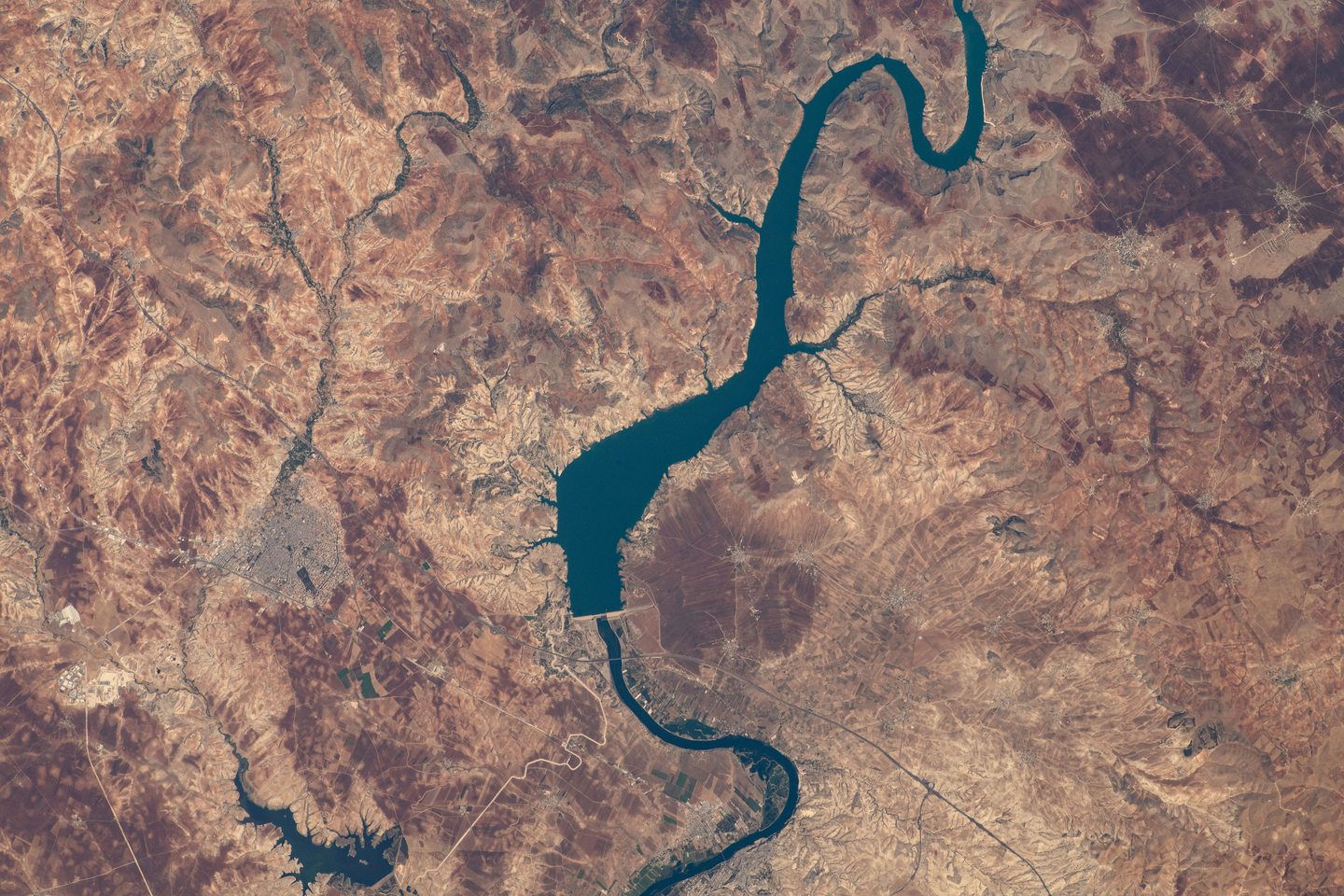
Euphrates River from the International Space Station.
The Euphrates is one of the rivers named in Genesis 2; a modern view of the river does not establish Eden’s location.
NASA / Kjell Lindgren · NASA media guidelines · Original recordImage changes
Resized proportionally to at most 1440px and JPEG compressed; no crop or content alteration.
The words
Bdellium
A precious substance, probably a fragrant tree resin; older interpreters suggested a pearl or crystal.
Genesis lists it with gold and onyx as the treasures of Havilah, the land the river Pison winds around, picturing Eden’s surroundings as richly provided.
Did you know?
Bdellium appears only once more in the King James Bible: Numbers 11:7 says the manna was “as the colour of bdellium.”
Genesis 2:12 (opens a new tab) · Numbers 11:7 (opens a new tab) · Strong’s H916 (bedolach) (opens a new tab) · Encyclopedia of the Bible: Bdellium (opens a new tab) · Wikipedia: Bdellium (opens a new tab) · Bible Gateway: KJV search, “bdellium” (opens a new tab)
Deep Sleep
God causes a deep sleep to fall on Adam before taking the rib from which the woman is made.
Did you know?
The same Hebrew word, tardemah, describes the deep sleep that falls on Abram in Genesis 15:12, just before God makes a covenant with him.
Genesis 2:21 (opens a new tab) · Genesis 15:12 (opens a new tab) · Strong’s H8639 (tardemah) (opens a new tab)
Dress
An older English sense: to till or cultivate.
God puts the man in the garden “to dress it and to keep it.” Work belongs to Eden from the start, before anything goes wrong.
Did you know?
The Hebrew verb behind “dress,” avad, also means to serve, and elsewhere describes serving God in worship.
Genesis 2:15 (opens a new tab) · Strong’s H5647 (avad) (opens a new tab) · Webster’s 1828: dress (opens a new tab)
Eastward
“The LORD God planted a garden eastward in Eden”: the first direction given in the story.
Did you know?
East keeps returning. Cherubim guard the garden’s east side (Genesis 3:24), and Cain settles “on the east of Eden” (4:16), the phrase John Steinbeck borrowed for his 1952 novel.
Genesis 2:8 (opens a new tab) · Genesis 3:24 (opens a new tab) · Genesis 4:16 (opens a new tab) · Wikipedia: East of Eden (opens a new tab) · Nobel Prize: Steinbeck biography (opens a new tab)
Eden
A name often connected with a Hebrew word for delight.
The land in which God plants the garden. The garden is “in Eden,” a planted place within a larger region.
Did you know?
The prophet Ezekiel remembers it as “Eden the garden of God,” and in English “Eden” came to mean any delightful place, a paradise.
Genesis 2:8 (opens a new tab) · Ezekiel 28:13 (opens a new tab) · Strong’s H5731 (Eden) (opens a new tab) · American Heritage Dictionary: Eden (opens a new tab) · Dictionary.com: Eden (opens a new tab)
Euphrates
The fourth of the rivers parting from Eden’s river, and the only one the passage names without describing: “the fourth river is Euphrates.”
Did you know?
At about 1,740 miles (2,800 km), the Euphrates is the longest river in southwest Asia, flowing from the mountains of Turkey to the Persian Gulf.
Genesis 2:14 (opens a new tab) · Britannica: Euphrates River (opens a new tab)
Garden
The heart of the puzzle: a planted place full of trees “pleasant to the sight, and good for food,” entrusted to the man to tend.
Did you know?
The Greek Septuagint translated it paradeisos, from an Old Iranian word for a walled enclosure. Through Latin, it became our word “paradise.”
Genesis 2:8–9, 15 (opens a new tab) · Wikipedia: Paradise (opens a new tab)
Gihon
The second river, which “compasseth the whole land of Ethiopia.” Here “Ethiopia” translates the Hebrew name Cush.
Did you know?
Gihon is also a spring near Jerusalem. Solomon was anointed king there, and King Hezekiah later channeled its water “straight down to the west side of the city of David.”
Genesis 2:13 (opens a new tab) · 1 Kings 1:38–39 (opens a new tab) · 2 Chronicles 32:30 (opens a new tab) · Strong’s H3568 (Kush) (opens a new tab) · NET Bible note, Genesis 2:13 (opens a new tab) · Strong’s H1521 (Gichon) (opens a new tab) · Wikipedia: Gihon Spring (opens a new tab)
Ground
“The LORD God formed man of the dust of the ground”: the man is made from the earth he will tend.
Did you know?
In Hebrew this is wordplay: God forms adam, “man,” from the adamah, “ground,” and in Genesis 3:19 tells him he will return to it.
Genesis 2:7 (opens a new tab) · Strong’s H127 (adamah) (opens a new tab) · Strong’s H120 (adam) (opens a new tab) · NET Bible note, Genesis 3:19 (opens a new tab) · Genesis 3:19 (opens a new tab)
Help Meet
“Meet” is an old adjective meaning suitable, unrelated to the verb “to meet.”
Seeing that it is not good for the man to be alone, God resolves to make “an help meet for him.”
Did you know?
Later readers took the two words as one, and “helpmeet” became an English noun for a spouse, first recorded in 1673, sixty-two years after the King James Bible.
Genesis 2:18 (opens a new tab) · Merriam-Webster: helpmeet (opens a new tab) · Webster’s 1828: meet (opens a new tab) · OUPblog: Liberman, “Helpmeet” (opens a new tab) · American Heritage Dictionary: helpmeet (opens a new tab) · American Heritage Dictionary: helpmate (opens a new tab) · Bible Gateway: about the KJV (opens a new tab)
Hiddekel
The Hebrew name of the river called the Tigris.
The third river, which “goeth toward the east of Assyria.”
Did you know?
The name returns in Daniel 10:4, where Daniel sees a vision “by the side of the great river, which is Hiddekel.”
Genesis 2:14 (opens a new tab) · Daniel 10:4 (opens a new tab) · Strong’s H2313 (Chiddeqel) (opens a new tab) · Encyclopedia of the Bible: Eden (opens a new tab)
Onyx Stone
Named with gold and bdellium among the treasures of Havilah.
Did you know?
Onyx returns in Exodus 28: two onyx stones for the shoulders of Aaron’s ephod are to be engraved with “the names of the children of Israel,” six on each.
Genesis 2:12 (opens a new tab) · Exodus 28:9–12 (opens a new tab)
Pison
Spelled Pishon in many modern translations.
The first river, which winds around “the whole land of Havilah, where there is gold.”
Did you know?
Pison has never been securely identified. The first-century historian Josephus took it to be the Ganges.
Genesis 2:11 (opens a new tab) · Josephus, Antiquities 1 (opens a new tab) · Genesis 2:11, parallel translations (opens a new tab) · Strong’s H6376 (Pishon) (opens a new tab) · Encyclopedia of the Bible: Eden (opens a new tab) · Wikipedia: Pishon (opens a new tab) · Encyclopedia of the Bible: Josephus (opens a new tab)
Pleasant
Every tree God makes grow in the garden is “pleasant to the sight, and good for food.”
Did you know?
The pairing returns in Genesis 3:6, when Eve sees the forbidden tree is “good for food” and “pleasant to the eyes.” The garden’s beauty becomes part of the temptation.
Genesis 2:9 (opens a new tab) · Genesis 3:6 (opens a new tab)
Tree of Life
Planted “in the midst of the garden” beside the tree of knowledge of good and evil.
Did you know?
Genesis 3:22 says that eating from it would let the man “live for ever.” It reappears in Revelation 22, where it “yielded her fruit every month.”
Genesis 2:9 (opens a new tab) · Genesis 3:22 (opens a new tab) · Revelation 22:2 (opens a new tab)
Sources
- Genesis 2:4-25 (King James Version)King James Version, passage navigation via Bible Gateway
- Genesis 3:1-24 (King James Version)King James Version, passage navigation via Bible Gateway
- Genesis 4:16 (King James Version)King James Version, passage navigation via Bible Gateway
- Genesis 15:12 (King James Version)King James Version, passage navigation via Bible Gateway
- Exodus 28:9-12 (King James Version)King James Version, passage navigation via Bible Gateway
- Numbers 11:7 (King James Version)King James Version, passage navigation via Bible Gateway
- 1 Kings 1:38-39 (King James Version)King James Version, passage navigation via Bible Gateway
- 2 Chronicles 32:30 (King James Version)King James Version, passage navigation via Bible Gateway
- Ezekiel 28:13 (King James Version)King James Version, passage navigation via Bible Gateway
- Daniel 10:4 (King James Version)King James Version, passage navigation via Bible Gateway
- Revelation 22:2 (King James Version)King James Version, passage navigation via Bible Gateway
- Strong’s Hebrew 127: adamah (ground, land)Bible Hub
- Strong’s Hebrew 5647: avad (to work, serve)Bible Hub
- Strong’s Hebrew 5731: EdenBible Hub
- Strong’s Hebrew 8639: tardemah (deep sleep)Bible Hub
- Paradise: etymologyWikipedia
- HelpmeetMerriam-Webster
- Euphrates RiverEncyclopaedia Britannica
- East of Eden (novel)Wikipedia
- Josephus, Antiquities of the Jews, Book 1 (trans. William Whiston)Project Gutenberg
- Strong’s Hebrew 916: bedolach (bdellium)Bible Hub
- BdelliumEncyclopedia of The Bible, via Bible Gateway
- Bdellium: In the BibleWikipedia
- Keyword search: bdellium (King James Version)Bible Gateway
- DressWebster’s Dictionary 1828
- EdenAmerican Heritage Dictionary of the English Language
- EdenDictionary.com
- Strong’s Hebrew 3568: Kush (Cush)Bible Hub
- Genesis 2:13 (New English Translation), translator’s noteNET Bible, via Bible Gateway
- Strong’s Hebrew 1521: Gichon (Gihon)Bible Hub
- Gihon SpringWikipedia
- MeetWebster’s Dictionary 1828
- Helpmeet, Or Can Stillborn Words Prosper?OUPblog (Oxford University Press)
- HelpmeetAmerican Heritage Dictionary of the English Language
- HelpmateAmerican Heritage Dictionary of the English Language
- King James Version (KJV)Bible Gateway
- Strong’s Hebrew 2313: Chiddeqel (Tigris)Bible Hub
- Eden (Garden of)Encyclopedia of The Bible, via Bible Gateway
- Genesis 2:11 in parallel translationsBible Hub
- Strong’s Hebrew 6376: PishonBible Hub
- Pishon: IdentificationWikipedia
- Josephus, FlaviusEncyclopedia of The Bible, via Bible Gateway
- John Steinbeck – BiographicalNobelPrize.org
- Strong’s Hebrew 120: adam (man, mankind)Bible Hub
- Genesis 3:19 (New English Translation), translator’s noteNET Bible, via Bible Gateway