
America’s National Parks
Puzzle 09 · Southeast and Caribbean · Page 23 in print
Everglades
South Florida is the only place where the American alligator and the American crocodile live side by side, the alligator at the southern edge of its range and the crocodile at the northern edge of its own.
Jump to a word
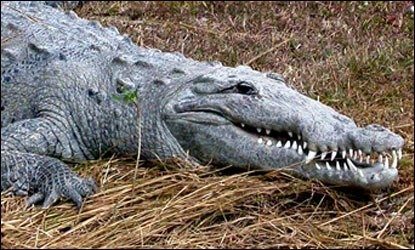
An American crocodile, with its relatively narrow snout.
NPS photo · Public domain (U.S. federal government work) · Original recordImage changes
Resized and converted to JPEG for display; no subject alteration.
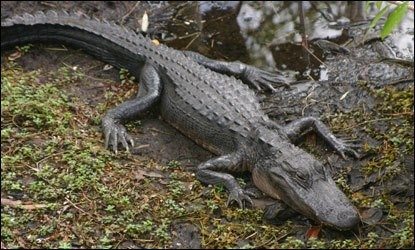
An American alligator, with its broader snout.
NPS photo · Public domain (U.S. federal government work) · Original recordImage changes
Resized and converted to JPEG for display; no subject alteration.
The words
Alligator
American alligators reshape the Everglades by digging holes that retain water during the dry season. These pools become refuges for fish and other wildlife, although severe drought can dry them out.
Did you know?
When her eggs hatch, a female alligator can carry several young at once in her mouth to reach the water.
Anhinga Trail
Anhinga Trail begins at Royal Palm and winds through sawgrass marsh. Alligators, turtles, anhingas, herons and egrets inhabit the area; the park especially highlights winter wildlife viewing.
Crocodile
American crocodiles inhabit the park’s coastal, brackish and saltwater areas. Their narrow, triangular snouts contrast with the alligator’s broader snout; eyes, ears and nostrils near the head’s top allow them to remain mostly submerged.
Flamingo
Before becoming a park visitor area at the end of the main road, Flamingo supported small farms and charcoal production. Its African American residents included people born in the Bahamas and Jamaica.
Gumbo Limbo
Gumbo limbo grows in the shaded groves along the trail at Royal Palm, among palms, ferns and air plants. The tree grows quickly and tolerates strong winds.
Did you know?
The park calls it the “tourist tree,” a nickname inspired by its red, peeling bark.
Park Service: Gumbo Limbo Trail plants (opens a new tab) · Park Service: Everglades tree bark (opens a new tab)
Pa-hay-okee
Pa-hay-okee’s elevated boardwalk looks across the River of Grass. Its raised observation platform offers views of dwarf cypress trees, magnolias, air plants and string lilies.
River of Grass
The title of Marjory Stoneman Douglas’s 1947 book describes the Everglades’ shallow water moving slowly through sawgrass marshes. Her conservation work emphasized how the region depends on water flowing from farther north.
Park Service: Marjory Stoneman Douglas (opens a new tab) · Park Service: Sawgrass and water flow (opens a new tab)
Royal Palm
Royal Palm takes its name from tall palms growing in its hammock, a dense island of trees. Florida clubwomen protected the area as a state park before its transfer to Everglades National Park in 1947.
Park Service: Everglades tree bark (opens a new tab) · Park Service: Women and Royal Palm (opens a new tab)
Sawgrass
Sawgrass belongs to the sedge family rather than the true grasses. Sharp teeth line each leaf blade, and shallow water moves slowly through the broad marshes where this characteristic Everglades plant grows.
Shark Valley
Shark Valley’s loop road enters the freshwater marsh of Shark River Slough. A 70-foot (21 m) observation tower overlooks sawgrass and tree islands, habitats shared by alligators, wading birds and other wildlife.
Park Service: Shark Valley habitats (opens a new tab) · Park Service: Shark Valley landscape (opens a new tab)
Slough
A low-lying wetland channel that carries slow-moving water.
Shark River Slough in the west and Taylor Slough in the east are the park’s main water channels. They remain flooded almost year-round, carrying freshwater slowly through the marsh.
Snail Kite
This bird of prey depends on freshwater marshes and shallow lake edges where apple snails live. Water levels and vegetation affect whether kites can find enough snails to feed.
Did you know?
A snail kite catches snails with its feet, then uses its slender, curved bill to extract them from their shells.
Spoonbill
Roseate spoonbills forage in the park’s shallow waters by sweeping a partly opened bill from side to side. When small fish or other prey touch its sensitive edges, the bill snaps shut.
Tamiami Trail
Completed in 1928, Tamiami Trail carried cars across the Everglades but also blocked natural water flow. Elevated bridges completed in 2013 and 2019 helped water move south into the park again.
Did you know?
The road’s name joins Tampa and Miami, the two cities its builders set out to connect.
Wood Stork
Wood storks find small fish by touch, sweeping their open bills through shallow water. Seasonal drying concentrates fish in pools, so disrupted water cycles can make feeding and nesting less successful.
Did you know?
A breeding pair needs about 440 pounds (200 kg) of fish during one nesting season.
Sources
- American Alligator: Species Profile - Everglades National ParkNational Park Service
- American Crocodile: Species Profile - Everglades National ParkNational Park Service
- Gumbo Limbo Trail - Everglades National ParkNational Park Service
- Everglades Soundscape - Everglades National ParkNational Park Service
- Anhinga Trail - Everglades National ParkNational Park Service
- Developing the Everglades - Everglades National ParkNational Park Service
- Barking Up a Tree: Photography Exhibit - Everglades National ParkNational Park Service
- Pa-hay-OkeeNational Park Service
- A Dream Come TrueNational Park Service
- Ecosystems: Freshwater SloughNational Park Service
- Snail Kite: Species Profile - Everglades National ParkNational Park Service
- Roseate Spoonbill: Species Profile - Everglades National ParkNational Park Service
- Wood Stork: Species Profile - Everglades National ParkNational Park Service
- Removing the cork in the bottle: Reconstructing Tamiami Trail to restore water flow to Everglades National ParkNational Park Service
- Grasses - Everglades National ParkNational Park Service
- Marjory Stoneman DouglasNational Park Service
- Shark Valley - Everglades National ParkNational Park Service