
America’s National Parks
Puzzle 08 · Northeast and Appalachians · Page 20 in print
Cape Cod
From Marconi’s South Wellfleet station, messages between President Theodore Roosevelt and King Edward VII made the first public two-way wireless communication between Europe and America.
Jump to a word
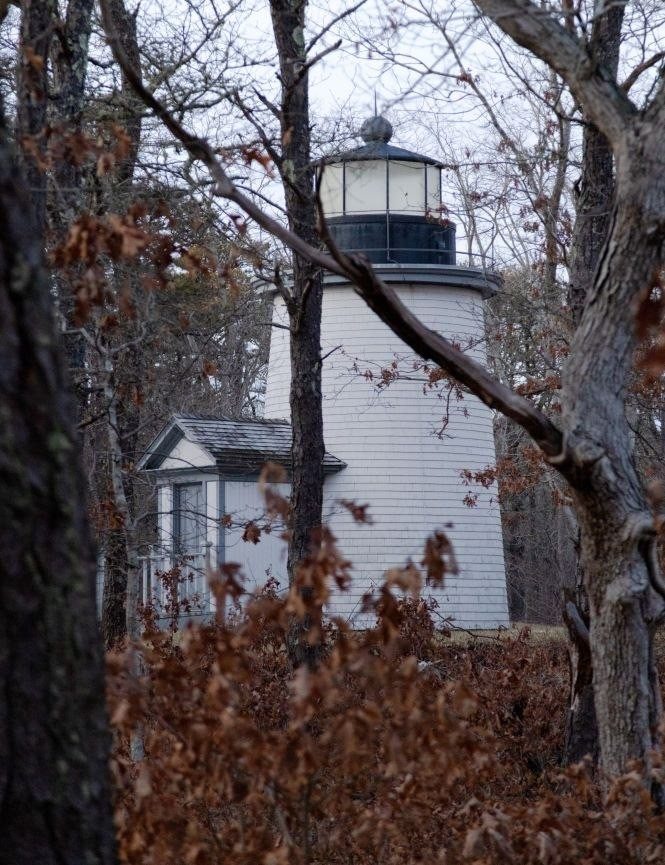
One of the Three Sisters lighthouses at Cape Cod.
NPS / Katy Perrault · Public domain (U.S. federal government work) · Original recordImage changes
Resized and converted to JPEG for display; no subject alteration.
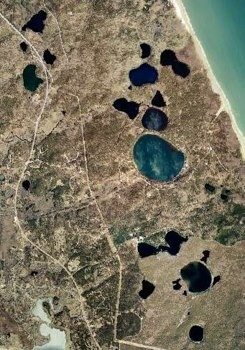
Kettle ponds recall the glacial history of Cape Cod.
NPS Photo · Public domain (U.S. federal government work) · Original recordImage changes
Resized and converted to JPEG for display; no subject alteration.
The words
Breeches Buoy
A rescue life ring fitted with canvas trousers and carried along a suspended rope.
Cape Cod lifesavers used the breeches buoy when rough seas prevented launching a rescue boat. Suspended from a line between ship and shore, it carried stranded sailors ashore one at a time.
Doane Rock
Doane Rock is a glacial erratic, a boulder carried from its original location by ice. Standing above Eastham’s plain, it records the immense ice sheets that helped shape Cape Cod.
Dune Shacks
The dune shacks of Peaked Hill Bars belong to a historic district encompassing both buildings and their surrounding dunes. Listed in 2012, the district preserves connections with American art and literature.
Gray Seal
Gray seals gather on Cape Cod’s sandbars to rest out of the water. Adult males have long, curved noses that give their heads a horse-like profile.
Did you know?
Gray seal pups are born with white fur that absorbs sunlight and traps heat; they shed it after about three weeks.
Park Service: Coast Guard Beach wildlife (opens a new tab) · NOAA: Gray seal biology (opens a new tab)
Highland Light
Highland Light in North Truro marks a station established in 1797, the first lighthouse on Cape Cod. Its surviving brick tower replaced earlier structures in 1857.
Did you know?
Erosion brought the cliff dangerously close, so the light station was moved 450 feet (137 m) inland in 1996.
Kettle Ponds
Melting blocks of glacial ice left depressions in Cape Cod’s sand and gravel. When rising groundwater filled the deeper hollows, kettle ponds formed; they receive water from groundwater and precipitation.
Marconi
Marconi’s South Wellfleet station used radio waves to send messages without wires. Ocean-going ships used its broadcasts for news and ship-to-shore communication, making the station part of a growing maritime network.
Did you know?
The station’s spark transmitter was so loud that its crack could be heard four miles (6 km) downwind.
Nauset Light
Nauset Light began as one of Chatham’s twin lighthouses before being moved to Eastham in 1923. Continued coastal erosion forced another move inland in November 1996.
Did you know?
Nauset Light gained its red-and-white paint in the 1940s, giving mariners a distinctive marker during daylight as well as at night.
Nauset Marsh
Nauset Spit shelters this salt marsh from the open ocean. Tides carry nutrients through its food web, while the marsh provides nursery habitat for fish and shellfish and feeding habitat for birds.
Pilgrim Spring
A marker along Pilgrim Spring Trail in Truro commemorates the Pilgrims’ early exploration. The Park Service describes the spring site as representative of where they found fresh water, rather than an exact established location.
Province Lands
The Province Lands occupy Cape Cod’s northern tip, where wind blew beach sand inland to form dunes. European settlers’ clearing and grazing later removed vegetation, leaving much of the landscape unstable and shifting.
Race Point
Race Point’s light station stands near Cape Cod’s northwestern tip. First established in 1816, its original stone lighthouse was replaced in 1876 by a cast-iron tower lined with brick.
Thoreau
The naturalist and writer visited Highland Light several times in the 1850s. His account describes staying with its keeper, with the lighthouse lamp shining into his room at night.
Three Sisters
The Three Sisters were a group of Eastham lighthouses whose white towers and dark lantern housings resembled women in white dresses and black hats. Their surviving wooden towers were eventually reunited on Cable Road.
Did you know?
Two retired towers were joined with a connecting room in 1920, creating a summer cottage that also served as a dance studio.
Wampanoag
Wampanoag communities remain on Cape Cod, including Mashpee. The Mashpee Tribe’s timeline records that Wampanoag people were killed and men sold into slavery during King Philip’s War.
Mashpee Wampanoag: Tribal history (opens a new tab) · Mashpee Wampanoag: Community museum (opens a new tab)
Sources
- Lifesavers - Cape Cod National SeashoreNational Park Service
- National Park Service Finalizes Dune Shack Historic District Preservation and Use Plan - Cape Cod National SeashoreNational Park Service
- Coast Guard Beach - Eastham - Cape Cod National SeashoreNational Park Service
- Lakes and Ponds - Cape Cod National SeashoreNational Park Service
- Marconi and the South Wellfleet Wireless - Cape Cod National SeashoreNational Park Service
- The Three Sisters Lighthouses - Cape Cod National SeashoreNational Park Service
- Pilgrim Spring TrailNational Park Service
- Guide’s Guide: Doane Rock and Doane MemorialNational Park Service
- Gray SealNOAA Fisheries
- Highland LightNational Park Service
- A Brief History of Nauset LightNauset Light Preservation Society
- Nauset Marsh TrailNational Park Service
- Sand Dunes - Cape Cod National SeashoreNational Park Service
- Race Point LighthouseAmerican Lighthouse Foundation
- TimelineMashpee Wampanoag Tribe
- Mashpee Wampanoag MuseumMashpee Wampanoag Tribe