
America’s National Parks
Puzzle 29 · The Great Plains · Page 47 in print
Devils Tower
Due in large part to the influence of Wyoming Representative Frank W. Mondell, President Theodore Roosevelt proclaimed Devils Tower the first national monument on September 24, 1906.
Jump to a word
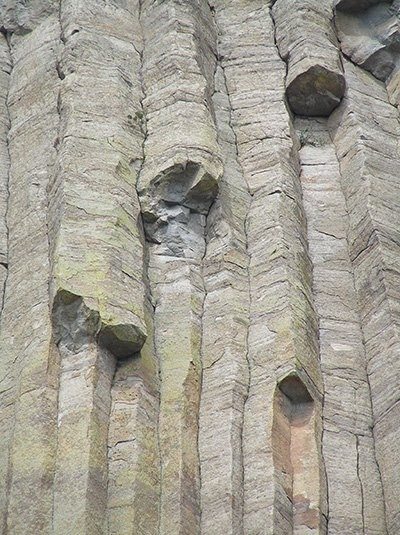
The Tower's great columns are made of phonolite porphyry.
NPS · Public domain (U.S. federal government work) · Original recordImage changes
Resized and converted to JPEG for display; no subject alteration.
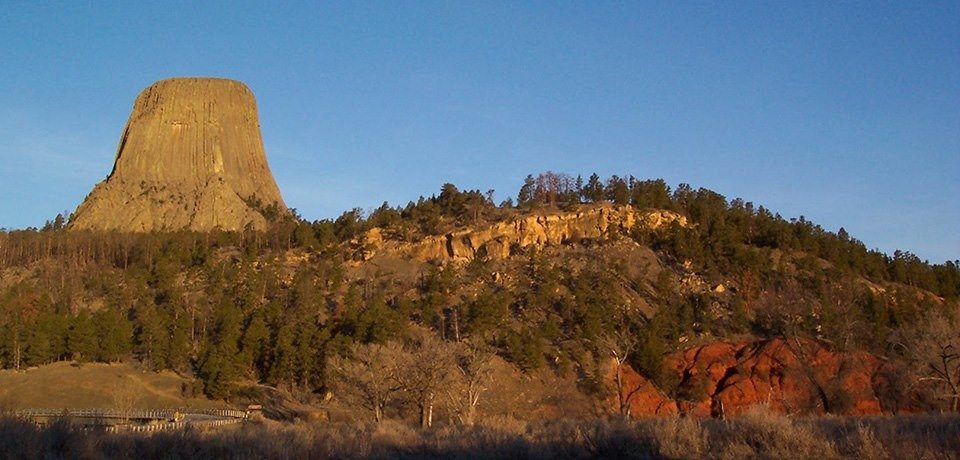
Sedimentary layers remain in the hills around Devils Tower.
NPS · Public domain (U.S. federal government work) · Original recordImage changes
Resized and converted to JPEG for display; no subject alteration.
The words
Bear Lodge
Bear Lodge reflects bear-related Indigenous names for the Tower. The Park Service describes federal efforts to sever tribal connections to the Black Hills; living communities retain sacred ties to this place.
Belle Fourche
The Belle Fourche River helped expose the Tower by carrying away surrounding sedimentary rock. Its riverbank habitats support a different community of wildlife from the monument’s rocky slopes and forests.
Did you know?
In 1937, the Park Service straightened a short section of the river to protect a bridge from recurring spring floods.
Claw Marks
In the Crow sacred account recorded from Ride-The-White-Hip-Horse, a rock rises to protect two girls from a bear. The bear scratches its sides while trying to reach them.
Devils Tower
Devils Tower rises above northeastern Wyoming’s prairie, with igneous columns surrounded by sedimentary hills. The Park Service traces its English name to an 1875 military expedition, while acknowledging uncertainty about its origin.
Park Service: The Tower’s disputed name (opens a new tab) · Park Service: How the Tower formed (opens a new tab)
George Hopkins
Hopkins parachuted onto the Tower in October 1941 as a publicity stunt. A rope dropped for his descent landed out of reach, leaving him stranded while rescuers organized a climb.
Jack Durrance
On October 6, 1941, Durrance led seven other climbers to the summit to rescue George Hopkins. Their descent ended the parachutist’s six-day ordeal on the Tower.
Mato Tipila
In the Lakota account told by Short Bull in 1932, a worshipper finds himself on the summit and returns to its base after prayer, recognizing the rock as a bear’s lodge.
Phonolite
An uncommon igneous rock; the Tower’s variety is phonolite porphyry.
The Tower’s columns formed as molten rock cooled, contracted and cracked. Geologists agree on its igneous origin, but differ over the sequence of events that shaped it before erosion exposed the rock.
Did you know?
Not every column has six sides: many are five-sided, and the Tower’s unusually large columns have irregular shapes.
Prairie Dog
Black-tailed prairie dogs live in the monument’s grasslands, digging burrows and clipping vegetation. Their tunnels shelter other animals, while the prairie dogs themselves provide food for many predators.
Did you know?
A town’s burrows do not all connect underground. The Park Service compares family groups to neighborhoods, with separate burrows like houses.
Prairie Falcon
Prairie falcons nest on exposed rock, and the Tower offers ledges for their eyries. The Park Service monitors nesting activity because disturbance near nests can harm chicks or cause abandonment.
Prayer Cloths
Prayer cloths and bundles express personal spiritual connections to the Tower. They may accompany an offering, request or remembrance; the Park Service emphasizes their private religious meaning and asks visitors to leave them undisturbed.
Seven Sisters
In the Kiowa account told by I-See-Many-Camp-Fire-Places in 1897, seven girls escape pursuing bears as a rock lifts them into the sky, where they become the Pleiades.
Stake Ladder
Willard Ripley and Bill Rogers built a wooden stake ladder in a crack in 1893. It reached the Meadows below the summit, supporting the Tower’s earliest recorded climbs.
Did you know?
In 1972, the Park Service removed the ladder’s lower remains and restored its upper 140 feet (43 m).
Sun Dance
The Park Service describes the Lakota Sun Dance as a ceremony of fasting and sacrifice for individual and communal renewal. Its records document ceremonies at the Tower from 1983.
Tower Trail
Tower Trail circles the formation beside its boulder field, providing close views of the columns. Interpretive waysides explain the monument’s natural and cultural history along the paved route.
Sources
- American Indians - Devils Tower National MonumentNational Park Service
- Hiking Trails - Devils Tower National MonumentNational Park Service
- First Stories - Devils Tower National MonumentNational Park Service
- Devils Tower or Bear Lodge?National Park Service
- Parachutist George Hopkins - Devils Tower National MonumentNational Park Service
- How the Tower Formed - Devils Tower National MonumentNational Park Service
- Current Climbing Closures - Devils Tower National MonumentNational Park Service
- Rogers & Ripley Stake Ladder - Devils Tower National MonumentNational Park Service
- A Place of Reverence for Native Americans - Devils Tower National MonumentNational Park Service
- Belle Fourche River - Devils Tower National MonumentNational Park Service
- Prairie Dogs - Devils Tower National MonumentNational Park Service