
America’s National Parks
Puzzle 28 · The Great Plains · Page 46 in print
Theodore Roosevelt
“I would not have been president had it not been for my experience in North Dakota.” — Theodore Roosevelt
Jump to a word
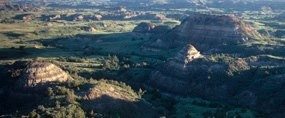
Harder rock caps protect softer Badlands layers below.
NPS Photo · Public domain (U.S. federal government work) · Original recordImage changes
Resized and converted to JPEG for display; no subject alteration.
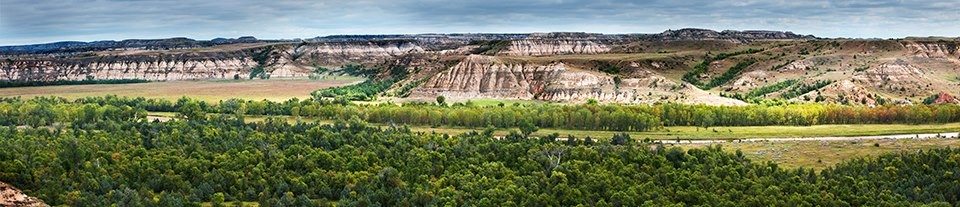
The Little Missouri River beneath striped buttes.
NPS / Laura Thomas · Public domain (U.S. federal government work) · Original recordImage changes
Resized and converted to JPEG for display; no subject alteration.
The words
Buck Hill
Buck Hill’s summit in the South Unit provides a high vantage over the badlands. Its short, steep trail leads to views across the surrounding broken terrain.
Cannonball
Mineral-bearing water cements loose sediment together around a core, building a concretion outward. Erosion later uncovers these rounded stones in the North Unit, revealing formations once hidden inside a butte.
Caprock Coulee
Caprock Coulee’s North Unit trails pass through dry washes and varied badlands habitats. The longer route climbs onto a grassy butte and follows a ridge before descending.
Cottonwood
Cottonwoods shade the Elkhorn Ranch site beside the Little Missouri River. Bill Sewall and Wilmot Dow also used cottonwood logs to build Roosevelt’s ranch house during the winter of 1884–1885.
Did you know?
The house contained eight rooms and an east-facing porch; the ranch complex also included stables, a chicken house and a blacksmith shop.
Park Service: The Elkhorn Ranch site (opens a new tab) · Park Service: Building Elkhorn Ranch (opens a new tab)
Elkhorn Ranch
Roosevelt established Elkhorn in 1884 while seeking solitude after his wife and mother died. Sewall and Dow built the house he regarded as his principal Dakota home.
Lignite
Soft coal formed from compressed ancient plant material.
Lignite seams in the badlands preserve evidence of ancient swamps. Fallen leaves and branches accumulated as peat, then changed under the pressure of later sediments into coal.
Did you know?
Roosevelt and his ranch hands dug lignite from nearby hillsides to fuel their stove, putting the landscape’s ancient plant remains to practical use.
Longhorn
Longhorn cattle were driven north from Texas to Dakota grazing lands. The park’s demonstration herd began in 1967, recalling the cattle drives that crossed the future North Unit on the Long X Trail.
Maltese Cross
The Maltese Cross Cabin belonged to Roosevelt’s first Dakota ranch, also called Chimney Butte. Its ponderosa pine walls enclosed three rooms, with a loft above for ranch hands.
Did you know?
During Roosevelt’s presidency, the cabin traveled to the St. Louis World’s Fair and Portland’s Lewis and Clark exposition before returning to North Dakota.
Medora
Roosevelt’s Maltese Cross Ranch lay seven miles south of Medora. The town anchors the cabin’s original setting, although the preserved building was later moved to the park.
Painted Canyon
Painted Canyon’s colored rock bands record layers of ancient river sediment and volcanic ash. Unequal erosion of hard and soft layers produced its buttes and protective sandstone caps.
Ranchman
Roosevelt entered Dakota cattle ranching as an investor in 1883, employing experienced local managers. He also joined roundups and helped organize the Little Missouri Stockmen’s Association to represent ranchers’ interests.
Roosevelt
Roosevelt’s Dakota ranching experience helped shape his conservation outlook. Overgrazing and the devastating winter of 1886–1887 exposed the cattle industry’s limits and contributed to his concern for natural resources.
Scoria
The regional name for clinker, sedimentary rock baked by burning coal.
Burning coal seams bake the sediments above them into durable red rock. These hardened layers resist erosion, helping form caps on badlands buttes as softer surrounding material wears away.
Wild Horses
The park’s free-ranging horses descend from domestic stock used in open-range ranching. Bands that escaped a 1954 roundup remained, linking the herd’s history to the landscape’s ranching past.
Did you know?
Stallions herd their mares by lowering and stretching their heads and necks in a gesture called snaking.
Wind Canyon
Wind Canyon in the South Unit has been sculpted by wind. Its nature trail follows the canyon and climbs to a viewpoint over the Little Missouri River.
Sources
- Hiking and Trail Information - Theodore Roosevelt National ParkNational Park Service
- Cannonball ConcretionsNational Park Service
- Elkhorn Ranch Unit - Theodore Roosevelt National ParkNational Park Service
- Geologic Formations - Theodore Roosevelt National ParkNational Park Service
- Elkhorn Ranch - Theodore Roosevelt National ParkNational Park Service
- Maltese Cross Cabin - Theodore Roosevelt National ParkNational Park Service
- Horse Background and History - Theodore Roosevelt National ParkNational Park Service
- Theodore Roosevelt the Rancher - Theodore Roosevelt National ParkNational Park Service
- Painted Canyon OverlookNational Park Service
- Longhorn Cattle History - Theodore Roosevelt National ParkNational Park Service