
America’s National Parks
Puzzle 18 · Great Lakes and Ozarks · Page 34 in print
Voyageurs
The North Canoes the voyageurs paddled here were built by the Ojibwe from birch bark, cedar, spruce resin and spruce roots; each weighed about 300 pounds and ran some 25 feet long.
Jump to a word
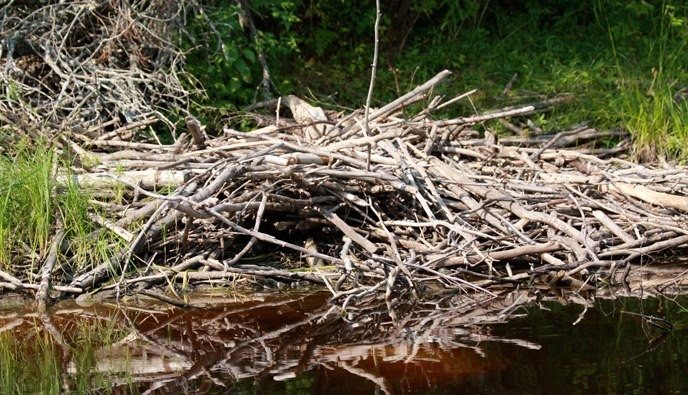
A beaver lodge creates shelter within Voyageurs' waterways.
NPS · Public domain (U.S. federal government work) · Original recordImage changes
Resized and converted to JPEG for display; no subject alteration.
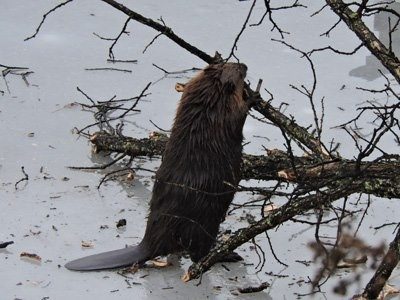
A beaver at work beside the water.
NPS · Public domain (U.S. federal government work) · Original recordImage changes
Resized and converted to JPEG for display; no subject alteration.
The words
Aurora
The aurora borealis sometimes lights Voyageurs’ northern sky. It forms when particles from the Sun collide with gases high in Earth’s atmosphere; darkness and clear skies affect whether the display is visible.
Did you know?
Oxygen can produce green or red auroral light, while nitrogen produces blue or purple, depending on altitude.
Beaver
Beavers build lodges along Voyageurs’ large lakes as well as in ponds they create by damming streams. Their ponds provide habitat for moose, water birds and other aquatic wildlife.
Did you know?
A beaver’s paddle-shaped tail works as a swimming rudder and also props up its body while it chews a tree.
Birchbark
Birchbark provided the waterproof outer covering for canoes used on northern waterways. Anishinaabe builders fitted bark over cedar frames and also shaped it into containers for food and water.
Bois Forte
Bois Forte Ojibwe communities lived around these lakes. The Park Service records disease, settler pressure and treaty land loss, while Bois Forte’s own history emphasizes continuing rice harvesting, maple sugaring and berry gathering.
Park Service: Bois Forte lakeside history (opens a new tab) · Bois Forte: Community history (opens a new tab)
Common Loon
Common loons dive for fish in Voyageurs’ lakes. Feet placed far back on the body help them swim but make walking awkward, so they nest close to shore, where waves can threaten eggs.
Did you know?
Young loon chicks stay close to their parents and sometimes ride on an adult’s back while the family travels across the lake.
Fur Trade
Voyageurs carried goods west from Grand Portage and exchanged them for pelts. Ojibwe communities supplied rice and smoked fish along the route, making Indigenous food and knowledge essential to the trade.
Houseboat
Houseboats combine travel and overnight accommodation on Voyageurs’ lakes. Sleeping quarters, cooking space and food storage let visitors stay on the water rather than return to a mainland base each evening.
Kabetogama
Kabetogama Lake’s north shore holds Ellsworth Rock Gardens, where carpenter and self-taught artist Jack Ellsworth arranged terraces and stone sculptures on a natural outcrop. His work combines gardening with the lakeside landscape.
Did you know?
Over roughly twenty years, Ellsworth filled his terraced flower beds with more than 13,000 lilies and other flowers.
Park Service: Ellsworth’s lakeside gardens (opens a new tab)
Kettle Falls
Indigenous people gathered and fished for sturgeon at Kettle Falls before voyageurs passed through with goods and furs. Dam construction began in 1910, bringing workers who became early patrons of the hotel.
Namakan
Namakan Lake was included in the park’s 2006–2009 beaver studies. Researchers examined how managed winter water-level drops affected animals living in lodges along the large lakes.
Pemmican
A preserved food of dried meat and fat, sometimes with dried berries.
The North West Company relied on pemmican to feed its inland workforce. Trading posts obtained this concentrated travel food from Indigenous producers, linking canoe transport to the bison-hunting regions farther west.
Portage
Carrying a canoe or its cargo over land.
Voyageurs were expected to carry two fur bales each time they walked a portage route, with each bale averaging 90 pounds (41 kg).
Rainy Lake
Rainy Lake’s Little American gold discovery in 1893 sparked a short-lived mining rush. Rainy Lake City grew rapidly in 1894, but poor yields ended the boom, leaving a ghost town by 1901.
Voyageurs
The park’s name honors French-Canadian fur-trade canoe workers. A crew divided tasks between a guide in front, paddlers in the middle and a steersman at the back.
Did you know?
Several North Canoes traveling together made a brigade, with at least one clerk accompanying the crews.
Park Service: Voyageur namesake (opens a new tab) · Park Service: Canoe crews and cargo (opens a new tab)
Wild Rice
Wild rice, called manoomin in Ojibwe, has long sustained communities around these lakes. The 1854 Treaty Authority protects rice ecosystems as both a food source and a culturally significant resource.
Park Service: Early use of wild rice (opens a new tab) · 1854 Treaty Authority: Wild rice (opens a new tab)
Sources
- Beaver Ecology Project - Voyageurs National ParkNational Park Service
- Voyageurs - Voyageurs National ParkNational Park Service
- Voyageurs National Park (NPS article)National Park Service
- Common Loon - Voyageurs National ParkNational Park Service
- History & Culture - Voyageurs National ParkNational Park Service
- Bull Boats During the Fur TradeNational Park Service
- Native American - Voyageurs National ParkNational Park Service
- Northern LightsNational Park Service
- A Brief Summary of Bois Forte HistoryBois Forte Band of Chippewa
- Showplace of Lake KabetogamaNational Park Service
- BeaversNational Park Service
- Kettle FallsNational Park Service
- Houseboating in Voyageurs National ParkNational Park Service
- Wild Rice1854 Treaty Authority
- Plants - Grand Portage National MonumentNational Park Service
- Industry - Voyageurs National ParkNational Park Service