
America’s National Parks
Puzzle 17 · Great Lakes and Ozarks · Page 33 in print
Isle Royale
Any mammal that reaches Isle Royale must cross at least 14 miles of Lake Superior’s icy waters; bats can fly over, moose may swim, and wolves can walk across when the lake freezes.
Jump to a word
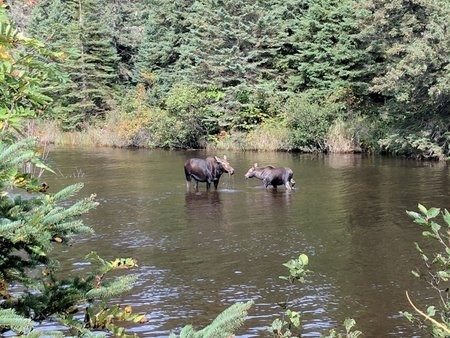
A cow and calf moose in Washington Creek.
NPS · Public domain (U.S. federal government work) · Original recordImage changes
Resized and converted to JPEG for display; no subject alteration.
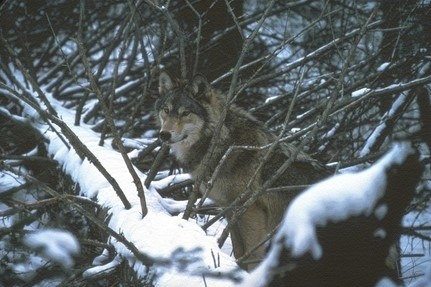
A wolf in winter on Isle Royale.
NPS · Public domain (U.S. federal government work) · Original recordImage changes
Resized and converted to JPEG for display; no subject alteration.
The words
Edisen Fishery
Edisen Fishery preserves a family fishing camp at the south end of Rock Harbor. Its residence, fish house, dock and outbuildings show how commercial fishing shaped life along the island’s shoreline.
Did you know?
Pete and Laura Edisen continued fishing while demonstrating camp life to visitors, supplying fresh fish to the Rock Harbor Lodge.
Gray Wolf
Gray wolves hunt moose on Isle Royale, often taking calves and older or weakened animals. They also eat smaller prey, including beavers and snowshoe hares, linking several parts of the island’s food web.
Did you know?
Wolf pups are born in spring and remain in their den for the first six to eight weeks.
Greenstone
Greenstone Ridge forms the island’s central backbone, built from an ancient lava flow. The Greenstone Ridge Trail follows this landscape between the island’s southwestern and northeastern ends, crossing forests and exposed rock.
Park Service: Lava and glacial landforms (opens a new tab) · Park Service: Greenstone Ridge Trail (opens a new tab)
Ice Bridge
Seasonal lake ice that links an island to the mainland.
New wolves arriving from the mainland can increase genetic diversity on Isle Royale. Less frequent winter ice bridges limit those natural arrivals, contributing to problems of inbreeding in small populations.
Park Service: Ice bridges and wolf genetics (opens a new tab)
Isle Royale
Isle Royale is the main island in a Lake Superior archipelago, a group of islands. Forested shores, inland lakes, ponds and bogs form a landscape shaped by ancient rock and glacial ice.
Park Service: Forested island archipelago (opens a new tab) · Park Service: Lava and glacial landforms (opens a new tab)
Lake Superior
Lake Superior’s cold water chills the air around Isle Royale, helping support species beyond the southern edges of their usual ranges. The surrounding lake influences the island’s forests, wildlife and shoreline.
Park Service: Lake Superior’s cooling role (opens a new tab)
Lookout Louise
Lookout Louise stands above Duncan Bay on the island’s eastern end. Its outlook crosses Lake Superior toward Ontario, with Pie Island, the Sibley Peninsula and Edward Island visible in clear weather.
Did you know?
The overlook is named for Louise Savage, whose family owned a nearby Tobin Harbor island before Isle Royale became a national park.
Minong
Minong is the Ojibwe name for Isle Royale. The Grand Portage Band’s ancestral relationship with the island includes fishing, plant gathering and spiritual practices, continuing connections that extend beyond the park’s creation.
Park Service: Minong name and mining (opens a new tab) · Park Service: Living Anishinaabe heritage (opens a new tab)
Moose
Moose feed in Isle Royale’s inland lakes and beaver ponds during summer, finding aquatic plants while cooling their bodies. They also seek shade in forests and bogs when temperatures rise.
Rock Harbor
Rock Harbor occupies the island’s northeastern end, where visitor facilities meet boreal forest. Spruce and fir line this lakeside landscape, and Lake Superior’s wind and waves shape the rugged shore.
Park Service: Rock Harbor’s forest setting (opens a new tab)
Rock of Ages
Rock of Ages Lighthouse stands on a narrow reef outside Washington Harbor. Its steel framework, brick walls and concrete foundation carried a beacon above rocks that threatened vessels using Lake Superior’s shipping lanes.
Did you know?
The lighthouse’s large glass lens was made to order in Paris, using hundreds of prisms fitted into brass frames.
Scoville Point
The Stoll Memorial Trail reaches Scoville Point through two contrasting shorelines. Woodland faces Tobin Harbor, while the Rock Harbor side is exposed and rocky; the paths meet before the final ascent.
Siskiwit Lake
Siskiwit Lake is the largest of Isle Royale’s inland lakes. Its fish habitat belongs to the island’s interior-water system, which supports a different mix of species from the surrounding Lake Superior.
Park Service: Island landscape and lakes (opens a new tab) · Park Service: Inland and lake fish habitats (opens a new tab)
Thimbleberry
Thimbleberry is an abundant Isle Royale shrub with broad, maple-like leaves, large white flowers and soft red fruit. It adds a recognizable layer to the island’s varied shrub vegetation.
Did you know?
Thimbleberry belongs to a group of island plants whose local populations are separated from their main range in the western United States.
Park Service: Thimbleberry and island shrubs (opens a new tab)
Windigo
Windigo sits at the island’s southwestern end beside Washington Harbor. Maple and birch woodland surrounds this visitor portal, where the harbor links the island’s shores with trails into its interior.
Park Service: Windigo and Washington Harbor (opens a new tab) · Park Service: Island landscape and lakes (opens a new tab)
Sources
- Wolves - Isle Royale National ParkNational Park Service
- Blind/Low Vision - Isle Royale National ParkNational Park Service
- Rock Harbor - Isle Royale National ParkNational Park Service
- Minong Mine Designated as National Historic Landmark - Isle Royale National ParkNational Park Service
- Windigo - Isle Royale National ParkNational Park Service
- Shrubs - Isle Royale National ParkNational Park Service
- Edisen FisheryNational Park Service
- Anishinaabe HeritageNational Park Service
- NPS Geodiversity Atlas—Isle Royale National Park, MichiganNational Park Service
- MooseNational Park Service
- Climate Change at Isle Royale: WolvesNational Park Service
- Lookout LouiseNational Park Service
- Nature & Science - Isle Royale National ParkNational Park Service
- Greenstone Ridge Trailhead: Hidden LakeNational Park Service
- Climate Change at Isle Royale: Lake SuperiorNational Park Service
- Fish - Isle Royale National ParkNational Park Service
- Stoll Memorial TrailNational Park Service
- Rock of Ages LighthouseNational Park Service