
The Life of Jesus
Puzzle 73 · Toward the Holy City · Page 105 in print
The Woman Taken in Adultery
In this familiar KJV passage, Jesus answers an accusation with a challenge to the accusers and a charge to leave sin.
Jump to a word
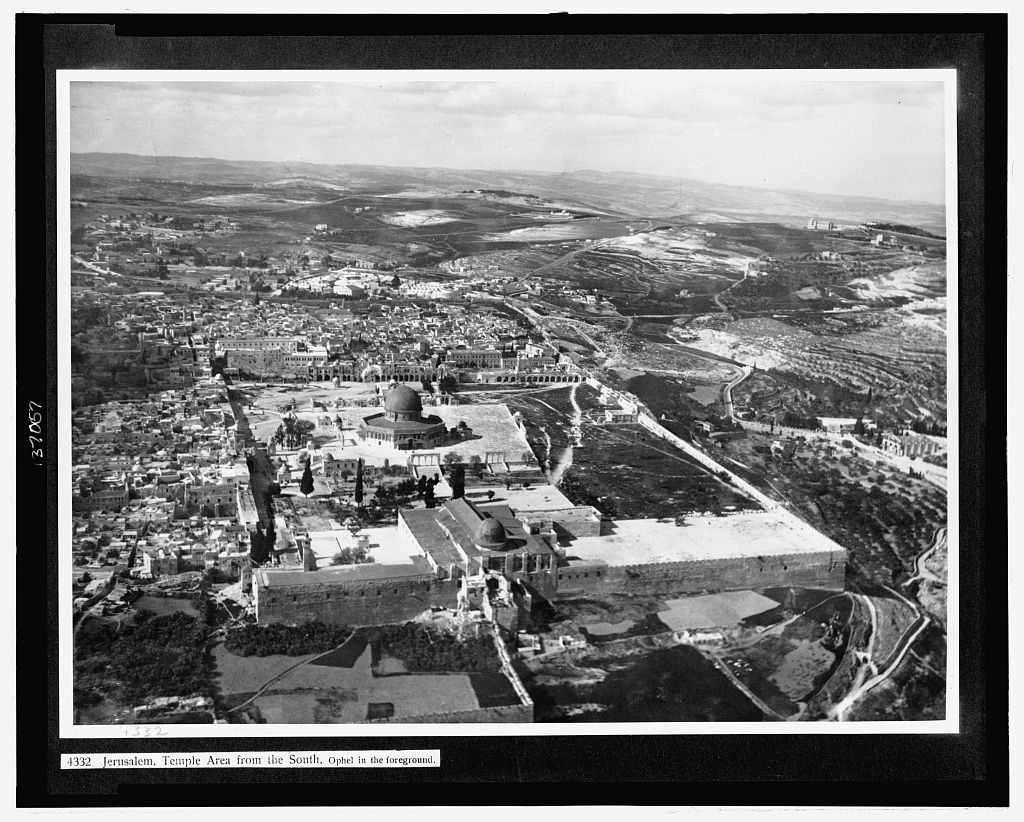
Jerusalem’s Temple Mount area seen from the south, 1931.
The temple-area view gives geographical context for the setting of the accusation, centuries after the episode.
American Colony Photo Department / Matson Photo Service; G. Eric and Edith Matson Photograph Collection, Library of Congress. · No known restrictions on publication · Original recordImage changes
Resized proportionally to at most 1440px and JPEG compressed; no crop or content alteration.
The words
Accusers
In the KJV account, Jesus asks where the woman’s accusers are after they leave one by one. Her reply that no one has condemned her precedes his own response.
Adultery
In this KJV passage, the scribes and Pharisees bring an unnamed woman whom they say was caught in adultery. The narrator identifies their question as a way to accuse Jesus.
Condemned
Passed sentence on.
In the KJV, Jesus asks whether anyone has condemned the woman after her accusers depart. She answers that no one has; he replies that he does not condemn her either.
Conscience
The KJV says the accusers’ conscience convicts them. The King James Version follows later manuscripts here; many modern Bibles, following older ones, read differently or put these words in a footnote.
John 8:9 (opens a new tab) · NET Bible: John 7:53-8:11 (opens a new tab)
Convicted
Convinced of guilt; here, an inward response.
The KJV describes the departing accusers as convicted by their own conscience. The NET retains their one-by-one departure but does not include that inward-response clause.
John 8:9 (opens a new tab) · NET Bible: John 7:53-8:11 (opens a new tab)
Early
In the KJV account, Jesus returns to the temple early in the morning after going to the Mount of Olives. The people gather, and he sits down to teach.
Eldest
Oldest; here, the first to leave.
The KJV says the departures begin with the eldest and continue to the last. This follows Jesus’s challenge about the first stone and his second act of writing on the ground.
Ground
In the KJV account, Jesus bends toward the ground and writes with his finger. The questioners continue asking for an answer before he straightens and speaks.
Morning
Morning marks the teaching scene that precedes the accusation in the KJV account. Jesus has returned to the temple, and the people are gathered around him before the scribes and Pharisees bring the woman.
Mount of Olives
The KJV narrative sends Jesus to the Mount of Olives before his early return to the temple. The passage names his destination but does not describe what he did there.
Did you know?
In a separate passage, Luke describes Jesus teaching in the temple by day and spending nights at the Mount of Olives; people come early to hear him.
John 8:1–2 (opens a new tab) · Luke 21:37–38 (opens a new tab)
Sin No More
After the woman says that no one has condemned her, the KJV records Jesus saying that he does not condemn her either. His final charge is to go and sin no more.
Stoned
Executed by throwing stones.
The accusers say Moses’s law calls for stoning. Jesus challenges the person without sin to throw first; the KJV account then describes the accusers leaving rather than carrying out the punishment.
John 8:5–9 (opens a new tab) · NET Bible: John 7:53-8:11 (opens a new tab)
Stooped
Bent down.
Stooped describes Jesus bending down to write in the KJV. After giving his answer about the first stone, he bends down again; the accusers then begin leaving one by one.
Tempting
Testing or trying to trap.
The KJV says the questioners are tempting Jesus so they can accuse him. They keep asking while he writes on the ground, until he rises and gives his challenge about the first stone.
John 8:6–7 (opens a new tab) · NET Bible: John 7:53-8:11 (opens a new tab)
Wrote
The KJV records Jesus writing with his finger, then writing again after his reply about the first stone. It gives no words for either act, leaving the content of his writing unstated.
John 8:6–8 (opens a new tab) · NET Bible: John 7:53-8:11 (opens a new tab)
Sources
- John 7:53-8:11 (King James Version)King James Version, passage navigation via Bible Gateway
- John 7:53-8:11 (NET Bible), translation and notesNET Bible, via Bible Gateway
- Luke 21:37-38 (King James Version)King James Version, passage navigation via Bible Gateway